












Índice
Polyurethane (PU) machinery is categorized by processing pressure (High-Pressure vs. Low-Pressure), material application (Soft, Rigid, or Elastomers), and production method (Pouring, Spraying, or Injection). High-pressure machines (4~30Mpa) utilize solvent-free impingement mixing for mass production, while low-pressure machines use mechanical stirring for complex formulations. For industrial-grade durability, specialized Elastomer Casting machines are required. Selecting the right hardware depends on precise flow rates, gel times, and the level of turnkey integration required for stable production.
Introduction: Why "Right Fit" Trumps "High Price"
In the global polyurethane (PU) manufacturing sector, a common misconception is that high-quality raw materials alone guarantee a perfect final product. In reality, if your production line’s “mechanical architecture” is misaligned with your “process logic,” you will inevitably face daily defects: uneven density, micro-bubbles, or structural collapsing.
Because PU applications range from soft furniture foams to high-precision industrial elastomers, each material demands a specific pressure and mixing profile. Mismatched configurations lead to production instability and low yields, causing operational costs to skyrocket. With 40 years of engineering heritage, Haifeng Polyurethane Machinery understands that equipment is not just a standalone tool—it is the functional heart of a Polyurethane Turnkey Project.
1. The Core Categorization of PU Machinery
To make an informed engineering decision, you must understand the three dimensions of equipment classification:
-
The Two Pressure Camps:
-
High-Pressure Foaming Machines: Utilizing impingement mixing , these systems are solvent-free and highly efficient. They are the industry standard for high-volume, automated production where consistency is non-negotiable.
-
Low-Pressure Foaming Machines: Relying on mechanical agitators, these machines are better suited for complex formulations, frequent color changes, or smaller-batch customized products.
-
-
Application-Based Classification: Depending on the molecular structure, machines are tuned for Soft PU, Rigid PU, or Elastomer PU.
-
Production Process Types: Equipment is further specialized for Pouring/Casting, Spraying, or Injection.
Application Classification of Materials
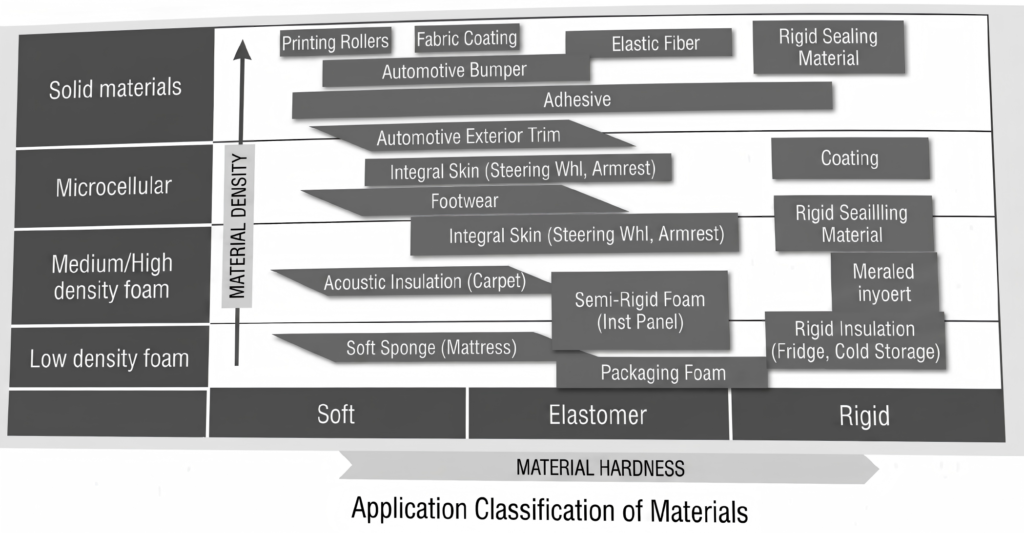
Before you even look at a machine catalog, you need to map your final product on the PU Material Matrix. The chart above illustrates the comprehensive application landscape of polyurethane, mapping end-use products based on two non-negotiable physical parameters: Material Density (vertical axis) e Material Hardness (horizontal axis).
Understanding where your product lands on this grid is step one in dialing in your equipment.
-
1. Material Density (From Light Foams to Solids) Density dictates your cellular structure. At the lower end of the vertical axis, you have high-expansion, lightweight foams used in packaging, acoustic insulation (carpets), and soft mattress sponges. As you move up the scale, the cellular structure tightens. You hit microcellular foams and eventually reach completely solid, dense materials used in automotive bumpers, solvent-free synthetic leather coatings, and industrial printing rollers.
-
2. Material Hardness (From Soft Cushions to Rigid Insulation) The horizontal axis categorizes physical flexibility. On the soft left side, you’re looking at pure cushioning. The massive middle ground is dominated by Elastomers—the sweet spot that balances flexibility with tough wear resistance. This quadrant drives the automotive and footwear industries, covering instrument panels (semi-rigid foam), steering wheels and armrests (integral skin), and durable shoe soles. On the far right, Rigid Materials are engineered for structural integrity and thermal resistance. This is the domain of refrigerator insulation, cold storage panels, and tough industrial sealants.
Matching the Grid to the Iron: You cannot cheat physics. Different quadrants on this chart demand completely different mechanical approaches. For instance, a low-density soft foam might run perfectly on a standard low-pressure line. But if you are shooting microcellular elastomers for footwear or injecting dense, rigid insulation panels, you absolutely need the precision of a high-pressure system.
As a true EPC+M+O service provider, Haifeng Polyurethane Machinery uses this exact matrix as the foundation for our Polyurethane Turnkey Projects. We don’t just sell off-the-shelf units; whether you need a heavy-duty elastomer casting machine or a lightning-fast high-pressure line, we engineer the iron to match your specific density and hardness targets perfectly.
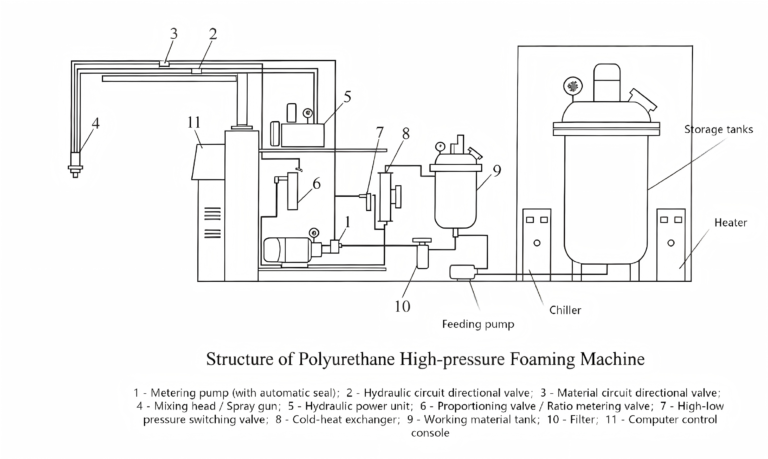
Core Characteristics of High-Pressure Foaming Machines:
Within the Haifeng Polyurethane Machinery portfolio, high-pressure systems are the engineering backbone for high-volume, automated production. The technical logic relies on advanced fluid dynamics rather than simple mechanical stirring.
-
Pure Impingement Mixing: You won’t find any mechanical stirring blades inside the mixing chamber because it’s incredibly tiny. Instead, the system relies on sheer pressure (usually between 4 to 30 Mpa) to force liquid components through tiny nozzles. The materials literally smash into each other at high speed. This collision gives you a perfectly even, molecular-level mix almost instantly.
-
Self-Cleaning (No More Solvents): This is usually the biggest selling point for plant managers. After every single shot, a precision hydraulic piston pushes out any leftover material from the chamber. Since the head cleans itself mechanically, you completely eliminate the need to flush the system with expensive, toxic chemical solvents. It’s better for your ESG compliance, and it cuts down your daily consumable costs significantly.
-
Smart Power & Low Clamp Force: To keep your electricity bills in check, the machine idles in a low-pressure circulation mode and only spikes to high pressure during the actual injection. Also, because you are pouring a liquid mixture—rather than forcing melted plastic into a cavity like standard injection molding—the internal pressure inside the mold is remarkably low. This means you can save a lot of money on mold design and clamping structures.
-
Built for Speed: If you need to hit high daily targets, this is your workhorse. The liquid reacts fast, cures quickly, and allows for short demolding cycles. On an industrial floor, it’s common to hook up a single Haifeng high-pressure unit to multiple pouring heads to maximize throughput.
-
Higher CAPEX, Faster Payback: Let’s be upfront—because they operate at extreme pressures and demand tight tolerances, the initial investment for a high-pressure system is definitely higher than low-pressure alternatives. However, when you factor in the high-speed production, zero solvent costs, and low maintenance, the ROI is typically very fast.
-
The Viscosity Catch: There is one limitation to keep in mind. Because impingement mixing relies on that high-speed collision, it works best with low-viscosity (thinner) materials. If your chemical formulation is too thick, the collision loses its impact, and the mix becomes uneven. If you have to process thicker materials, we usually solve this by integrating inline heating systems to drop the viscosity before it reaches the head.
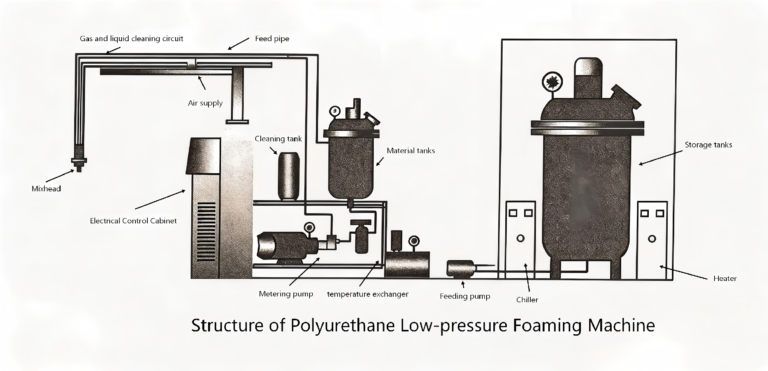
Core Characteristics of Low-Pressure Foaming Machines:
For clients dealing with complex chemical formulations, frequent color changes, or smaller customized batches, we at Haifeng Polyurethane Machinery often point them toward low-pressure systems. Instead of relying on brute force and extreme pressure, these machines get the job done through sheer mechanical agility.
-
Lower CAPEX and a Smaller Footprint: Because the entire system operates under much gentler conditions (tanks, pipes, and metering pumps typically only need to handle around 0.3 to 0.8 MPa of pressure), you don’t need the massive, ultra-reinforced components found in high-pressure setups. This keeps the machine structurally compact and significantly drops the initial purchasing cost, making it highly accessible for growing factories.
-
True Mechanical Stirring: The mixing head contains a high-speed dynamic agitator (stirring blade). Whether you are dealing with sluggish materials or tricky customized ratios, the mechanical blade physically forces them to blend. It offers a level of material forgiveness and versatility that impingement mixing just can’t match.
-
Cheap to Run, Easy to Fix: Since you aren’t fighting to maintain massive system pressure, your daily energy consumption stays low. Plus, the internal mechanics are fairly straightforward. Your in-house maintenance crew can usually troubleshoot and service the machine without needing specialized, expensive technical interventions.
-
The Downside—Solvent Dependency: We believe in being fully transparent about equipment trade-offs. Because sticky PU material coats the mechanical stirring blades, the head cannot clean itself. After pouring, you must flush the mixing chamber with chemical solvents. This leads to recurring solvent costs, potential environmental pollution, and irritating odors that can pose health risks for your floor operators.
-
The Foundation for Elastomers: As a quick industry note—while “Elastomer Casting Machines” (used for solid industrial rollers or seals) are often treated as their own distinct category, their underlying mechanics place the vast majority of them firmly in the low-pressure camp. Elastomers are simply too thick and require too much mechanical agitation for standard high-pressure heads to handle effectively.
2. Technical Comparison: High-Pressure, Low-Pressure, and Elastomer Casting
Feature | High-Pressure Machine | Low-Pressure Machine | Elastomer Casting Machine |
Mixing Method | Impingement (Self-Cleaning) | Mechanical (Solvent Flush) | High-Precision Dynamic Stirring |
Viscosity Range | Low to Medium, usually the viscosity is under 2000mPa*s@Working temperature | Wide and flexiable (includes high viscosity) , from 5~100000mPa*s@Working Temperature | Extremely High (Requires Heat), usually the viscosity is 500~100000+mPa*s@Working Temperature |
Solvent Usage | 100% Solvent-Free | Requires Chemical Cleaning | Thermal/Mechanical Cleaning |
Typical End Products | Auto Seats, Fridge Insulation | Footwear, Furniture, Small Parts | Industrial Rollers, Heavy-Duty Wheels |
3. The Key Elements of Polyurethane Machines
This is the technical heart of your factory’s profitability. When auditing a casting machine or planning a new line, these mechanical metrics dictate your ROI:
-
Pouring Flow Rate: The weight of material discharged per second. This must be matched to your mold size and cycle time.
-
Working Viscosity: Viscosity shifts with temperature. Without Haifeng’s closed-loop thermal control, your flow rate will drift, causing weight inconsistencies.
-
Mixing Ratio Accuracy: The precision of A:B component delivery determines the chemical integrity and final hardness of the product.
-
Gel Time Synchronization: Your machine’s mixing speed (RPM) and cleaning cycle must be calibrated to the specific chemical reaction speed of your formulation.
-
Continuous vs. Intermittent Logic: Continuous lines (e.g., for sandwich panels) require extreme system uptime, while intermittent lines (e.g., for footwear) require high-precision start/stop nozzle accuracy.
4. Why "Turnkey" is the Only Pathway to Stability
At Haifeng Polyurethane Machinery, we have seen countless factories struggle by piecing together mismatched standalone machines. True manufacturing excellence is only achieved through Polyurethane Turnkey Projects.
By integrating material conditioning (such as dry nitrogen blanketing), high-precision metering, and synchronized robotic lines into one cohesive system, we eliminate the invisible variables that cause scrap. Our 40 years of resource integration allow us to assist clients from the initial factory layout to the final product realization, ensuring that every cent invested translates into a stable, high-yield production environment.
FAQ
What exactly makes up the entire Polyurethane Industry supply chain?
The PU industry isn’t just about one product; it’s an ecosystem comprising four main pillars:
-
Raw Material Giants: Chemical plants like BASF, Wanhua, and Huntsman that formulate the polyol and isocyanate.
-
End-Product Manufacturers: OEM factories producing footwear, synthetic leather, or auto parts.
-
Equipment Manufacturers: That’s where Haifeng Polyurethane Machinery comes in. We bridge the gap between raw chemicals and the final product.
-
Mold Makers: Precision tooling for casting and injection. Because Haifeng has been manufacturing PU equipment since 1986, our roots run deep across this entire supply chain. We don’t just sell a machine; we offer true Polyurethane Turnkey Projects. Whether you are building a factory from scratch (from 0 to 1) or looking for trusted OEM partners who already use our machines to produce high-performance parts, we have the resources and network to make it happen.
Is the terminology for PU machines standardized globally?
Absolutely not, and this causes a lot of confusion! Depending on the region and the industry, buyers refer to them as PU foaming machines, polyurethane casting machines, pouring machines, or injection systems. On top of that, you have to specify “High-Pressure” or “Low-Pressure.” Because the terminology is so fragmented, we always insist on understanding your final product application e production environment before recommending a specific machine. It’s the only way to ensure we are speaking the same language.
Are there universal compliance standards for PU foaming machines?
While the engineering classification (High-Pressure vs. Low-Pressure) is globally understood, environmental and chemical application standards vary wildly by region. A critical example: as of January 1, 2026, the use of HCFC-141b as a blowing agent is strictly banned in China due to environmental regulations. Haifeng’s equipment is proactively engineered to handle next-generation, eco-friendly blowing agents like cyclopentane, ensuring your production remains compliant and sustainable globally.
How do you guarantee the accuracy of the mixing ratio (A:B components)?
Ratio drift is the number one cause of bad foam. It’s influenced by several moving targets: equipment condition, material temperature fluctuations, and circulation pressure. You must perform flow rate calibrations before starting any production run.
To eliminate human error, Haifeng pouring machines feature a closed-loop compensation system that actively adjusts the flow, maintaining an incredible accuracy margin between 0.3% and 1%. For ultra-demanding, continuous operations—such as TPU pelletizing or solvent-free synthetic leather production—we can integrate premium Coriolis mass flow meters (from brands like Endress+Hauser or Emerson) for absolute, real-time precision.
What kind of end-products can be manufactured using PU machinery?
The versatility of PU is unmatched. Depending on the formulation and the machine setup, you can produce:
-
Footwear soles and solid OTR (Off-the-Road) tires.
-
Heavy-duty industrial mining screen meshes.
-
Rigid insulation for refrigerators and district heating pipes.
-
Faux wood architectural moldings.
-
Continuous sandwich panels for construction.
-
Memory foam pillows and bedding.
-
Advanced PU composite wind turbine blades and lightweight fiber materials.
-
Waterproof and anti-corrosion spray coatings for infrastructure.

Vice-Presidente, Vendas e Marketing da Zhejiang Haifeng Automation Equipment Co., Ltd
- Member of the Polyurethane Equipment Professional Committee, China Polyurethane Industry Association
- Member of the Expert Committee on Footwear and Apparel Equipment, China Leather Association
- Executive Vice President, Wenzhou Footwear Machinery Chamber of Commerce, China


