







In the demanding landscape of heavy-duty industrial manufacturing, material failure is not just an inconvenience; it represents catastrophic downtime and severe financial loss. For decades, engineers have sought materials that combine the flexibility of natural rubber with the extreme durability and load-bearing capacity of metals and rigid plastics. Polyurethane elastomers represent the pinnacle of this material evolution.
However, achieving the theoretical physical properties of a polyurethane elastomer—whether for mining screens, off-the-road (OTR) tire fills, or high-performance rollers—is entirely dependent on the mechanical precision of the casting and mixing process. A 1% deviation in the stoichiometric ratio or a minor drop in processing temperature can lead to severe structural defects, rendering the elastomer useless.
As a globally recognized polyurethane machinery expert, the engineering team at Haifeng Polyurethane Machine routinely encounters manufacturers struggling to unlock the full potential of their chemical formulations. This comprehensive guide will dissect the fundamental properties of polyurethane elastomers, compare the different chemical types, and demonstrate why partnering with a true solution provider for the polyurethane field is the only way to guarantee consistent, world-class production.
Technical Deep Dive: Understanding the Core Properties of Polyurethane Elastomers
Polyurethanes compete directly against many traditional materials, including rubber, plastics, and metals. Their superiority lies in a unique matrix of highly engineered physical, mechanical, and chemical properties.
1. Hardness and Load-Bearing Capacity
The most common method of classifying polyurethanes is according to their hardness, typically measured using Shore A (softer) and Shore D (harder) durometers. Polyurethane elastomers are uniquely versatile, available in a massive range from a gel-like 10 Shore A (softer than an eraser) to a rigid 85 Shore D (harder than a golf ball).
Unlike conventional elastomers, which lose elasticity and become brittle when compounded for higher hardness, polyurethane maintains incredible impact resistance even at its highest hardness levels. Furthermore, they exhibit significantly greater load-bearing capacity in both tension and compression than conventional elastomers of equal hardness. This exceptional compression deflection (measured via ASTM D-575) makes them the undisputed choice for industrial wheels, feed rollers, and die-stripper springs.
2. Unmatched Abrasion and Wear Resistance
In severe wear applications, polyurethane drastically outlasts rubbers, plastics, and even hardened metals. This abrasion resistance is a complex property influenced by the exact chemical formulation and the curing integrity provided by the casting equipment. For applications like slurry pump impellers or pipeline scrapers, selecting the right polyurethane—and processing it through high-precision dosing equipment from Haifeng Polyurethane Machine—ensures maximum durability against abrasive friction.
3. Mechanical Toughness: Tear Strength and Tensile Properties
Toughness in elastomers is often indicated by tear strength (measured via Angle and Trouser tests like ASTM D624). Polyurethane boasts extreme resistance to both tear initiation and tear propagation. This inherent toughness translates to longer service life in dynamic applications.
Additionally, tensile testing (ASTM D412) reveals that these elastomers are characterized by high elongation, high tensile strength, and high modulus. The massive area under the stress-strain curve for a high-quality polyurethane part illustrates its ability to absorb enormous amounts of energy before rupturing.
4. Dynamic Flex Properties and Resilience
Polyurethane elastomers strongly resist cracking under repeated flexing. While conventional elastomers often fail in very thin sections due to heat buildup and cut growth under constant flexing, polyurethanes can be engineered into extraordinarily thin, dynamic components. Furthermore, resilience (rebound) can be precisely engineered. For shock-absorbing applications, low rebound formulations (10-40% resilience) are utilized. For high-frequency vibrations requiring quick recovery, formulations with 40-65% resilience are ideal.
5. Extreme Environmental Resilience
Industrial components are subjected to brutal environments. Polyurethane elastomers are engineered to survive where other materials degrade:
-
Temperature Extremes: They maintain outstanding flexibility and resist thermal shock at low temperatures, functioning in environments below -50°C. Conversely, specially formulated materials can withstand continuous dry heat operation up to 120°C.
-
Water and Hydrolysis Resistance: Polyether-based systems exhibit excellent long-term stability in water immersion (up to 50°C), with negligible water absorption (0.3-1.0% by weight).
-
Chemical and Oil Resistance: They are highly resistant to degradation by atmospheric oxygen and ozone, showing zero attack even under 20% strain in a 3ppm ozone atmosphere. They also offer excellent resistance to a wide range of oils, greases, and chemicals, making them ideal for automotive and petrochemical environments.
6. Specialized Manufacturing Properties
Beyond physical toughness, polyurethanes offer unique manufacturing advantages. They feature excellent electrical insulating properties for potting applications. They can be formulated to meet strict fire-resistant specifications and do not support fungal growth (mould/mildew resistance), which is critical for tropical or subterranean deployments. Furthermore, during the initial liquid moulding process, they exhibit incredible bonding capabilities to metals, wood, and plastics—often yielding a bond strength to metal that is several times higher than that of traditional rubber.
Comparing the Different Types: Polyether vs. Polyester and TDI vs. MDI
Understanding the fundamental properties is only the first step. To achieve the specific performance metrics detailed above, manufacturers must select the correct chemical backbone. As a dedicated polyurethane machinery expert, Haifeng Polyurethane Machine designs equipment tailored to handle the distinct viscosities and curing profiles of all primary polyurethane types.
Polyether vs. Polyester Polyols
The choice of polyol determines the baseline environmental resistance and physical toughness of the final elastomer:
-
Polyether Polyurethanes: These are the undisputed champions of moisture environments. They possess superior hydrolytic stability (resistance to breakdown in water), exceptional low-temperature flexibility, and excellent dynamic properties with low heat build-up. They are highly resistant to fungal attack.
-
Polyester Polyurethanes: These formulations are chosen when absolute mechanical toughness is the priority. They offer vastly superior cut and tear resistance, higher tensile strength, and unparalleled resistance to oils, solvents, and hydrocarbon-based chemicals. However, they are more susceptible to hydrolysis in high-humidity, high-heat environments.
The Isocyanate Curatives: TDI vs. MDI
The isocyanate used dictates the processing requirements and the ultimate health and safety protocols during manufacturing:
-
TDI (Toluene Diisocyanate): Traditionally used for high-performance elastomers, TDI systems offer excellent mechanical properties, ease of processing (longer pot life), and outstanding resilience. However, they require stringent vapor extraction and handling protocols due to high volatility.
-
MDI (Methylene Diphenyl Diisocyanate): MDI systems are becoming increasingly dominant. They offer a safer environmental profile (lower vapor pressure), superior dynamic properties, and are exceptional for thick, massive castings (like industrial wheels or marine fenders). MDI formulations, however, often react faster and require highly precise, temperature-controlled dynamic mixing heads to prevent premature curing inside the equipment.
The Haifeng Solution: Engineering Precision for Flawless Elastomers
Understanding that polyurethane outlasts rubber, plastic, and metal is standard chemical knowledge. However, successfully manufacturing a polyether-MDI high-load wheel or a polyester-TDI pipeline scraper requires flawless mechanical execution. The hidden cause of premature elastomer failure—whether it manifests as internal air voids, soft spots, or rapid abrasion—is almost overwhelmingly a mechanical dosing or mixing failure.
When processing highly reactive, temperature-sensitive elastomers, partnering with a proven polyurethane machinery expert like Haifeng Polyurethane Machine ensures your chemical investment translates into physical perfection.
Why Precision Machinery is Non-Negotiable: Elastomer systems, particularly prepolymers, often require melting and holding at specific elevated temperatures (e.g., 70°C – 90°C) to achieve a workable viscosity. If the temperature drops, the viscosity spikes, altering the pump output and destroying the required stoichiometric ratio.
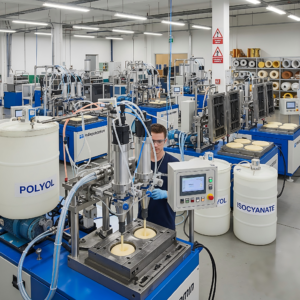
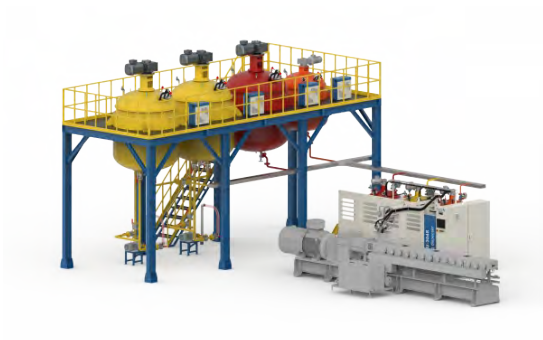
As a premier solution provider for the polyurethane field, our specialized Elastomer Casting Machines are engineered to eliminate these variables:
-
Triple-Jacketed Thermal Control: Our material tanks and entire fluid delivery circuits utilize triple-jacketed thermal oil heating. This guarantees a uniform temperature profile from the holding tank, through the precise metering gear pumps, all the way to the tip of the mixing head, ensuring the prepolymer viscosity remains perfectly stable.
-
Advanced Dynamic Mixing: Because elastomers often involve blending components with vastly different viscosities, simple static mixing is insufficient. Our proprietary high-speed dynamic mixing heads utilize variable frequency drives (VFD) and specialized agitator designs to ensure aggressive, flawless homogenization without inducing sheer-heat degradation.
-
Continuous Vacuum Degassing: Micro-bubbles act as stress concentrators in an elastomer, drastically reducing tear strength and load-bearing capacity. Haifeng Polyurethane Machine integrates automated, continuous vacuum degassing into our material preparation tanks, ensuring the final cast is 100% void-free.
-
Intelligent PLC Architecture: Our advanced Siemens PLC control systems continuously monitor flow rates, pressures, and temperatures in real-time. If a deviation occurs, the system utilizes closed-loop feedback to instantly adjust pump speeds, guaranteeing that every single pour meets exact engineering tolerances.
Beyond just supplying equipment, acting as a comprehensive solution provider for the polyurethane field means our engineering team works directly with your chemical suppliers. We analyze your specific material viscosity, pot life, and curing temperatures to custom-calibrate the machinery, ensuring you transition from raw chemistry to a flawless, high-margin industrial component with zero waste.
Take the Next Step in Manufacturing Excellence
Upgrading to superior polyurethane chemistry is only half the equation; you need the mechanical precision to process it. Stop letting inaccurate dosing and poor mixing compromise the integrity of your elastomer products.
Contact the engineering team at Haifeng Polyurethane Machine today. Let our polyurethane machinery experts analyze your specific material formulations and operational bottlenecks. Reach out to us for a comprehensive technical consultation, custom machinery blueprints, or a detailed ROI analysis on upgrading your current casting lines. Together, we will redefine your factory’s production capabilities.