











Étude de cas sur la modernisation de la chaîne de production de matériaux pour chaussures de sécurité en polyuréthane de Haifeng : aider les entreprises australiennes du secteur des EPI à mettre en place une fabrication intelligente à grande échelle de chaussures de sécurité haute performance
Historique de la clientèle
As a backbone enterprise in Australia’s personal protective equipment (PPE) industry, the company has been deeply engaged in the safety shoe sector for 20 years, covering a factory area of 30,000 square meters and currently operating 8 semi-automated polyurethane safety shoe production lines. Its core products include 3-5 mainstream specifications of safety shoes such as industrial impact-resistant, puncture-resistant, and chemical oil- and slip-resistant safety shoes, focusing on standardized large-scale production with an annual output of about 800,000 pairs and annual sales exceeding 35 million Australian Dollars. The products not only supply large enterprises in Australia’s construction, mining, chemical, machinery manufacturing and agricultural industries, but also are exported to overseas markets such as New Zealand, Southeast Asia and the Middle East. In recent years, protective standards for safety shoes at home and abroad have been continuously upgraded (e.g., high-end indicators of the Australian Standard AS/NZS 2210.3 and the European Standard EN 20345), and major downstream customers have increasingly stringent requirements for product protection, consistency and delivery stability. However, the enterprise’s original production lines suffered from poor consistency of shoe material performance, low large-scale production efficiency and severe raw material waste, which failed to meet high-end supply demands. There is an urgent need to complete technological transformation through professional rotary disc polyurethane molding equipment to enhance core competitiveness.
Aperçu du projet
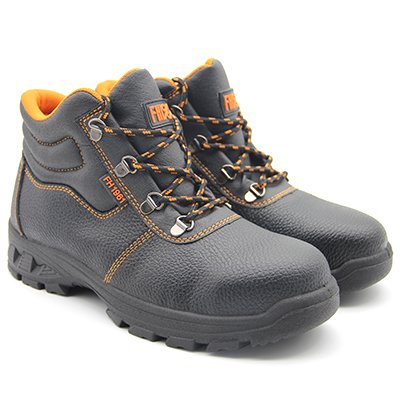
As a leading enterprise deeply engaged in Australia’s personal protective equipment (PPE) industry, the company has nearly 20 years of experience in R&D and production of safety shoes, and has long been plagued by three core pain points: poor protective performance of polyurethane shoe materials for safety shoes, low production efficiency, and high comprehensive manufacturing costs. Combining the Australian and European protective standards for the safety shoe industry with the enterprise’s demand for large-scale production of fixed specifications, Haifeng Automation leveraged its core polyurethane rotary disc molding technology to tailor a full-chain upgrade solution integrating customized rotary disc multi-station equipment, precise process optimization, intelligent closed-loop control, and eco-compliant production. By introducing dedicated rotary disc dual-density multi-station polyurethane safety shoe molding production lines, optimizing puncture and impact resistant foaming formulas, and building an intelligent management and control system, we completed the installation and commissioning of 5 core production lines in just 7 days. This enabled the enterprise to transform from “semi-automated extensive production” to “intelligent and precision manufacturing”, successfully overcoming the challenges of large-scale and stable mass production of high-protection grade polyurethane safety shoes, and providing core support for its expansion in the high-end PPE market covering industrial, construction, chemical and agricultural sectors in Australia and overseas.
Principaux points de douleur des clients
01
Insufficient product performance, failure to meet high-end protection requirements
The polyurethane midsole/outsole adopted traditional single-density formula plus simple molding process, with puncture and impact resistance only meeting basic standards, failing to reach the requirements of Australian and European high-end industrial safety shoe standards. Manual pouring combined with fixed mold table production led to uneven shoe material density, prone to cracking, deformation, debonding and other problems, resulting in short product service life and difficulty in entering the supply chain of high-end major customers in Australia and Europe.
02
Severe raw material waste, poor consistency in large-scale production
Raw material proportioning and pouring in the production process relied entirely on manual experience, with a polyurethane raw material waste rate of up to 12%, causing significant cost losses. Manual operation combined with single or double cavity mold tables resulted in large deviations in sole size, hardness and thickness even in large-scale production of the same specification. Some batches failed to pass the acceptance of major customers in Australia and overseas, with a rework rate of 10%.
03
Low large-scale production efficiency, insufficient capacity support
A single production line adopted manual assisted molding, with a production cycle of 5 minutes for polyurethane shoe materials of a single pair of safety shoes and a daily output of only 250 pairs. Based on an average of 260 working days per year, the annual capacity of 8 semi-automated production lines is about 520,000 pairs, far from meeting the annual supply demand of 1 million pairs from core major customers in Australia and surrounding markets. Although there is no high-frequency mold change demand, the traditional production line requires more than 1.5 hours to change molds for new products or customized specifications, and requires debugging by professional technicians, resulting in long downtime and further restricting capacity release.
04
Lack of process standards, high pressure of environmental compliance
There was no standardized molding process and full-process quality inspection system. Manual operation led to product defects such as burrs, air bubbles and poor adhesion, with a finished product qualification rate of only 80%. Unorganized VOCs emission during production and high pollution of traditional release agents brought regulatory pressure in line with Australian environmental regulations (e.g., AS/NZS 4140), and overseas compliance requirements also became an obstacle to exports to European and American markets.
Les solutions de Haifeng
01
Core Equipment Upgrade: Rotary Disc Dual-Density Multi-Station Production Line, Adapting to Large-Scale Production Characteristics
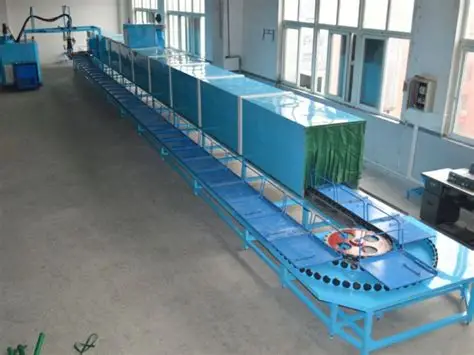
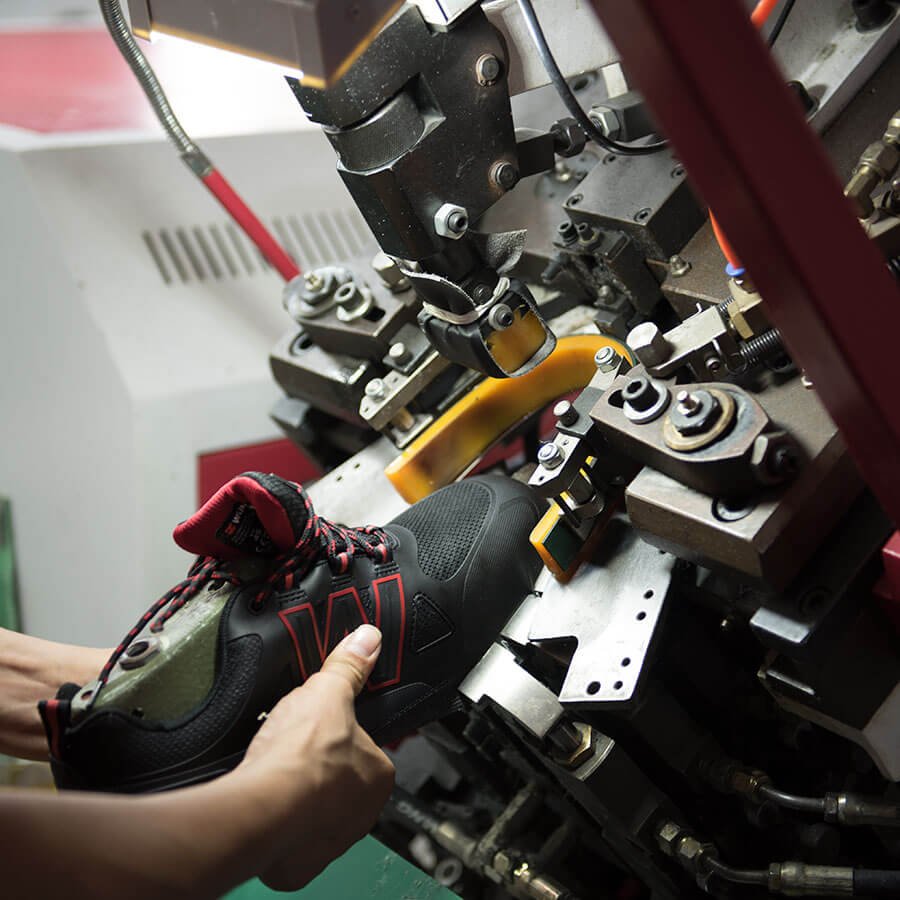
We configured 5 sets of Haifeng’s dedicated rotary disc dual-density multi-station molding production lines for polyurethane safety shoes for the enterprise,paired with high-precision quantitative pouring modules (metering accuracy ±0.5%) and intelligent constant temperature control units (temperature control error ±0.3℃). Through continuous cyclic operation, each station of the rotary disc accurately matches processes such as raw material pouring, foam molding, constant temperature curing and automatic demolding, realizing seamless connection of the production process and perfectly adapting to the demand for continuous large-scale production of mainstream specifications. The equipment can accurately control the mixing ratio of polyurethane A/B components, support the integrated production of single/double density midsole/outsole, meet the technological and protective requirements of high-end safety shoes complying with AS/NZS 2210.3 and EN 20345 standards, and improve the stability of large-scale production by reducing manual intervention.
02
Intelligent Control Implementation: Interconnected System Enabling Visualized Mass Production + Convenient Mold Change
The production line is equipped with a PLC industrial control system + rotary disc station interconnection control module, combined with robotic arm automatic demolding and handling equipment. The system pre-stores production formulas for 3-5 mainstream specifications and multiple backup specifications of the enterprise. For large-scale production scenarios, it can realize precise and constant control of pouring volume, temperature and curing time of each station to ensure high consistency of products in the same batch. For low-frequency mold change scenarios such as new product R&D and customized orders, no professional technicians are needed—one-click formula switching can synchronously adjust the process parameters of each station, eliminating tedious debugging links and shortening downtime. A multi-dimensional online quality inspection station is added, seamlessly connected with the discharge end of the rotary disc, to real-time monitor core indicators such as sole size, density and puncture strength, realizing visualized production process and traceable data to meet the quality control requirements of high-end major customers in Australia and Europe.
03
Process and Environmental Optimization: Stable Mass Production Quality + Full-Process Green Compliance
An automated raw material pretreatment system is configured to ensure the stability of raw material viscosity and foaming performance through constant temperature preheating (60-70℃) and vacuum dehydration, avoiding quality problems caused by raw material fluctuations in large-scale production from the source. For the core protective needs of safety shoes in Australia’s mining, construction, agricultural and other industries, customized special formulas with puncture resistance, impact resistance, oil resistance and slip resistance are developed. Combined with the continuous molding characteristics of the rotary disc production line, the foaming temperature-pressure curve of each station is optimized to allow raw materials to foam and cure evenly under constant temperature and pressure, improving the structural strength and durability of the sole. High-precision CNC trimming and deburring equipment and performance testing equipment are matched to build a full-process closed-loop production chain of “raw material processing – molding – finishing – testing”. Water-based release agents + closed foaming covers at rotary disc stations + activated carbon waste gas treatment devices are adopted to realize up-to-standard VOCs emission, complying with Australian AS/NZS 4140, EU REACH, ROHS and other environmental regulations.
04
Full-Cycle Supporting Services: Ensuring Stable Operation of Production Lines
A team of 6 senior technical engineers is arranged to be stationed in the factory for 7 days to complete the installation, commissioning of core equipment and dismantling and transformation of old equipment. Modular installation is adopted to minimize production downtime. Targeted practical training is carried out for production workers and quality inspectors, focusing on large-scale production operation, inspection of mainstream specifications and low-frequency mold change skills. Core skills can be proficiently mastered in only 4 hours without professional technical background. A 1-year whole-machine warranty service is provided, and a 24-hour on-site technical support mechanism is established. Relying on Haifeng’s service outlets in Australia and surrounding regions, conventional faults can be solved on-site within 2 hours. Regular equipment maintenance, calibration and process optimization guidance are carried out to match the enterprise’s large-scale production and supply needs in Australia and overseas markets.
Principales réalisations de la mise en œuvre du projet
Upgraded product performance, entering high-end supply chain
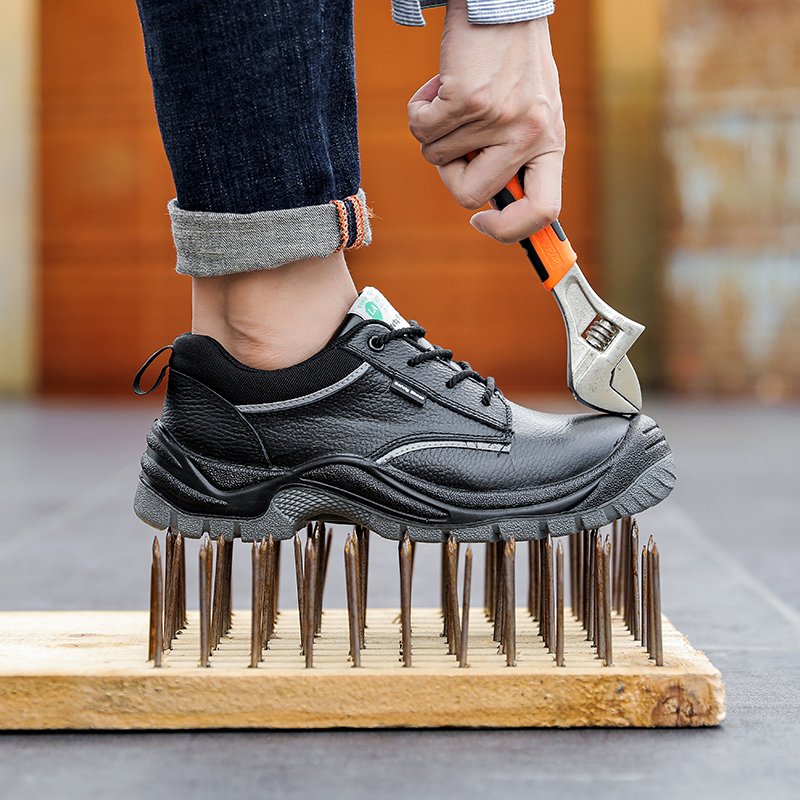
The sole puncture strength is increased to over 1800N, and the impact resistance reaches 200J, fully meeting the high-end grade requirements of Australian Standard AS/NZS 2210.3 and European Standard EN 20345. The product service life is increased by more than 1.5 times. At present, high-end high-protection safety shoes account for 50% of total sales, successfully entering the high-quality supplier list of many large Australian construction, mining and chemical enterprises.
Leap in mass production efficiency, capacity matching demand
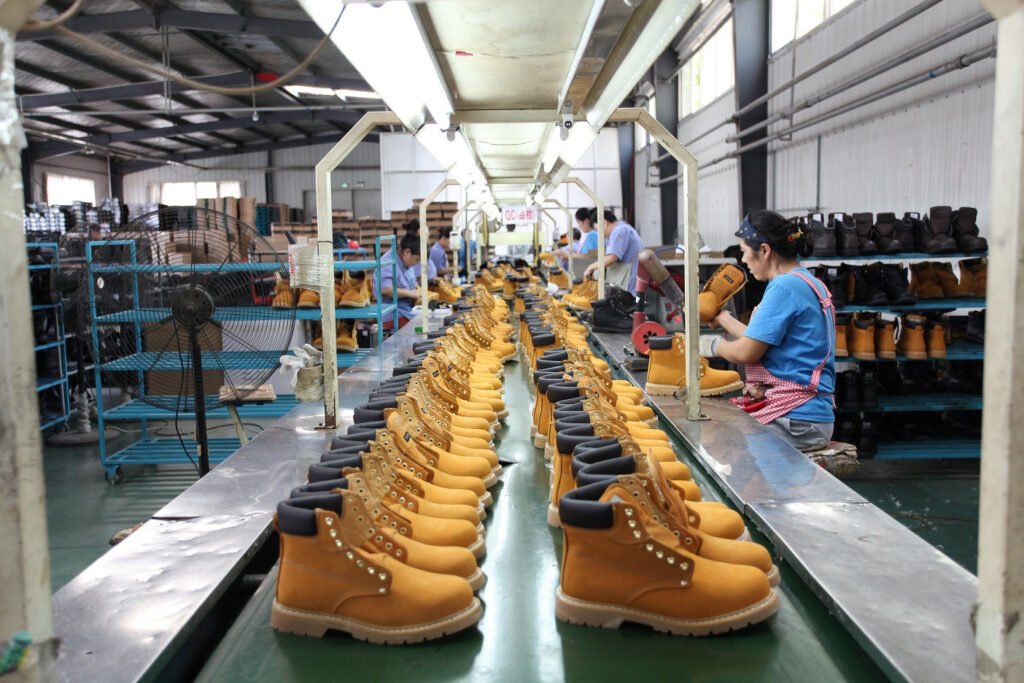
The production cycle of a single pair of shoe materials is shortened from 5 minutes to 1.5 minutes, and the daily output of a single production line is increased from 250 pairs to 800 pairs. Based on an average of 260 working days per year, the annual output of 5 intelligent production lines reaches 1.04 million pairs,which is just over the annual supply demand of 1 million pairs from core customers, fully meeting the requirements of large-scale supply. The low-frequency mold change time is shortened from 1.5 hours to 15 minutes, greatly improving the stability of production and delivery.
Sharp reduction in comprehensive costs, expanded profit margin
The raw material waste rate is reduced from 12% to 4%, saving more than 840,000 Australian Dollars in raw material costs annually; automated equipment replaces more than 70% of manual labor, reducing the number of operators per line from 10 to 3, saving more than 2.6 million Australian Dollars in labor costs annually for 5 lines. The unit production cost is reduced by 22%, and the gross profit margin of core products is increased by 10 percentage points.
Highly unified quality, improved brand reputation
The sole dimensional deviation is controlled within 0.3mm, the density and hardness deviation is ±1D, the appearance is free of defects, and the consistency of products in the same batch and different batches is significantly improved. The finished product qualification rate is increased from 80% to 99%, the rework rate is reduced from 10% to 0.8%, and the customer complaint rate is reduced by more than 90%, making it a benchmark supplier in the high-end safety shoe field in Australia.

Upgraded compliance capability, expanded domestic and overseas markets
The VOCs emission concentration is reduced to below 30mg/m³, complying with Australian and international environmental standards and breaking overseas compliance barriers. The proportion of overseas sales is increased from 20% to 35%, successfully opening up mid-to-high-end PPE markets in Europe, North America and New Zealand.


