








1. Polymerization Inhibition: Causes and Preventive Measures
Polymerization inhibition or even complete non-polymerization is one of the most costly failures in MC nylon production. It usually occurs due to improper catalyst selection, insufficient vacuum dehydration and excessive moisture in raw materials.
1.1 Optimize Catalyst System
Traditional NaOH catalyst generates water during reaction with caprolactam, and its own hygroscopicity also brings moisture risk. Once residual moisture cannot be fully removed, it will interrupt the anionic polymerization reaction.
Switching to sodium methoxide as the catalyst can avoid water generation during the reaction, which has been verified to effectively reduce non-polymerization risks in actual production. All additives should be fully dried before use to eliminate impurity-induced polymerization inhibition.
1.2 Ensure Sufficient and Stable Vacuum Degree
MC nylon polymerization must be carried out under anhydrous conditions. Insufficient vacuum or false vacuum will lead to incomplete dehydration, cause reverse reaction and finally result in non-polymerization.
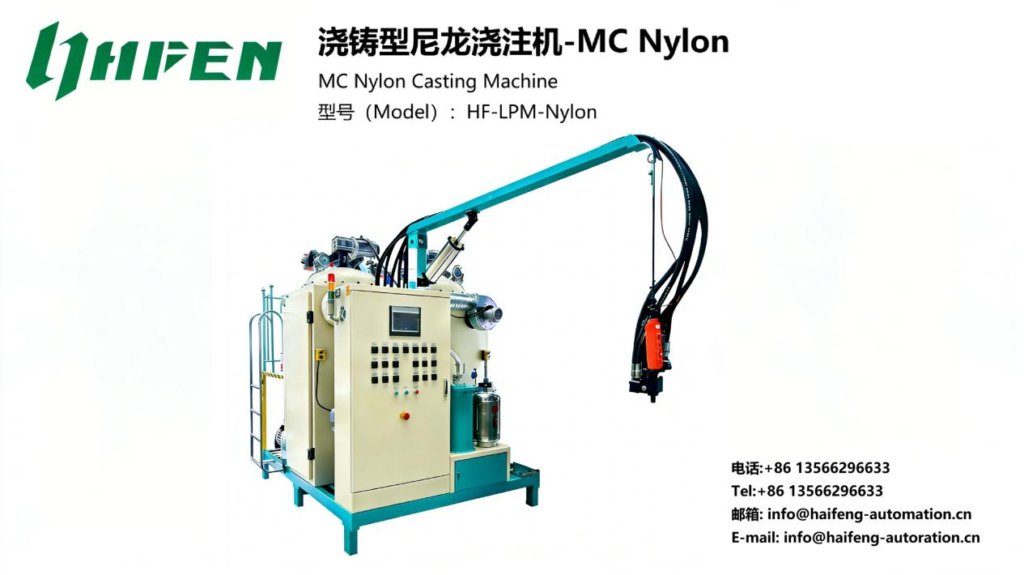
Our Haifeng MC Nylon Casting Machine is equipped with a high-precision vacuum degassing system with stable vacuum degree control, which can fully remove moisture and volatile impurities from raw materials, fundamentally reducing the risk of polymerization failure.
2. Toughening Improvement: Reduce Cracking Risk of Large Castings
Poor toughness and low impact strength are common defects of MC nylon products, especially for large-scale castings, which are prone to cracking during demolding, machining and long-term use. The following measures can effectively improve product toughness.
2.1 Material Formula Modification
Lorem ipsum dolor sit amet, consectetur adipiscing elit. Ut elit tellus, luctus nec ullamcorper mattis, pulvinar dapibus le
- Plasticizer modification: Adding 5%-30% hexamethylphosphoramide (HMPA) during polymerization can significantly improve the impact toughness of finished products. The addition ratio can be adjusted according to actual performance requirements.
- Co-catalyst optimization: Triphenylmethane triisocyanate with trifunctional structure can bring better impact resistance and low-temperature toughness than conventional difunctional isocyanates.The high-precision metering system of Haifeng casting machine ensures accurate and stable proportioning of catalysts and modifiers, guaranteeing consistent performance of each batch.
2.2 Standardized Heat Treatment Process
- Water heat treatment: Boil the nylon blank in water at 100°C (about 15 minutes per 1mm thickness), then cool slowly. It can effectively improve toughness but has limited improvement on mechanical strength.
- Oil heat treatment: Heat the blank in engine oil or cylinder oil to 160°C, keep for 1-2 hours, then cool slowly to room temperature. It can improve mechanical strength, wear resistance and reduce water absorption. For better effect, silicone oil can be used. Place wooden blocks at the bottom of the oil tank to ensure uniform heating.
2.3 Machining Specification
- Control the drilling speed below 100 r/min. For large-diameter holes, expand gradually from small drill bits to avoid cracking.
- When planing keyways, avoid one-pass heavy cutting. Reserve slight allowance in depth to prevent cracking during assembly and use.
3. Friction Reduction & Wear Resistance Upgrade
4. Porosity Defects: Root Causes and Control Methods
Internal pores and shrinkage cavities are the most common quality problems in MC nylon casting, which directly reduce the mechanical strength and first-pass yield of products. The problem can be controlled from three dimensions.
4.1 Optimize Mold Temperature Setting
Excessively high mold temperature will cause shrinkage cavities; too low temperature will lead to incomplete dissolution of polymer in monomer and form micropores.
It is recommended to adjust the mold temperature according to seasons and product size: 155-160°C in winter, 165-180°C in spring and summer. For large molds with high heat capacity, increase the temperature appropriately.
Haifeng casting machine is equipped with a closed-loop temperature control system with ±1℃ accuracy, which can stably maintain the optimal casting temperature and reduce bubble defects caused by temperature fluctuation.
4.2 Strict Raw Material Quality Control
Volatile impurities and excessive moisture in raw materials will generate gas during casting and form internal pores. It is necessary to ensure the cleanliness of raw materials and strictly control moisture content, and do a good job in sealing and drying of all materials.
4.3 Optimize Mold Gating & Venting Design
Unreasonable mold design, poor venting at dead corners and uneven wall thickness will lead to inconsistent cooling rate and form bubbles or shrinkage cavities.
For special-shaped products, the gate should be designed to allow the material to enter the cavity in a steady fine stream, and open risers should be set at thick sections to facilitate air discharge.
5. Heat Resistance Enhancement
MC nylon has a relatively high coefficient of linear thermal expansion, and its mechanical properties decrease obviously when temperature rises. For high-temperature working conditions, filling modification is an effective solution.
Introducing fillers such as nano-montmorillonite and rare earth additives can significantly improve the heat distortion temperature, dimensional stability and strength of MC nylon, expanding its application range in high-temperature scenarios.
The high-shear mixing system of professional casting equipment ensures uniform dispersion of nano-fillers, giving full play to the modification effect.
Improve MC Nylon Production Stability With Professional Casting Equipment
- High-precision closed-loop metering system to ensure accurate proportioning of raw materials, catalysts and modifiers
- Efficient vacuum degassing system to fully remove moisture and reduce polymerization inhibition and porosity risks
- ±1℃ precision temperature control system to maintain stable reaction temperature
- Uniform multi-stage stirring structure to ensure consistent mixing of fillers and additives
- Stable pouring flow control to reduce air entrainment during mold filling