









Haifeng Automation Empowers Water-Based Eco-Leather Manufacturing: Intelligent Molding Production Line Upgrade Case of a Hebei Factory
Historique de la clientèle
As an enterprise specializing in the R&D and production of water-based eco-leather in the Beijing-Tianjin-Hebei region, the factory covers an area of 15,000 square meters and operates 3 semi-automated production lines. Its core products include water-based PU eco-leather and plant-based recycled leather, which are used in clothing fabrics, environmental packaging, luggage accessories, and other fields. With an annual production capacity of approximately 5.5 million meters, it mainly provides supporting services for domestic mid-range clothing brands and packaging manufacturers, achieving an annual sales volume of 88 million RMB.
Currently, the water-based eco-leather industry is experiencing dual growth driven by policy dividends and market demand, but competition is becoming increasingly fierce with the continuous emergence of similar manufacturers. Downstream brand customers not only have strict requirements for leather thickness uniformity, hand feel softness, and color fastness but also explicitly require products to pass environmental certifications (such as REACH and OEKO-TEX Standard 100). The factory’s original production model relied heavily on manual cloth laying and manual control of curing temperature, resulting in large cloth laying errors, unstable molding effects, waste of environmental additives, and incomplete waste gas treatment. These issues made it difficult to undertake high-end orders, and the enterprise urgently needed an automated upgrade solution that “meets environmental standards, ensures precision control, and can be quickly implemented” to break through development bottlenecks.
Aperçu du projet
A water-based eco-leather production enterprise in Hebei with 12 years of industry experience has long been plagued by three core pain points: “low molding precision, high environmental pressure, and poor batch stability.” As environmental policies tighten and downstream brands raise demands for “green, precise, and high-quality” leather, the traditional production model of manual cloth laying and extensive molding can no longer adapt to the market.
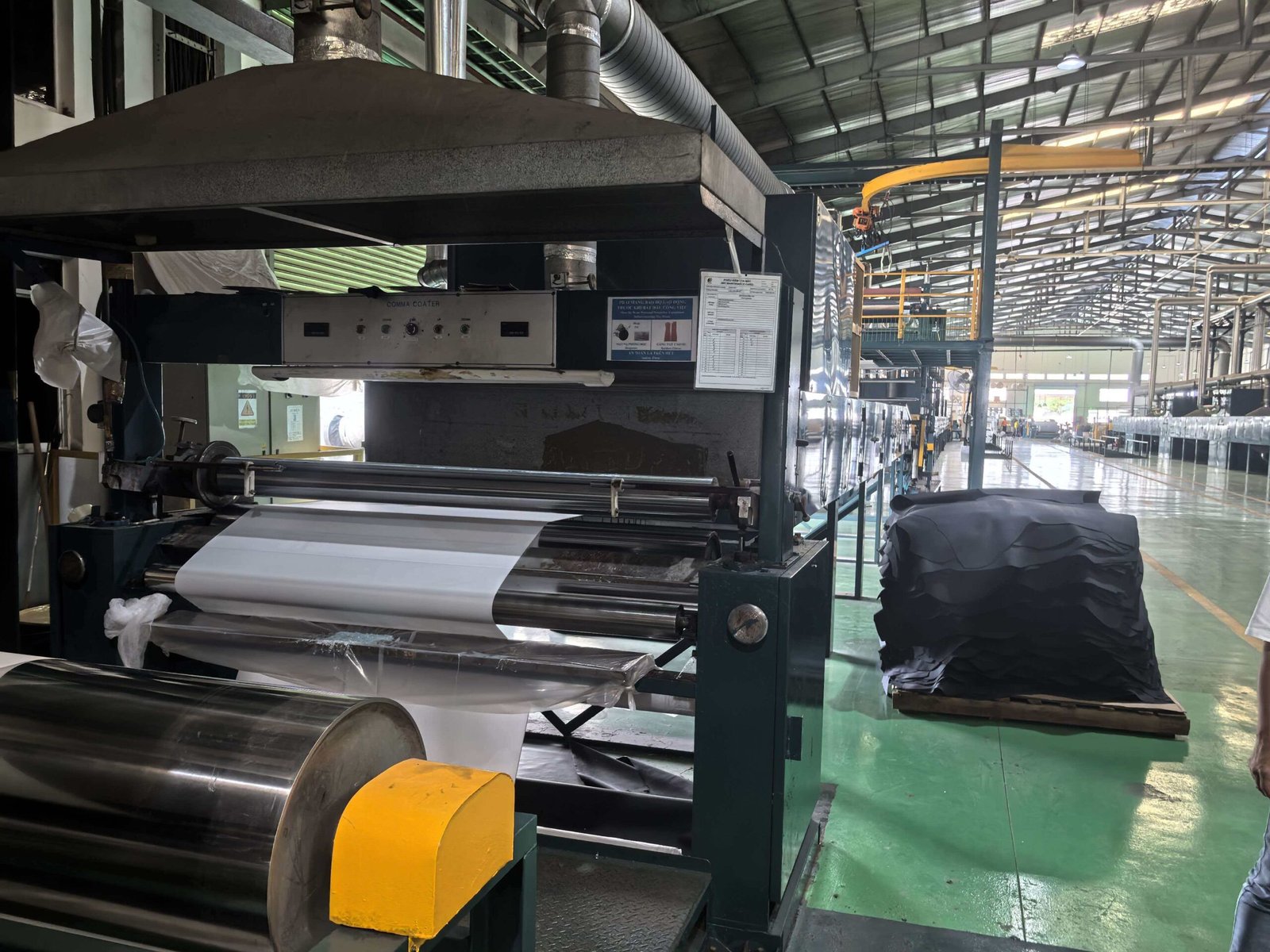
After multiple on-site investigations, Haifeng Automation tailored a full-chain upgrade solution integrating “intelligent molding equipment + environmental process optimization + data-driven management” based on the process characteristics of water-based eco-leather (environmental materials and low-temperature molding). By introducing independently developed high-precision water-based leather molding production lines and optimizing material laying and curing parameters, the transformation of 3 core production lines was completed in just 6 months. Haifeng led the entire process of technology implementation and process iteration, helping the enterprise transform from “extensive manual molding” to “intelligent precision manufacturing.” This successfully solved the mass production quality challenges of water-based eco-leather and enabled the enterprise to smoothly enter supporting markets for high-end clothing, environmental packaging, and luxury luggage.
Principaux points de douleur des clients
01
Low Molding Precision and Unstable Product Quality
Manual cloth laying errors exceeded 10%, leading to significant leather thickness deviations (±0.18mm), which failed to meet the high-end customer requirement of ±0.06mm. Uneven cloth laying also caused inconsistent hand feel (hard and soft areas) and surface defects such as pinholes and bubbles, resulting in a finished product unqualified rate of 12% and annual rework losses exceeding 950,000 RMB. The enterprise was repeatedly rejected by high-end brand customers due to quality issues, hindering market expansion.
02
High Environmental Pressure and Prominent Compliance Risks
The addition of environmental additives in the traditional molding process relied on manual experience, resulting in a waste rate of 18%. Based on an annual consumption of 380 tons of water-based environmental additives at a unit price of 19,000 RMB/ton, the annual waste cost exceeded 1.2996 million RMB. Incomplete waste gas collection during production led to VOCs emission concentrations close to the limit, posing environmental compliance risks. The enterprise was once ordered by environmental authorities to rectify within a time limit.
03
Low Production Efficiency and Insufficient Capacity for Large Orders
Each production line required 10 workers responsible for cloth laying, feeding, temperature control, inspection, and other links. The processing speed for a single batch of water-based leather molding + curing was only 9m/min, with a daily output of 13,500 meters per line and a total annual capacity of 5.5 million meters for 3 lines. Restricted by efficiency, the enterprise could only undertake small-batch orders and was unable to meet the tight delivery deadlines for million-meter-level large orders common in the high-end market, limiting its development scale.
04
High Comprehensive Costs and Compressed Profit Margins
Labor costs rose year by year, with an annual labor cost of over 680,000 RMB per line, totaling 2.04 million RMB for 3 lines. Old equipment consumed high energy, with a daily power consumption of 380 kWh per line, resulting in serious energy waste. Coupled with environmental rectification investments, the enterprise’s profit margins were continuously compressed, facing the dilemma of “being eliminated if not upgraded.”
Les solutions de Haifeng
01
Customized Intelligent Molding Equipment to Improve Precision and Efficiency
To meet the enterprise’s production needs, Haifeng Automation specially customized 3 sets of water-based eco-leather dedicated production line supporting equipment (XJJF-3×50Z70A polyurethane foaming pouring machine as the core) to replace the traditional manual coating and laying equipment and ordinary open-type curing ovens. The equipment is equipped with an automatic material laying and cloth feeding system with a precision of ±0.03mm and a high-speed water-based material uniform mixing and distribution device (rotating speed: 6000±200 rpm), eliminating the defects of uneven material laying and cloth deviation caused by manual operation from the source. It is also equipped with an intelligent temperature-controlled closed curing oven (temperature error: ±0.4℃) combined with a zonal hot air circulation system to ensure uniform curing of water-based leather and fundamentally solve the problems of surface cracking and unstable molding caused by uneven heating.
Adopting a modular assembly design, the whole set of equipment can be split and installed on site without large-scale renovation of the workshop. Only 1 day of shutdown is needed for the overall circuit connection and debugging, which will not affect the daily production progress of the enterprise and fully meets the demand for rapid implementation and commissioning of the production line.
02
Optimized Environmental Processes to Reduce Compliance Risks
Haifeng’s technical team optimized environmental processes in a targeted manner: introduced a precise additive dosing system that automatically calculates dosage based on leather output to achieve quantitative additive injection and reduce waste; upgraded the waste gas collection and adsorption device, combined with an activated carbon adsorption + photocatalytic degradation dual treatment system, reducing VOCs emission concentration to below 45mg/m³, far lower than the national standard limit; optimized the water-based leather curing curve (low-temperature preheating – constant temperature curing – gradient cooling) to ensure product quality while reducing energy consumption and environmental pressure.
03
Implemented Intelligent Management to Ensure Batch Consistency
The production lines are equipped with a PLC intelligent control system, pre-storing formula databases for more than 45 mainstream specification products (including cloth laying thickness, additive ratio, and curing parameters), realizing full-process automation of cloth laying, feeding, curing, and cooling. An online thickness detection and defect identification module was added to real-time monitor leather thickness and surface conditions. When exceeding the standard, it automatically issues an early warning and adjusts parameters to ensure consistent quality of products in the same batch and different batches.
At the same time, a production data traceability system was established to record all process parameters and environmental emission data in real-time, facilitating the enterprise’s compliance self-inspection and customer quality audits.
04
Comprehensive Full-Cycle Services to Ensure Stable Operation
Haifeng dispatched 3 professional engineers to be stationed at the factory for 6 days, taking full responsibility for equipment installation, commissioning, old equipment removal, and process parameter calibration. For the factory’s existing workers, a 3-day practical training was conducted, covering core skills such as equipment operation, parameter adjustment, and daily maintenance through hands-on teaching to ensure workers can quickly master the operation.
A 1-year whole-machine warranty service is provided, with a 24-hour technical docking mechanism established to respond immediately to fault consultations. A spare parts warehouse is set up in the Beijing-Tianjin-Hebei region with sufficient common spare parts, ensuring that technical personnel can arrive at the scene within 2.5 hours and repair general faults on the same day. Comprehensive on-site equipment maintenance and process optimization guidance are provided every quarter to help the enterprise continuously improve production efficiency.
Principales réalisations de la mise en œuvre du projet
Dual Qualification of Molding and Quality, Leap in High-End Order Undertaking Capacity
With the support of intelligent molding equipment and precise processes, the leather cloth laying error is controlled within ±0.03mm, significantly improving thickness uniformity and consistent soft hand feel. The defect rate of pinholes, bubbles, and other issues has dropped to 1.5%, and the finished product unqualified rate has decreased from 12% to 2.2%, saving over 850,000 RMB in annual rework losses. The products have successfully passed REACH and OEKO-TEX Standard 100 environmental certifications, and passed the supplier qualification reviews of 3 domestic first-tier clothing brands and 2 luxury luggage brands. The enterprise has secured 2 high-end orders totaling 2.8 million meters, with a single order value exceeding 5.8 million RMB.
Eliminated Environmental Compliance Risks and Significantly Reduced Costs
The precise additive dosing system reduced the additive waste rate from 18% to 6%, saving over 974,700 RMB in annual environmental additive costs. The upgraded waste gas treatment system achieved up-to-standard VOCs emissions, completely eliminating environmental compliance risks and no need for additional rectification investment. The intelligent curing oven has an energy-saving rate of 35%, with the daily power consumption per line reduced from 380 kWh to 247 kWh, saving over 152,000 RMB in annual electricity fees for 3 lines.
Doubled Production Efficiency and Full Breakthrough of Capacity Bottlenecks
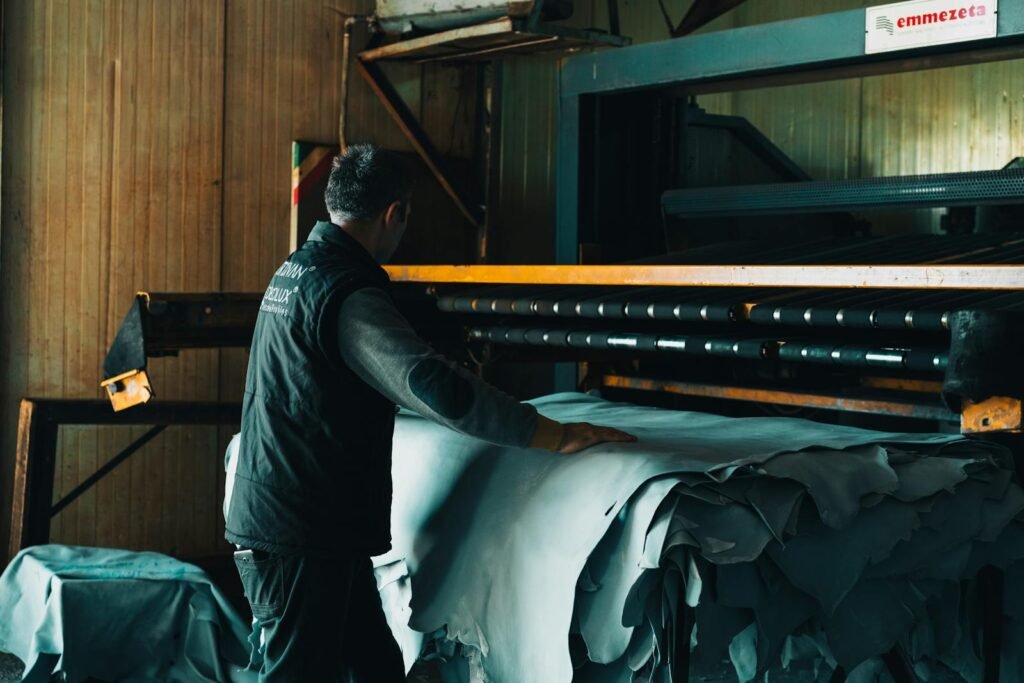
After the full-process automated transformation, the processing speed of water-based leather molding + curing increased from 9m/min to 20m/min, the daily output per line rose from 13,500 meters to 30,000 meters, and the total annual capacity of 3 lines exceeded 10.8 million meters, a 96.4% increase compared with before the transformation. The enterprise is no longer limited to small-batch orders and can efficiently undertake large-value high-end orders, achieving leapfrog growth in production scale.
Upgraded Comprehensive Competitiveness and Stabilized Market Position
The automated equipment significantly reduced labor demand, with the number of operators per line decreased from 10 to 4, saving 1.632 million RMB in annual labor costs for 3 lines. Combined with savings in additives and electricity fees, the annual comprehensive cost decreased by 2.7587 million RMB, with an investment payback period of only 3.8 years. The proportion of high-end orders increased from 8% before the transformation to 38%, and the annual sales volume rose from 88 million RMB to 175 million RMB. The enterprise has successfully emerged as a benchmark enterprise in the domestic water-based eco-leather industry, with comprehensively enhanced market competitiveness.


