












Table des matières
How do you precisely control the gram weight of a single shoe sole to maximize raw material savings in polyurethane (PU) manufacturing?
Traditional water displacement methods and blindly reducing chemical density are obsolete. Authored by the Chief Engineer at Haifeng Polyurethane Machinery, this guide dissects the core practical processes of a modern PU workshop. From 3D CAD-based cavity volume calculations and Haifeng’s exclusive closed-loop dispensing compensation algorithms, to diagnosing the four critical metrics of a standardized “Cup Test.” We also deliver a dimensional strike against traditional TPR/PVC injection molding and confront the physical limits of PU materials, exploring how Haifeng’s latest “Polyurethane Physical Foaming Technology” (achieving densities of 0.2-0.25 g/cm³) is seizing the high-end market from supercritical EVA.
1. Precise Material Calculation: Saying Goodbye to the "Water Displacement" Method
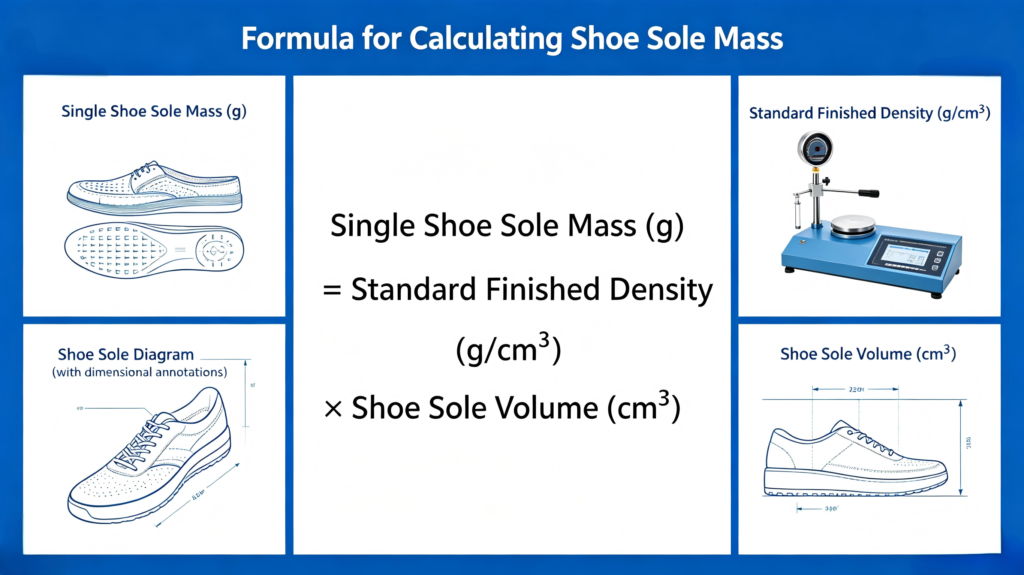
In PU shoe sole production, your net profit is squeezed out of every single gram of raw material saved. How do you accurately calculate exactly how much liquid chemical a single shoe sole needs? The core formula remains eternal:
1.1 The Archaic Approach (Water Displacement)
Over a decade ago, to measure the volume of a brand-new mold, workshop technicians relied on a primitive method: they would fill the mold cavity with water and then pour that water into a 2000mL measuring cylinder or weigh it on a scale (since 1g of water ≈ 1cm³). This “dirty method” is plagued with massive margins of error. Hidden air bubbles in the tread patterns and the surface tension of water easily cause deviations of several grams per sole. Magnify that error across a daily output of 10,000 pairs, and you are bleeding thousands of dollars in wasted chemical raw materials.
1.2 The Modern Top-Tier Approach (3D CAD Extraction)
Never rely on outdated procedures. Today, all modern shoe sole molds are CNC-engraved based on AI or 3D software models (such as Rhino or Shoemaster). In the digital software environment, an engineer simply clicks on “Mass Properties,” and the software instantly outputs the absolute, mathematically perfect shoe sole volume (cm³) accurate to four decimal places. By combining this exact digital volume with the chemical supplier’s recommended standard density, you lock in your exact Bill of Materials (BOM) cost long before the physical mold is even mounted on the machine.
2. The Ultimate Solution for Scientific Material Saving: Algorithmic Control > "Cutting Corners"
“How can I save on material costs?”* This is the mandatory question asked by every factory owner investing in our equipment. The essence of saving material lies in either lowering the density or eliminating dispensing errors. However, the engineering paths taken to achieve this are worlds apart.
2.1 The Dangerous Old Path (Sacrificing Physical Properties):
Historically, some chemical suppliers would recommend adding excess water or chain extenders (like 1,4-Butanediol) to forcefully drag the standard density of 0.5-0.7 g/cm³ down to a brittle 0.35 g/cm³. While water acting as a blowing agent does increase expansion, blind water addition destroys the microcellular structure. The sole becomes porous, the surface finish turns terribly dull, and crucially, the abrasion resistance, tear strength, and structural support suffer a catastrophic drop, leading to massive client returns. Another old trick is dual-density filling using low-density EVA scraps as the core. While this reduces cost, it severely compromises the ergonomic comfort and rebound of the sole.
2.2 Haifeng’s Modern Solution (Closed-Loop Control & Dispensing Compensation Algorithms)
In a modern workshop, material savings are achieved through extreme mechanical and algorithmic precision.
Haifeng’s latest PU casting machines have completely abandoned the crude “time-to-mass conversion” methods of the past. We employ a Closed-Loop Flow Control System. The machine’s PLC monitors the rotational speed of the high-precision gear pumps, pipeline pressure, and fluid viscosity variations every single second. If the algorithm detects the slightest flow fluctuation, it automatically corrects the dispensing valve’s open-time within milliseconds.
What does this mean for your factory? It means if you program the machine to dispense exactly 150.5 grams of material for a specific shoe size, it will dispense exactly 150.5 grams—never 155 grams due to pump wear or pressure spikes. By eliminating “flash” and material over-pouring on every single mold, a mid-sized factory can save enough money on wasted chemicals in one year to purchase a brand-new Haifeng casting machine.
3. The Only Truth on the Workshop Floor: The Standardized "Cup Test"
No matter how advanced your machinery is, before launching mass production every morning, the workshop foreman must perform one non-negotiable ritual: The Free-Foaming Test, universally known in the industry as the “Cup Test.” This is the ultimate touchstone for diagnosing the state of your raw chemicals.
3.1 Why Perform a Cup Test? Diagnosing Four Core Metrics:
- Detecting A/B Ratio Drift: If the chemical ratio is severely imbalanced, the free-foamed material will be extremely brittle once cooled—you can crumble it with your bare hands (abysmal tear strength). If you fail to find the correct ratio center here, everything you pour into the molds will be scrap.
- Measuring Free-Foaming Density: A standard PU chemical typically has a free-foaming density of around 0.25 g/cm³. (The finished in-mold density is usually 0.5-0.7 g/cm³. You need this density differential to generate internal “foaming pressure,” which forces the surface against the mold to create a smooth, dense skin). If the Cup Test reveals a density that is abnormally high or low, it indicates that the chemical reaction or gelation speed is totally out of sync.
- Catching Mixing Head Air Leaks:** When you install a new dynamic mixer, if the Cup Test reveals dense micro-bubbles trapped deep within the liquid before it even foams, your mixing head seals or injection valves are compromised and sucking in ambient air.
- Calibrating Phased Time Parameters: Operators must use a stopwatch to record four critical phases: Cream Time, Rise Time, Tack-Free Time, and Elastomer Curing Time.
3.2 The Chief Engineer’s Practical Warning:
Currently, Cup Testing in most factories is highly unstandardized. Technicians grab whatever is nearby—a paper cup, a plastic cup, or even a metal can. You must understand that the A/B chemical reaction is a hyper-sensitive thermodynamic process! Different cup materials have vastly different thermal conductivities. The speed of heat dissipation will directly cause massive deviations in foaming time and density. Furthermore, the amount of “head material” (the initial scrapped shot due to pressure differentials) discarded before filling the cup must also be standardized. A top-tier factory must unify its cup materials (standard paper cups are recommended) and enforce a strict SOP for the Cup Test.
4. The Dimensional Strike: PU Casting vs. Traditional TPR/PVC Injection
When competing for high-margin brand orders, why do we say that PU casting equipment executes a “dimensional strike” against traditional TPR/EVA/PVC injection molding factories?
- Fundamental Differences in Molding Principles: Injection molding is a *physical* process. It relies on extreme heat to melt solid plastic pellets and immense physical pressure (often over 10 MPa) to forcefully inject the molten plastic into heavy steel molds. Conversely, PU casting is a chemical reaction process. The materials flow into the mold as low-viscosity liquids. The internal cavity pressure is incredibly low (typically under 1 MPa).
- The Massive Profit Margin in Tooling Costs: Because they do not need to withstand high-tonnage clamping pressures, PU casting lines can utilize rapid-prototyped resin molds or lightweight aluminum molds. The tooling CAPEX is only 1/10 to 1/5 of the cost of heavy steel molds used for TPR/PVC, and a new mold can be ready for production in just 24 hours. This grants PU shoe factories an unparalleled capability for “small-batch, rapid-response” manufacturing.
- Material Performance Supremacy: Compared to PVC and TPR, Polyurethane presents absolute dominance in lightweight performance, abrasion resistance, high-energy rebound, continuous folding endurance (no broken soles), oil/slip resistance, and ergonomic comfort. While thermosetting PU scrap cannot be simply melted down and recycled like thermoplastic PVC, the high premium commanded by finished PU footwear easily covers this operational drawback.
5. Facing Reality: Is PU Truly "Perfect"?
As an equipment manufacturer with 30 years of history, we do not deal in marketing mysticism. PU shoe soles offer unparalleled ergonomic comfort and exceptional tooling economics, but they are not flawless. PU has its own physical ceilings:
- Heat Resistance is Inferior to Vulcanized Rubber: In heavy industrial environments where workers step on 300°C iron shavings, the extreme high-temperature and cut resistance of heavy vulcanized Rubber outsoles remains king.
- Extreme Lightweighting Loses to Supercritical EVA: The modern athletic running shoe market demands absolute zero-gravity weight. Currently, the most cutting-edge supercritical foamed EVA midsoles can compress their density down to a terrifying 0.08 g/cm³. Traditional chemical-blown PU, regardless of how much blowing agent is used, cannot break this physical barrier.
5.1 Haifeng’s Breakthrough: Polyurethane Physical Foaming Technology
Facing the relentless pressure from supercritical EVA, Haifeng did not passively stick to traditional chemical foaming. We have successfully developed and deployed our latest “Polyurethane Physical Foaming Equipment System.” By precisely injecting Supercritical Gas into the high-pressure mixing chamber, we have shattered the traditional density limits of PU, stably controlling the PU shoe sole density within an astonishing range of 0.2 to 0.25 g/cm³.
While there is still a gap to reach 0.08, Haifeng’s 0.2-density physical-foamed PU perfectly retains Polyurethane’s legendary Compression-Set Resistance (it never flattens out over time) and its unmatched high-energy rebound (“stepping-on-clouds” comfort)—core advantages that EVA inherently lacks and can never replicate.
Conclusion
The practical processing of PU shoe soles is essentially a dimensional battle of saying goodbye to “blind guesswork” and embracing “absolute precision.” Only when you completely discard the crude “water displacement” method, establish strict Standard Operating Procedures (SOPs) for the Cup Test, and utilize millisecond-level closed-loop algorithms to lock down every single gram of dispensing error, can you squeeze real profit out of fierce competition. Understanding the dimensional strike PU casting holds over traditional TPR/PVC injection, and proactively deploying the 0.2-density “Polyurethane Physical Foaming” technology, is what truly gives factory owners the winning hand in the high-margin footwear market. In the next installment, [Part 3: Workshop Chemicals & Auxiliary Agents], we will dive into the treacherous world of chemical additives, breaking down the root causes of fatal surface defects like “blisters” and “pitting,” and revealing the hidden cost battles behind mold release agents and mixing-head solvents. Stay tuned.
[If you are ready to phase out your outdated injection lines and upgrade to a modern PU casting system equipped with closed-loop algorithms, or if you are interested in Haifeng’s latest “PU Physical Foaming Equipment,” contact the Haifeng Engineering Team immediately. We will provide you with a precise Return on Investment (ROI) calculation.]
FAQ
What is the most accurate way to calculate the volume of a new shoe sole mold?
Discard the old “water displacement” method immediately. In a modern factory, the exact volume (in cm³) must be extracted directly from the 3D CAD software (like Rhino or Shoemaster) used to CNC engrave the mold. This digital Mass Properties calculation guarantees zero deviation before production even starts.
Does injecting excess water into PU drastically reduce material costs?
While adding excess water as a blowing agent reduces the material density (and thus the weight per sole), it fundamentally destroys the microcellular structure. The sole will suffer from severe shrinkage, poor surface finish, and a massive drop in tear strength. True cost savings come from Haifeng’s closed-loop dispensing compensation algorithms, which eliminate material over-pouring at the millisecond level without sacrificing physical properties.
Why is the choice of cup material critical during a Cup Test?
PU expansion is a highly sensitive exothermic chemical reaction. If you use a metal cup (which dissipates heat rapidly) today, and a paper cup (which acts as a thermal insulator) tomorrow, the cream time and rise time results will vary wildly, even if the chemical mixture is identical. Always standardize your Cup Test using the exact same type of cup.
Why is the mold cost for PU casting so much cheaper than PVC/TPR injection?
PVC and TPR are thermoplastic materials injected under immense physical pressure (over 10MPa), requiring heavy, expensive tool-steel molds. PU is a liquid chemical casting process with internal cavity pressures below 1MPa. Therefore, PU allows factories to use lightweight, low-cost aluminum or rapid-prototyped resin molds, reducing tooling CAPEX by up to 80% and drastically speeding up time-to-market.
Can PU shoe soles beat Supercritical EVA in terms of lightweight performance?
Frankly, no. Supercritical EVA can achieve an ultra-light density of 0.08 g/cm³, which traditional chemical-blown PU cannot reach. However, Haifeng’s latest PU Physical Foaming Technology pushes PU density down to 0.2-0.25 g/cm³. This delivers an unmatched balance: it is extremely lightweight, yet it retains PU’s legendary compression-set resistance (it won’t permanently deform) and superior kinetic energy return, which EVA inherently lacks.

Vice President, Sales & Marketing of Zhejiang Haifeng Automation Equipment Co., Ltd
- Member of the Polyurethane Equipment Professional Committee, China Polyurethane Industry Association
- Member of the Expert Committee on Footwear and Apparel Equipment, China Leather Association
- Executive Vice President, Wenzhou Footwear Machinery Chamber of Commerce, China


