








Part 1: Core Manufacturing Bottlenecks
1.1 Narrow Reaction Window & Control Complexity
The greatest challenge in solvent-free production is the precise control of chemical reaction speed. Two highly reactive prepolymers react within tens of seconds after mixing in the head. The gel time must be strictly controlled between 55 and 65 seconds. If it's too fast, leveling is lost and surface pinholes occur; if it's too slow, production capacity is affected.
High environmental sensitivity means microscopic fluctuations in humidity can drastically alter reaction kinetics. Furthermore, strict equipment requirements demand that A and B components enter the mixing chamber with perfect synchronization.
1.2 Cell Structure Disorder & Surface Shrinkage
The internal foaming structure determines the leather's hand feel, softness, and appearance. Regulating this microscopic structure is difficult:
- Excessive Closed Cells: If gelation is too fast, cell walls harden prematurely. When the foam cools, gas pressure drops, creating a negative pressure effect that pulls the material inward, causing severe surface shrinkage.

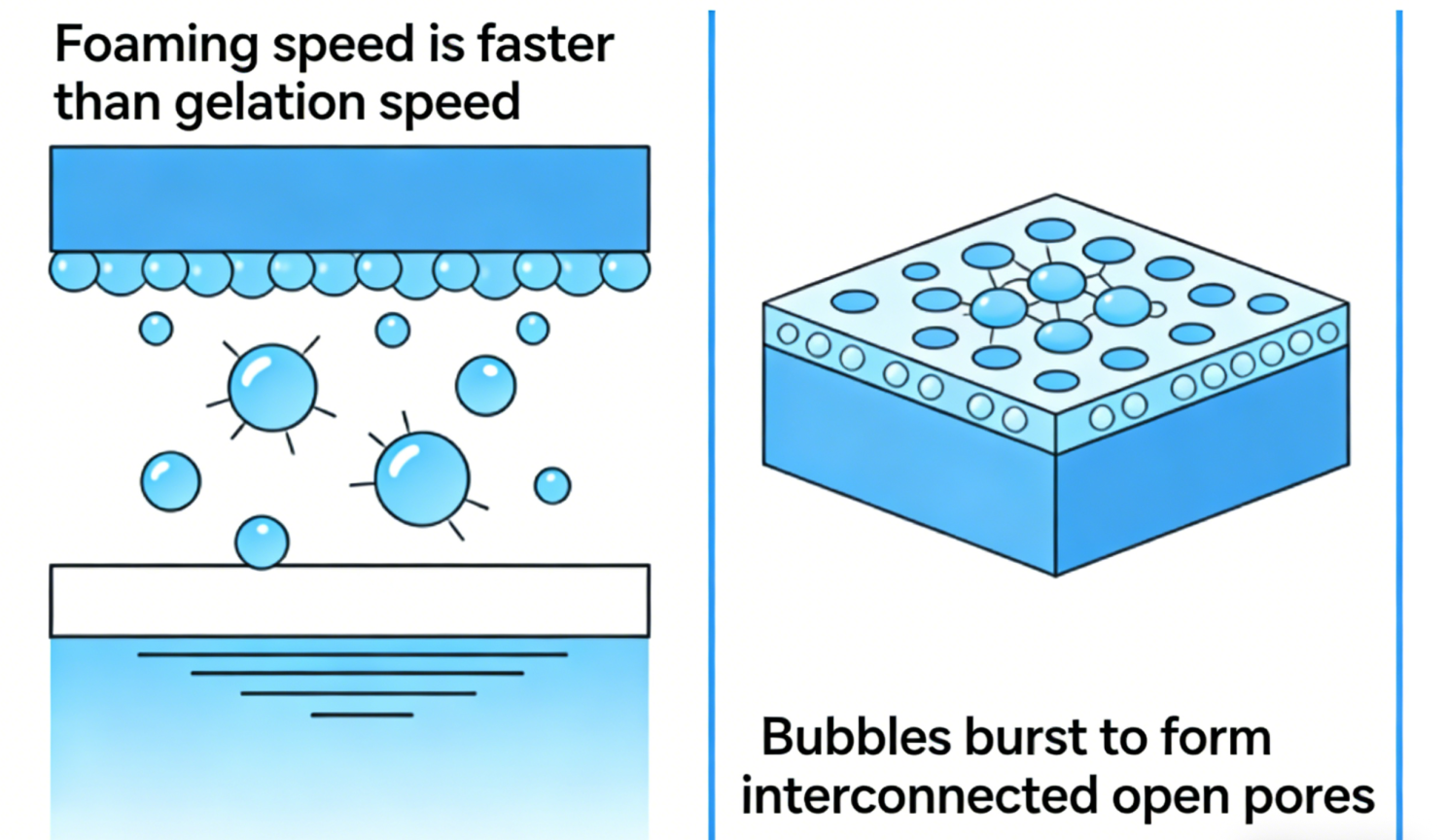
- Excessive Open Cells: If foaming outpaces gelation, bubbles rupture. This compromises tensile strength and abrasion resistance.
1.3 Inherent Limitations of Formulation
The Isocyanate Index (NCO index) is the core of the formulation, typically maintained around 1.05. Equipment metering accuracy directly determines the product's long-term durability.

- Low NCO Index Risk: Polymer chain ends are hydrophilic hydroxyl groups (-OH), which absorb moisture and swell in hot and humid environments, causing the leather to soften and deform.
- High NCO Index Risk: Excess NCO reacts with water to form rigid urea bonds, causing the coating to become hard and crack under pressure.
- Thermosetting Limitations: Once the cross-linking is complete, the molecular structure is permanently locked, restricting post-processing techniques like embossing.
Part 2: Surface Defects & Physical Failures
2.1 Surface Pinholes and "Dark Holes"
Pinholes occur when material viscosity is too high (>1800 mPa·s) or foaming starts prematurely. Microscopic air bubbles are trapped inside the coating and cannot escape before gelation.
2.2 Residual Odor
Poorly manufactured products emit odors due to unreacted isocyanate monomers (from high NCO index) or amine catalyst residues.
2.3 Wet-Heat Aging: The Hidden Risk
This is the ultimate test. Materials are exposed to 90℃ and 100% relative humidity for 200 hours. Equipment metering deviations leading to abnormal NCO index will cause irreversible softening deformation or embrittlement cracking in extreme environments.
Part 3: Haifeng Engineering Solution
At Haifeng Automation, we engineer equipment to perfectly accommodate the physics and thermodynamics of the polyurethane reaction.
3.1 Customized Mixing Rotors
Utilizing Computational Fluid Dynamics (CFD) and Finite Element Analysis (FEA), we customize rotor shear forces based on your raw material viscosity (1500~1800 mPa·s). This ensures millisecond-level homogeneous mixing, eliminating unmixed zones and dark holes from the source.
3.2 High-Precision Ratio Control
We utilize Coriolis Mass Flow Meters with closed-loop algorithms. Unlike volume meters, these measure actual mass, instantly adjusting pump speed to maintain the critical 1.05 NCO index, thoroughly solving wet-heat aging and odor issues.
3.3 Process Standardization
We provide turnkey engineering, establishing strict SOPs. Through precise temperature control (45~55℃) and environmental control, we shield the sensitive chemical reaction from external variables, ensuring batch-to-batch stability.
Part 4: Troubleshooting & Engineering Solution Matrix
| Problem Category | Specific Manifestation | Root Cause | Haifeng Solution |
|---|---|---|---|
| Reaction Control | Unstable gel time, explosive polymerization | Fast reaction speed, high humidity sensitivity | High-Pressure Impingement Mixing (HPIM); Closed-loop heating control (45~55℃) |
| Cell Structure Defects | Surface shrinkage, excessive closed cells | Catalyst mismatch, high functionality | Customized mixing rotors for uniform nucleation; Dynamic flow adjustment |
| Surface Pores | Pinholes, internal dark holes | Viscosity >1800 mPa·s, premature foaming | Coriolis Mass Flow Meters; Precise thermal management to delay foaming |
| Residual Odor | Sharp chemical smell, ammonia odor | Excess isocyanate monomers, amine residue | Closed-loop algorithms to stabilize NCO index, prevent monomer accumulation |
| Wet-Heat Aging | Softening/deformation in humidity, loss of elasticity | NCO index too low (hydrophilic) or too high (rigid) | Real-time mass metering feedback to stabilize NCO index at ~1.05 |
| Post-Processing Limits | Difficult embossing, rigid patterns | Thermosetting cross-linked network cannot be reshaped | Turnkey consulting: design multi-layer composite structures (SF base + water-based surface) |
결론
Solvent-free polyurethane synthetic leather represents the undeniable future of green manufacturing. However, moving from "producing" to "manufacturing perfectly" requires mastering a highly complex technical landscape.
에서 Haifeng Automation, we build machinery that masters polyurethane chemistry. We welcome you to share your thoughts, questions, and factory-floor challenges.