A spray operator running the same part for the third shift in a row will never deposit exactly the same film thickness as the first shift. This variation—often hidden until parts are rejected at assembly—is what drives manufacturers of complex-shaped components toward robot-assisted polyurethane spraying. The machine itself matters, but the gap between a good spray line and a high-scrap one usually sits in three things: how precisely you position the gun, how stably you meter the material, and whether your process can repeat the same path thousands of times without drifting.
Why Precision Spraying Fails Without Robotics
Manual polyurethane spraying works for flat insulation panels. Once part geometry becomes three-dimensional—automotive interior trims, contoured medical device housings, complex-shaped elastomer wear liners—manual spraying introduces two systemic problems.
Path inconsistency. A human operator tired at hour six will move the gun faster, overlap passes differently, or angle the nozzle away from the surface normal. On a part with curved edges, that changes local coating thickness by 30–50% even if the gun output stays the same.
Trigger timing errors. Many polyurethane spray systems use air-purge or solvent-flush cycles between shots. An operator who pauses a fraction of a second too long during a cycle can allow material to begin reacting in the nozzle. The next shot starts with partially cured droplets, ruining surface finish.
Robot-assisted systems solve both by decoupling path execution from human fatigue. A 6-axis industrial robot with ±0.05 mm repeatability holds the spray gun at the exact programmed angle, distance from the surface, and travel speed for every cycle. That consistency alone often cuts coating thickness variation from ±15% to under ±2%, provided the material delivery side keeps up.
How a Robot-Assisted PU Spray System Actually Works
These systems are not robots bolted onto a spray machine. They are integrated units where the robot controller, metering system, and spray gun communicate in real time.
1. The Metering Unit: Keeping Component Ratio Stable
Polyurethane spray foams and coatings are two-component reactive systems. The A-component (isocyanate) and B-component (polyol blend, often with blowing agents, catalysts, and additives) must meet at the mix point in the correct ratio, usually 1:1 by volume or a specific weight-based proportion.
A high-quality metering system uses servo-driven gear pumps with closed-loop feedback. The controller continuously monitors actual flow rate versus setpoint. If the robot speeds up to cover a larger flat area, the metering unit increases output proportionally; if the robot slows down for a tight radius, flow rate drops to avoid over-application. This synchronization—flow rate changes matching robot TCP speed—prevents heavy spots on corners and thin spots on flats.
The metering precision aimed for in top-tier systems is ±0.5% on each component stream. A 1% deviation in the ratio can shift final foam density by 2–4 kg/m³, which in a production run of insulating panels or automotive headliners means parts outside spec.
2. The Spray Mixing Head: Where Everything Comes Together
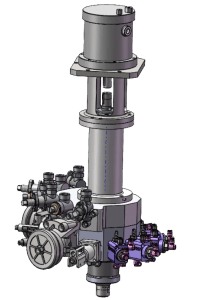
Polyurethane spraying mixing heads fall into two categories: impingement mix (high-pressure) and mechanical mix (low-pressure). For precision robot spraying, mechanical mix heads with dynamic stirring elements are more common because they handle a wider viscosity range and produce more uniform droplet size.
An E‑type multi‑stage spiral mixing head, for example, uses staggered helical elements to repeatedly split and recombine the material stream. This creates microlayer blending with mixing uniformity above 99.5% (ASTM D3795). The head is housed in a temperature-controlled jacket (±0.5 °C) because reaction rate, and thus viscosity rise during spraying, is strongly temperature-dependent. A few degrees fluctuation changes how the material atomizes.
After each shot, an automatic cleaning sequence—air flush, solvent wash, rotating air purge—runs through the mixing chamber. A well-engineered head can complete a full color or material change in under three minutes, which matters when you are spraying multiple polyurethane formulations on the same line.
3. Robot Motion and Path Programming
The robot carries the spray gun (or sometimes the part is held by the robot with a fixed gun). Programming follows the part’s CAD model, offset by the desired standoff distance—typically 150–300 mm for foam spraying, tighter for elastomer coatings. The robot maintains constant surface speed, not just constant joint speed, by adjusting TCP velocity based on surface curvature. This is critical: if the gun slows over a concave area, local thickness builds up, creating a drip or sag on vertical surfaces.
Spray path planning software also controls fan overlap. A typical spray fan width might be 50–80 mm. To achieve uniform coverage, the programmer sets a 50% overlap between passes. The robot must execute this overlap path-to-path within a millimeter, otherwise banding patterns appear. High-repeatability robots (ISO 9283 repeatability of ±0.05 mm) handle this well; lower-precision positioning can still produce visible stripes at 0.3 mm drift.
Real-World Outcomes: Where the Precision Pays Off
Automotive Interior Parts
Instrument panel skins, door panel cushion layers, and steering wheel rim coatings are sprayed with polyurethane foam or soft-feel elastomer. Defects like orange peel, pinholing, or thickness variation more than 0.1 mm are visible and tactile. A robot spray system with material-to-motion synchronization can hold layer thickness to within ±0.1 mm across a contoured instrument panel, reducing rework rates from 8–12% down to under 2%. For a line producing 500 panels a day, that saves thousands in material and labor per month.

Industrial Wear Linings
Pipe elbows, pump housings, and chute liners are sprayed with abrasion-resistant polyurethane elastomers. Uneven thickness here does not just waste material; it creates early failure points. A robot can spray an elbow interior with a uniform 3 mm coating, something nearly impossible for a manual operator to achieve in a confined space. One chemical plant that switched to robotic spraying of pipe linings reported a 40% extension in wear liner service life, simply because thickness variation dropped from ±1.5 mm to ±0.2 mm.

Medical-Grade Coatings
Polyurethane spray coatings for patient-contact devices must meet strict biocompatibility and thickness tolerance requirements. Robot repeatability, combined with accurate temperature-controlled mixing heads, prevents the uneven curing that can create extractable residues. In medical manufacturing, process validation demands documented, repeatable spray parameters—position, flow rate, temperature, pressure—for every shot. Robotic systems with PLC data-logging deliver this audit trail automatically.

What to Look for When Evaluating a Robot-Assisted Spray System
Not all integrated systems are equal. Over the years, I have seen three areas that separate reliable production systems from maintenance headaches.
Metering-to-robot synchronization. Ask whether the system uses true closed-loop flow control that responds to robot TCP speed in real time, or simply sets a constant pump speed. Constant speed means the operator must manually program robot speed to match, and any slight mismatch produces variation. Demand servo-driven, closed-loop metering with a dedicated communication channel between the robot controller and the pump drives.
Mixing head cleaning cycle design. Many early failures trace back to incomplete purging. A good system sequences air, solvent, and air again, with a final dry-air blow to remove residual solvent. If the head design allows solvent to accumulate and later drip into a fresh shot, you will see sporadic surface defects that are impossible to trace. Check the head’s drain path and look for designs that minimize dead volume.
Material compatibility and viscosity range. Polyurethane spray materials range from low-viscosity water-blown foams (500 mPa·s) to high-viscosity elastomers (15,000 mPa·s or more). Some mixing heads and pump designs struggle above 10,000 mPa·s, especially if the material contains fillers like ceramic beads for wear resistance. Confirm that the metering unit and mixing head are specified for your maximum viscosity, including any seasonal variation. Cold weather in an unheated plant can double material viscosity overnight.
Programming interface. If your team does not have robot programmers, look for systems that offer CAD-to-path import, offline programming, and simple parameter adjustments on the HMI. The operator should be able to adjust coating thickness by changing a single number, not by reprogramming robot speed and pump setpoints separately.
Built-in quality checks. Some advanced systems monitor spray pressure and flow rate in real time and flag deviations that signal a clogged nozzle or a material cure issue before bad parts are produced. This data can be fed into your MES or ERP system, giving you process visibility from the plant floor to the quality manager’s dashboard.
The Integration Reality: Robot + Spray Machine Is a System, Not Two Components
A common mistake in equipment purchasing is to buy a robot from one vendor and a spray machine from another, then expect the local integrator to make them work. The integration effort often exceeds the cost of the components if the protocols do not match or the spray gun mount requires custom engineering. Worse, when something goes wrong—a thickness deviation, a mixing ratio alarm—each vendor blames the other’s equipment.
A single supplier who takes responsibility for the entire robotic spray cell, including process commissioning, avoids this finger-pointing. The supplier should also provide process run-off at their facility: running your actual parts and materials to demonstrate thickness uniformity and cycle time before the system ships. Without this, you are debugging a production cell on your own floor, costing weeks of downtime.
Is Robot-Assisted Spraying Right for Your Operation?
Not every polyurethane spray application justifies a robot. If you are spraying large flat panels with a tolerance of ±2 mm on insulation thickness, a manual system or a reciprocator-based spray line is more cost-effective. But if your parts have complex geometry, if your scrap rate from hand spraying exceeds 5%, or if your customer demands documented process repeatability, a robot-assisted system becomes a hard requirement not a luxury.
Start with a pilot on your most challenging part. Measure the before and after: coating thickness variation, material waste, and rework hours. In most cases we have worked on, payback comes from three sources:
- Material savings: 10–30% reduction in overspray and rejected parts.
- Labor efficiency: One operator supervising a robotic cell can manage what three manual sprayers previously did, and with less fatigue-related quality drift.
- Rework reduction: Automotive and medical customers report up to 80% drop in rework after switching to robotic spray.
Frequently Asked Questions
Can a robot spray both polyurethane foam and elastomer coatings?
Yes, if the system is designed for it. The key is a mixing head and metering pump that handle a wide viscosity range, plus the ability to swap nozzles and adjust process parameters quickly. Look for models with modular quick-change heads and stored recipe management for different materials.
How long does it take to program a new part?
Offline programming from a CAD model typically takes a few hours for an experienced technician, including path optimization and simulation. On-site teaching of a simple part might take a day. Complex, multi-surface parts can require two to three days of fine-tuning to achieve thickness tolerances under ±0.2 mm.
What maintenance does a robotic spray system need?
Daily: inspect and clean the spray nozzle, check mixing head seals, verify pump calibration. Weekly: inspect robot cable tracks for wear, check material hoses for hardening. Monthly: full calibration check of metering pumps against a mass flow meter, robot axis zero check, mixing head teardown and inspection depending on material abrasiveness.
Is robotic spraying worth it for batch sizes under 100 parts per day?
Usually not, unless the part value is extremely high (medical, aerospace) or the rework cost is disproportionate. Below 100 parts per day, manual spraying with good process discipline and inspection can be economical. The economic crossover point is typically around 200–300 parts per day where labor, material, and rework savings justify the capital investment.
What happens if the robot goes down? Can we spray manually?
A well-designed cell includes a bypass mode that allows manual spraying using the same metering unit while the robot is under repair. This requires pre-planned quick-disconnect fittings and a manual gun station. Not all integrators provide this by default, so specify it in the requirements.
Moving Forward: Defining Your Own Process Requirements
Before talking to equipment suppliers, document your actual needs:
- Part geometry and size range (drawings, CAD files if available).
- Target coating thickness and tolerance.
- Required cycle time per part.
- Material system (chemical type, viscosity, pot life, any fillers).
- Production volume per shift and per year.
- Cleanliness requirements (medical, food-grade, or industrial).
- Available utilities: compressed air pressure and quality, electrical supply, ventilation.
Providing this information up front lets a competent supplier propose a system matched to your process, not just their standard package. It also lets them identify potential issues—like a material with short pot life that demands a fast-purge mixing head—before they become your production problem.
For manufacturers who depend on coating consistency, investing in the right robot-assisted system is not about the robot itself; it is about removing the one variable that no amount of operator training can eliminate: human fatigue. When every part leaves the cell with the same spray pattern, the same coating thickness, and the same cure profile, you stop chasing quality problems and start scaling production.
If you are evaluating whether robotic spraying fits your specific polyurethane application and need clarity on metering accuracy, mixing head selection, or integration risk, reach out to an engineer who has commissioned these cells on real production floors—not just on paper. Getting the details right before you buy is far cheaper than fixing a mismatched system six months after installation.