Choosing a production line for roof and wall sandwich panels is not a one-size-fits-all decision. A line that runs PUR panels perfectly at 6 m/min can produce unusable rock wool panels with delamination problems if the core temperature control isn’t designed for mineral wool heat absorption. I’ve seen factory owners buy lines based on brochure speed and panel width, only to discover that the 6-meter-long panel wasn’t flat enough for a clean installation. These problems start long before the first panel is produced — they start with how you match the machine configuration to what your building applications really require.
That’s the purpose of this guide: to walk through the functional blocks of a sandwich panel line, explain which specs matter for which industrial building applications, and highlight the errors that cost you yield, not just money.
What’s Inside an Industrial Building Panel
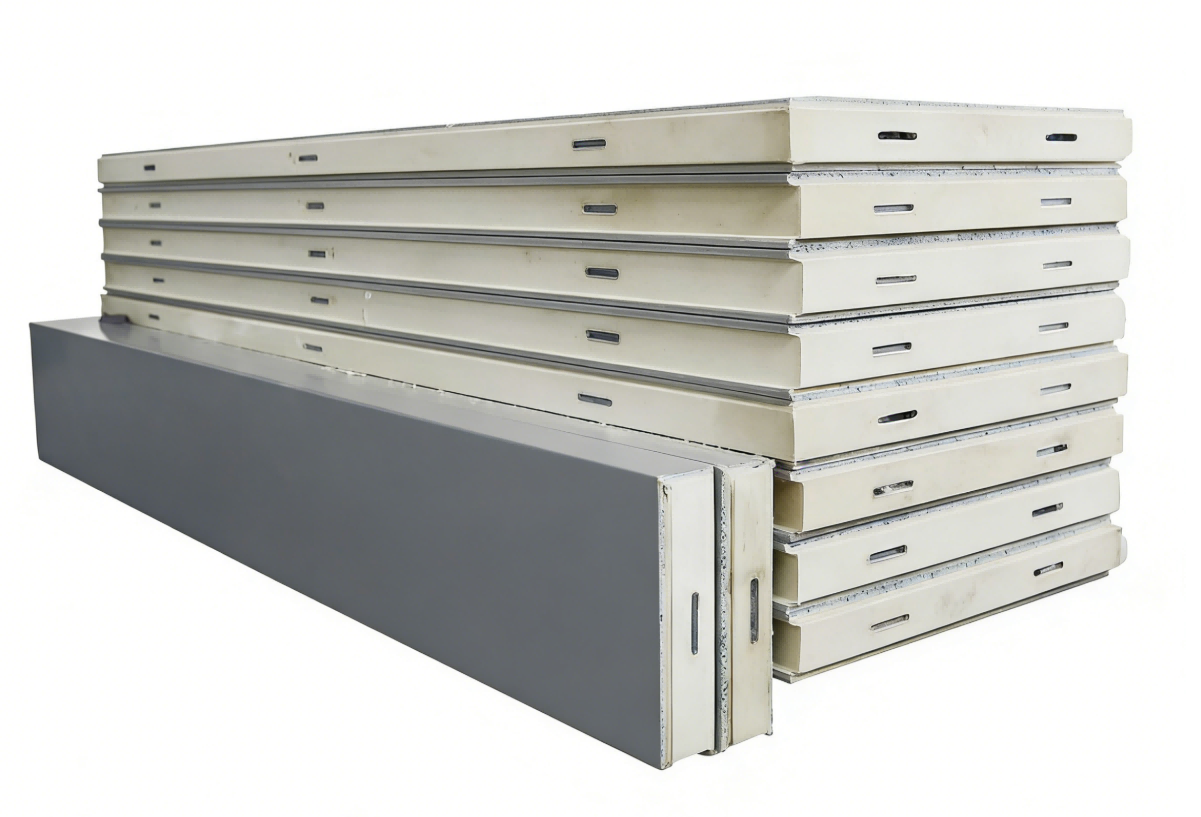
Industrial buildings — warehouses, factories, cold storage, cleanrooms — use metal-faced sandwich panels with a rigid foam core. The panel works as a structural and thermal barrier at the same time. That means your production line has to deliver three things simultaneously: flatness (no bow after cutting), core adhesion (so the steel faces don’t separate under wind load), and consistent insulation performance across the whole batch.
The most common core materials for industrial roofs and walls:
- PUR (polyurethane) foam: best strength-to-weight, excellent insulation, suitable for cold rooms and controlled environments.
- PIR (polyisocyanurate) foam: improved fire resistance, mandatory for many public and high-rise industrial facilities.
- Rock wool (mineral wool): non-combustible, used in fire-rated partition walls and roof systems with strict building codes.
- Glass wool: lighter and less expensive than rock wool, but requires edge-sealing to prevent moisture ingress.
Your first decision is which core materials your market needs. If you’re supplying panels for both cold storage and general industrial halls, you’ll need a line that can switch between PUR/PIR and mineral wool without a complete retooling. If fire-rated panels are growing in your region, a PIR-capable line with accurate temperature control may be a better investment than a PUR-only line with higher speed.
Core Machine Sections and What Goes Wrong
A continuous sandwich panel production line has five interdependent sections. A weak point in any one limits the entire output.
1. Decoiling and metal forming
The steel coil feeds into a roll former that creates the trapezoidal or corrugated profile. Not all profiles perform equally: a roof panel with deeper ribs carries more snow load, but requires a stronger roll tooling set and higher forming pressure.
What goes wrong
– Uneven roll gaps create residual stress that shows up as lengthwise bow after foam injection.
– Tooling for thin gauge steel (0.4 mm) isn’t automatically suitable for thicker 0.6 mm sheet — you need adjustable roll stations or quick-change cassette systems.
2. Pre-heating and surface treatment
The metal skins are heated before the polyurethane liquid is poured, typically to 35–55 °C. The purpose is to improve foam adhesion and accelerate the polymerization at the interface.
What goes wrong
If the pre-heating isn’t uniform across the panel width, the foam rises unevenly. You’ll get density variation from edge to middle, which can cause visible rippling on the face.
3. Foaming machine and mixing head
This is where the chemical reaction is triggered. A high-pressure foaming machine meters polyol, isocyanate, and blowing agent at a controlled ratio and delivers them to a mixing head. For PIR, the ratio is more sensitive and requires closed-loop servo control; a drift of 1 percentage point in the component ratio can shift foam density by more than 3 kg/m³ and ruin the fire certification. Metering accuracy ±0.5% is a benchmark for continuous lines producing PIR panels.

What goes wrong
– Inadequate mixing causes large, irregular cells and weak core shear strength.
– Temperature fluctuations during long runs — especially in hot climates — cause viscosity changes that throw off the ratio unless the machine has active viscosity-compensated metering.
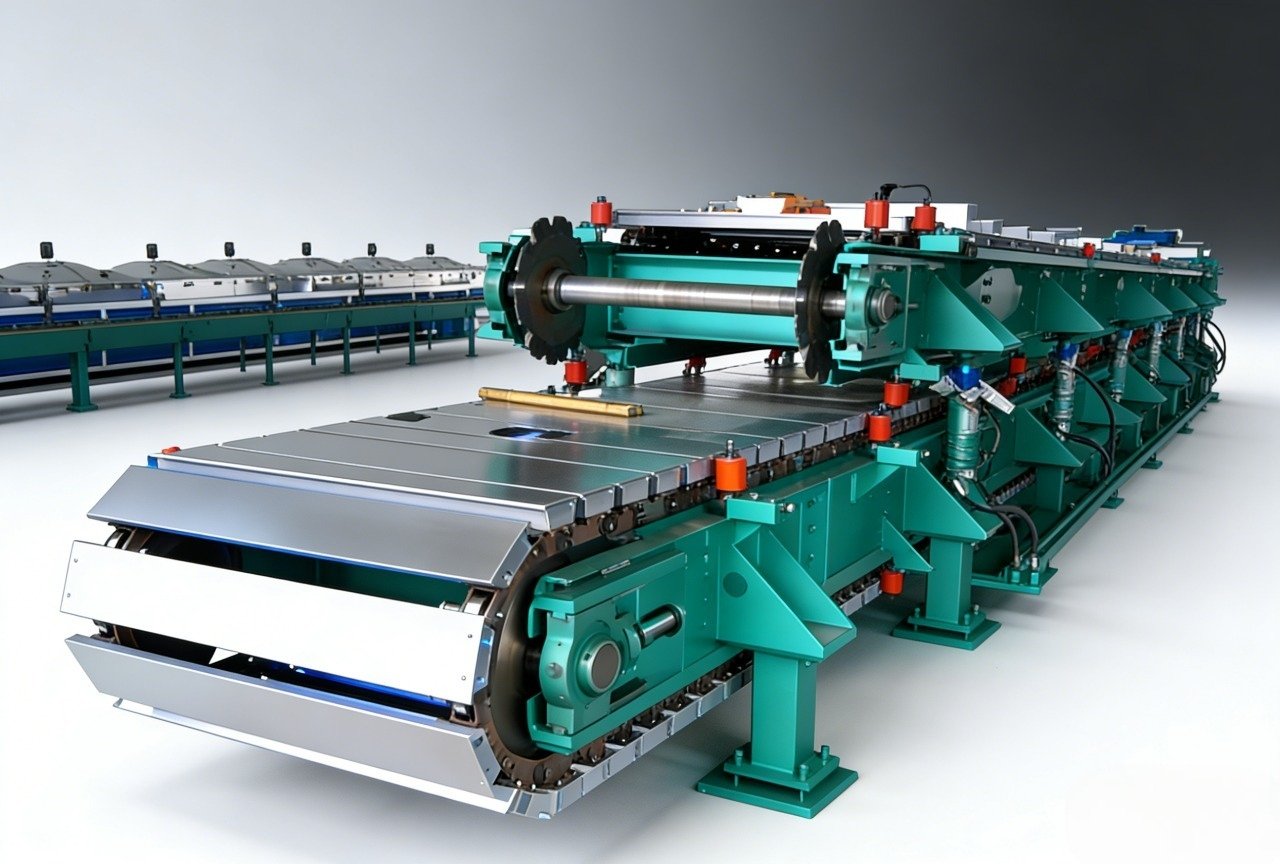
4. Double belt laminator with temperature zones
After the liquid mix is dispensed onto the lower metal face, it rises to fill the cavity while the panel travels through a heated laminator. The laminator is divided into temperature zones to control the reaction profile: the first zone triggers the raise, the middle zone controls cure hardness, the final zone stabilizes the panel.
What goes wrong
– If the line speed is set too high and the laminator is too short, the foam hasn’t fully gelled before cutting — you’ll see foam squeeze-out and poor adhesion.
– For rock wool, the laminator temperature isn’t there to cure the core but to activate the adhesive. Too low a temperature means poor bonding; too high and the rock wool fiber breaks down, creating voids.
5. Flying saw and cooling conveyor
The continuous panel is cut to length without stopping the line. After cutting, panels must cool gradually to avoid warping.
What goes wrong
A cheap saw servo with low torque causes vibration and jagged cuts on panels wider than 1000 mm. The panel edge then requires secondary trimming, wasting minutes per panel over a shift.
Five Questions That Determine Which Line You Need
- What building type are you supplying? Cold storage demands thick panels (100–200 mm) and airtight joints; logistic centers need long-span roof panels with high wind uplift resistance. Each application pushes different aspects of your line: thickness range, panel flatness tolerance, joint geometry capability.
- What line speed do you actually need?
A common mistake is to buy a line rated at 8 m/min when you can only supply material and handle finished panels at 4 m/min. High-speed lines have longer laminators and faster curing formulas — they also run hotter and require more precise temperature control. If you’re not running 24/7 or your downstream cutting and stacking can’t keep up, a 4–5 m/min line often delivers more stable quality. - Will you produce fire‑rated panels now or later?
A PUR‑only line can be upgraded to PIR later, but the foaming machine needs higher‑pressure mixing, and the laminator heating zones need to handle different time‑temperature curves. Planning for PIR from the start saves around 40% of the upgrade cost compared with a retrofit. - How critical is panel flatness for your customers?
Industrial building installers expect less than 2 mm bow per meter of panel length. That means your forming, lamination, and cooling sections must work together. Suppliers demonstrate this by showing panel flatness measurements from a real production run, not a lab sample. - What skill level will operate the line?
Highly automated lines with recipe‑based control reduce operator influence, but they cost more. For a startup factory, a line with automatic ratio control, one‑touch recipe switching, and integrated troubleshooting alarms can run with two operators instead of four.
How Edge Sealing and Grooving Affect Building Performance
Industrial wall panels often need edge grooving for hidden fastener systems or to reduce thermal bridging. If you produce fire‑rated panels for compartment walls, edge‑sealed rock wool blanks prevent moisture wicking and maintain the fire integrity of the joint.

The edge profiling station is usually downstream of the laminator. The tooling must be matched to the core density: rock wool edges require diamond tooling because mineral fiber is more abrasive than PU foam. Specifying the wrong tooling leads to fuzzy edges and frequent blade changes.
What Separates a Reliable Production Line from an Expensive Fixer-Upper
When you evaluate a line, go beyond the catalogue sheet. Ask about these points:
- Metering pump type and feedback
For PIR and precision PUR work, servo-driven gear pumps with real‑time mass flow monitoring beat standard gear pumps with only rpm control. You want a system that compensates for viscosity changes without operator adjustment. - Temperature control architecture
The laminator should have at least three independently controlled zones, each with PID control and thermocouple verification on the belt surface, not just the air temperature. Uneven belt heat is the number one cause of core density inconsistency. - Quick-change capabilities
If you run multiple panel widths or profiles, ask for the time to switch from one product to the next. A line with pneumatic roller adjustment and memory positions can do a width change in under 15 minutes. A manual system may take an hour and require recalibration of the foam laydown pattern. - Service and commissioning reality
A line that looks cheap on paper can cost you 10% scrap for the first three months while the supplier’s technician is absent. Insist on documented remote diagnostic capability (IoT with alarm logs and trend data) and a clear timeline for on‑site training.
Common Pitfalls When Buying
- Prioritizing speed over temperature
You buy a line capable of 8 m/min, but your blowing agent formula needs 60°C for 90 seconds to reach full rise. Your laminator is only 18 meters long, so at 8 m/min, the dwell time is just 72 seconds. The foam is undercured, and heat resistance drops. The real capacity of a line is determined by the combination of speed × laminator length × temperature. - Ignoring steel thickness range
A line designed for 0.4–0.6 mm steel won’t handle 0.7 mm for long-span roof panels without roll former tooling damage. If your market is moving toward heavier gauge for taller buildings, check the roll former material: GCr15 bearing steel for the rollers and heat‑treated shafts indicate it’s built for the load. - Underestimating core material handling
Rock wool and glass wool come in compressed panels that must be opened and fed continuously. A low-end feeding system can create gaps between wool lamellas, leaving thermal bridges every couple of meters. This is invisible until the building owner sees condensation stripes on the ceiling.
How Haifeng Automation Approaches This Problem
As a company that drafted China’s PU pouring machine industry standard, we’ve been designing metering and mixing systems for forty years, long before sandwich panel lines became a commodity. Our line design starts with the core density and fire performance outcome, then works backward to the machine configuration — not the other way around.
When we engineer a panel line for a client:
- We specify an LP or HP foaming machine with servo‑closed‑loop metering and a ±0.5% ratio tolerance, based on the core chemistry.
- The laminator heating zones are modeled using the actual reaction profile of the customer’s formula, not a generic polyurethane curve.
- For rock wool operations, we include an edge‑sealing unit that simultaneously applies adhesive and laminates the wool, so no moisture‑wicking path remains.
- Every machine we deliver has IoT‑based performance monitoring that captures temperature curves, line speed, and layer density through the shift — the same data we use for our own R&D.
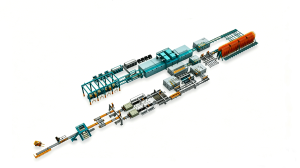
Whether you’re planning a new factory for cold room panels or upgrading an existing line to handle PIR fire‑rated walls, the machine selection should reflect your end‑use, not just your budget. Our team’s engineering background means we discuss production reality, not speculation.
Frequently Asked Questions
Can one line produce both wall panels and roof panels?
Yes, if the roll former has quick‑change cassettes for different profiles and the laminator belt supports the panel thickness range. The same foaming machine can serve both without modification, as long as the formula switch is automated. You will still need separate offline cutting and stacking configurations for roof panels with deep ribs.
How important is the sawing system for overall quality?
Critical. A flying saw with poor acceleration causes vibration that can crack the fresh foam bond. For panels wider than 1 meter, a servo‑driven saw with rigid gantry and vibration damping is not optional; it’s the minimum.
What’s the realistic investment range for a continuous sandwich panel line?
It depends heavily on core material capability (wool vs. PUR/PIR) and level of automation. A basic PUR‑only line with 4 m/min output may start under USD 200,000, while a fully automatic PIR + rock wool line with 5‑zone laminator and remote diagnostics can exceed USD 600,000. These are approximate figures for specification purposes; actual pricing depends on panel dimensions and required certifications.
Is it better to buy a complete line from one supplier?
Yes, when possible. Integrated control architecture means the foaming machine communicates with the laminator temperature controllers and the saw. If different suppliers provide parts, you assume the integration risk yourself. The cost of resolving interface issues during commissioning often exceeds the apparent savings.
How do I verify the fire performance of panels from a new line?
Run a full‑scale fire test (EN 13501‑1 or ASTM E84) on at least three randomly selected panels produced during a continuous 4‑hour shift. A single lab sample doesn’t tell you if the metering ratio drifted during the run. The line should record each panel’s density and metering data for traceability.
If you’re selecting a sandwich panel production line and need to understand how process parameters translate into building‑site performance, let’s talk. Contact Haifeng Automation with your target panel specifications and we’ll engineer a configuration based on your actual foam chemistry and factory layout, not just a price list.