One of the most expensive decisions in flexible polyurethane foam is made before formula, before plant layout and often before a real annual volume exists: choosing box foaming or continuous slabstock because one looks “more efficient.” Efficiency here is not an absolute. It is the product of output per grade, trim loss, cure time, transition scrap and labor movement. A continuous line run at low utilization with frequent density changes can cost more per finished kilogram than a well-matched box line.
Box Foaming: A Batch Route That Rewards Formula Flexibility
Box foaming is a discontinuous process. A metered batch of polyol, isocyanate, water, catalyst, surfactant and additives passes through a mixing head into an open-top box, mold or rectangular frame. The reacting mix rises, gels and cures as a discrete block. The block is later removed, trimmed and cut into sheets or buns.
Because each block is an independent event, the process tolerates change well. Grade changes, color changes, slow-rise systems, filled formulations and semi-rigid automotive thermoforming grades can be handled without producing long transition foam. Box foaming also suits trial production, because a failed block is limited in volume and does not force the entire line to stop.
The limits come from the block geometry. A taller block cools more slowly at the core. Side and top skins become trim waste, especially on smaller blocks. Density is affected by rise height, so vertical variation inside a single block is a real quality variable. Box foaming therefore requires disciplined demolding, cooling and stacking procedures, not simply a smaller machine.
Continuous Slabstock: Steady State as the Quality Model
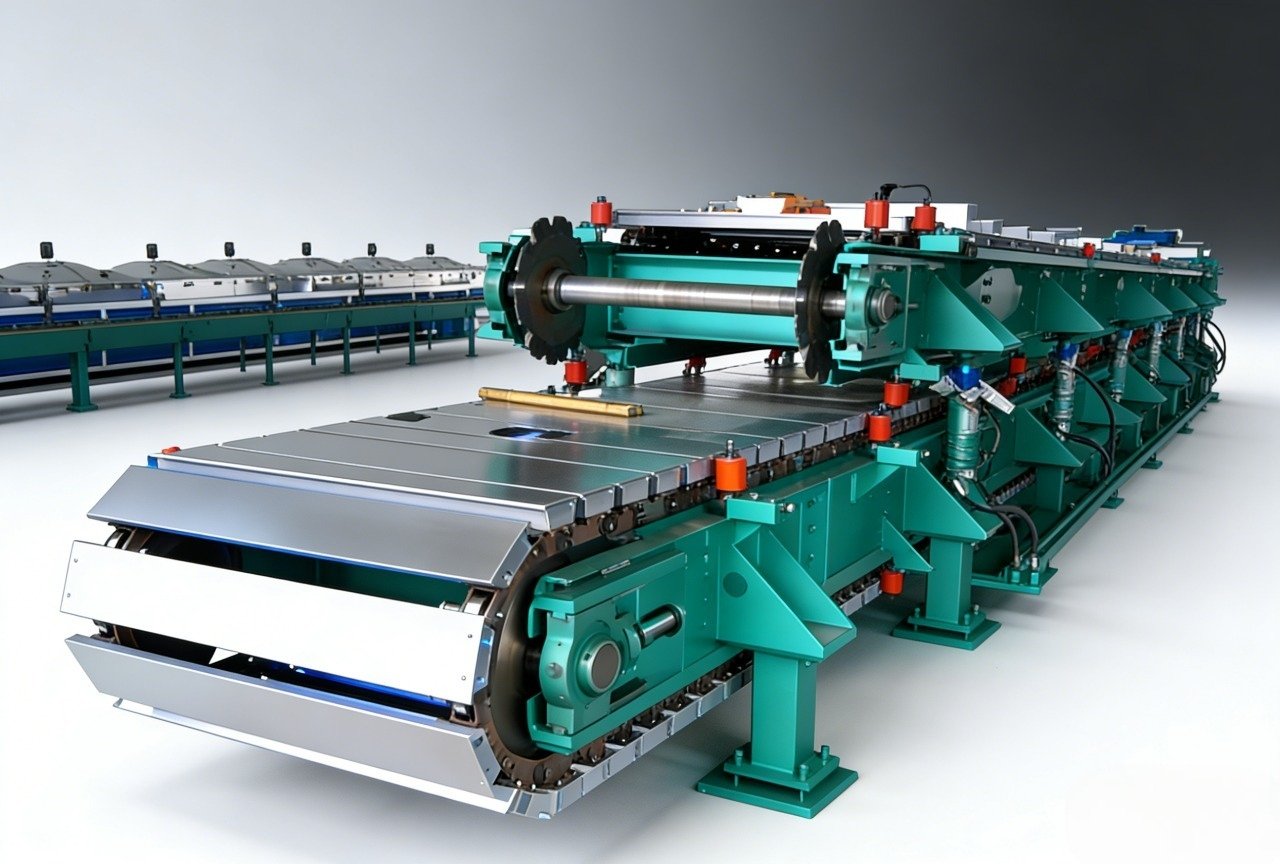
Continuous slabstock production builds a foam log on a moving conveyor. The polyurethane mixture pours onto bottom paper or film, with side papers carried in synchronized frames. The foam expands into an open-topped tunnel, and as the conveyor advances, the bun passes through flattening, trimming and cut-off stations before being sectioned into lengths [1].
The central advantage is steady state. Once flow, mixing, nucleation, conveyor speed and rise profile stabilize, the foam quality remains consistent along the log. This makes continuous slabstock attractive for long runs of conventional flexible foam, high-resilience foam and viscoelastic grades where lengthwise consistency matters.
The main engineering cost is transition. Startup foam, grade-change foam and ratio upset foam can run for several meters before the bun returns to specification. Control must be tighter than on a box line because any small deviation is multiplied across continuous length. Metering stability, mixing head trajectory, side-paper alignment and conveyor inclination all determine whether the line holds target density without banding, edge collapse or hard spots.
In both process routes, capacity planning should start from required kg/h at each density and the foam block height. <Continuous PU Foam Line Capacity Guide covers how much foam one line can produce.
Box vs. Continuous: Head-to-Head Comparison
The comparison is not simply “batch is smaller” and “continuous is bigger.” It is a process-fit decision.
| Factor | Box foaming | Continuous slabstock |
|---|---|---|
| Production mode | Discrete blocks; one batch per block | Continuous log; length set by cut-off |
| Best suited for | Short runs, frequent grade changes, filled or high-viscosity formulas | Long runs, standard flexible foam, high annual output per grade |
| Density uniformity | Batch-to-batch control is achievable, but vertical gradient within the block remains | Better lengthwise uniformity at steady state, with startup and transition zones |
| Trim and skin waste | Higher ratio of side and top skins, especially for small blocks | Lower edge waste relative to log width; top skin is still trimmed |
| Grade-change flexibility | High; limited mainly by flush and recipe handling | Lower; transition foam must be downgraded or scrapped |
| Floor space and capital | Lower for a compact box station; additional stations add footprint | Higher initial footprint for conveyor, tunnel, extraction and cut-off |
| Automation and traceability | Available, but often kept simpler | More natural fit for continuous recipe logging and production tracking |
| Startup risk | One block at a time | Transition foam can affect several meters of bun |
Density comparisons between the two routes are only meaningful when samples are conditioned and tested to the same method, such as ASTM D3574 [2]. For compression hardness and indentation-force-related values, ISO 3386-1 provides a consistent basis for comparing box blocks and continuous slabstock [3].
Decision Framework: Choosing by Process Fit, Not by Output Alone
Before asking for a quotation, the following inputs determine the better route:
- Realistic annual tonnage and peak daily volume by density
- Number of grades and density changes per week
- Maximum block or bun height that downstream cutting and storage can handle
- Whether the formulas are high-viscosity, filled or close to gel-time limit
- Required density tolerance across block height and along the log
- Available floor space, extraction capacity and skilled labor
- Working capital tied up in cooling inventory
There is no universal volume cutoff. Two plants making the same annual tonnage can legitimately choose different processes because their grade mix, block dimensions and tolerance needs differ. The financing case must include transition scrap, skin waste, core-temperature waiting time and handling labor, not just the machine price.
If you are deciding between box and continuous at the equipment-selection stage, define the output range by density and block dimension first. Haifeng Polyurethane Machinery can run both routes against your formula and show where the scrap and utility loads appear. Contact info@haifeng-automation.cn or WhatsApp at 86 13566296633 for a technical comparison.
Box and continuous slabstock are not the only route choices; many plants pair them with molding, RIM or elastomer lines. <Polyurethane Machinery 101: A Comprehensive Guide to Equipment Types and Engineering Selection covers equipment types and engineering selection.
Control Parameters That Decide Foam Quality
Many process complaints are assigned to the box foaming or continuous slabstock method when the real cause is metering, mixing or raw material conditioning.
Metering and ratio control. Closed-loop servo metering is more important than nominal pump size. A drifting polyol-to-isocyanate ratio changes water reaction extent, cell formation and final density. High-end servo-metering systems may be specified around ±0.5%, but that is a machine specification, not a guaranteed density tolerance. The foam result must still be verified by sampling.
Mixing quality. Low-pressure dynamic mixing and high-pressure impingement mixing each have advantages. For slabstock, the mixing head must keep the material homogeneous across the full pour width and through the complete shot duration. Pressure balance in high-pressure heads and shaft speed in dynamic heads directly affect streak formation and cell structure.
Pour pattern and traverse. In box foaming, the head movement determines whether the mix enters the mold evenly. In continuous slabstock, the traverse profile affects how the liquid layer spreads before rise. Uneven laydown shows up later as density bands, voids or edge defects.
Temperature and material preparation. Raw material temperature changes viscosity and reaction speed. Day-tank conditioning, recirculation and jacket control reduce the variation that looks like a process fault but is really a material-handling fault.
Rather than trust a single machine platform, ask the supplier to demonstrate ratio stability across the full intended output range. That exercise reveals more about the process than a catalog throughput number.
Mixing head cleanability, calibration and pressure balance determine whether a perfectly specified formula becomes a uniform foam block. <PU Foam Injection Machine: Key Components & Calibration Best Practices covers key components and calibration best practices.
Core Temperature, Curing and Storage Safety
The water-isocyanate reaction in flexible polyurethane foam is exothermic. In both box blocks and continuous buns, the center cools much more slowly than the surface. A block or bun section may look stable on the outside while the core remains hot. Stacking or enclosing it too early can lead to discoloration, scorch, odor or smolder [4].
Box foaming makes this risk visible because each block is handled as a unit. Continuous production creates a different risk: a long bun can hide a hot core if the cut plan and storage lane do not allow enough cooling time.
No full-height stacking should be scheduled before the core temperature is known. Cooling time is not fixed; it depends on density, block size, ambient conditions, catalyst level and water content. Operators need documented waiting times and, on larger lines, core-temperature measurement or infrared screening before blocks enter storage.
Build the Box-vs-Continuous Decision from Your Production Data
A reliable comparison needs the complete input set: target density range, maximum block or bun dimensions, annual tonnage by grade, formula viscosity, filler content and plant utilities. When those inputs are clear, the better process route usually becomes obvious. When the decision is still unclear, the uncertainty is almost always in process assumptions, not in the machine quotation.
Send your formula and block data to info@haifeng-automation.cn or WhatsApp: 86 13566296633. Ask for a box-vs-continuous capacity and scrap model first, not a standard machine offer.
Frequently Asked Questions
Which process gives better density uniformity?
Continuous slabstock often shows lower density variation along the log once steady state is reached. Box foaming can produce excellent batch-to-batch consistency with good metering and mixing. The more important question is where variation matters in your cutting plan. A vertical gradient in a box block may be less costly than a long transition zone in a continuous bun.
Can I start with box foaming and convert it to continuous later?
Not as a simple conversion. Material feeding, day tanks, metering skids and control systems may carry over, but the pour table, conveyor, side-paper handling and curing tunnel are process-specific. If growth is likely, design the material room and utilities for future continuous capacity while buying box foaming now.
Is box foaming only for low-volume production?
No. It is chosen when volume per grade is low, grade changes are frequent, formulas are difficult to process, or blocks are semi-rigid. A box plant with multiple stations can produce significant tonnage, but handling and trim costs rise differently than on a continuous line.
Which process is better for high-resilience or memory foam?
Both can produce high-resilience and viscoelastic grades. Continuous lines are common for HR and memory foam slabstock at volume. Box foaming is practical when slow-rise formulas, cell-opening requirements or specialty additives make long continuous runs difficult to hold.
How do I compare capital cost between box and continuous?
Initial equipment cost alone is misleading. Include trim waste, transition scrap, floor space, utilities, material-preparation systems and the working capital tied up in cooling inventory. A lower-cost box machine can become more expensive per finished kilogram if block yield and handling labor are high.
References
[1] Polyurethane Foam Association. “Continuous Flexible Slabstock Foam Production.” PFA Technical Bulletin.
[2] ASTM D3574-17. Standard Test Methods for Flexible Cellular Materials—Slab, Bonded, and Molded Urethane Foams. ASTM International.
[3] ISO 3386-1:2018. Polymeric materials, cellular flexible — Determination of stress-strain characteristics in compression. ISO.
[4] Polyurethane Foam Association. “Flexible Polyurethane Foam: Safe Handling, Storage and Fire Prevention.” PFA Guidance Document.
If you’re interested, check out these related articles:
PU Low Pressure Foaming Machine: Maintenance Checklist & Troubleshooting Guide
PU Shoe Production Line vs Traditional Shoe Production
What Is Explosion Proof Tire Filling Equipment
Continuous PU Foam Production Line Maintenance: How to Prevent Costly Downtime and Defects