Choosing between continuous and discontinuous polyurethane sandwich panel production usually starts with the wrong number. Buyers compare rated line speed first. The more consequential variables are width changeover time, foam density repeatability across a shift, and how the line handles short campaigns with frequent recipe changes. A continuous double-belt laminator is not simply a faster version of a discontinuous press; the two formats have different control problems, defect modes, and staffing models.
PU/PIR sandwich panels are covered by standards such as EN 14509 [1], with fire classification under EN 13501-1 [2] and steady-state thermal resistance measurement following ISO 8302 [3]. These standards describe the finished panel, not the production route. But the production route determines whether you can hold the declared lambda, dimensional tolerance, and fire performance consistently over thousands of square meters.
What Changes Between Continuous and Discontinuous Lines
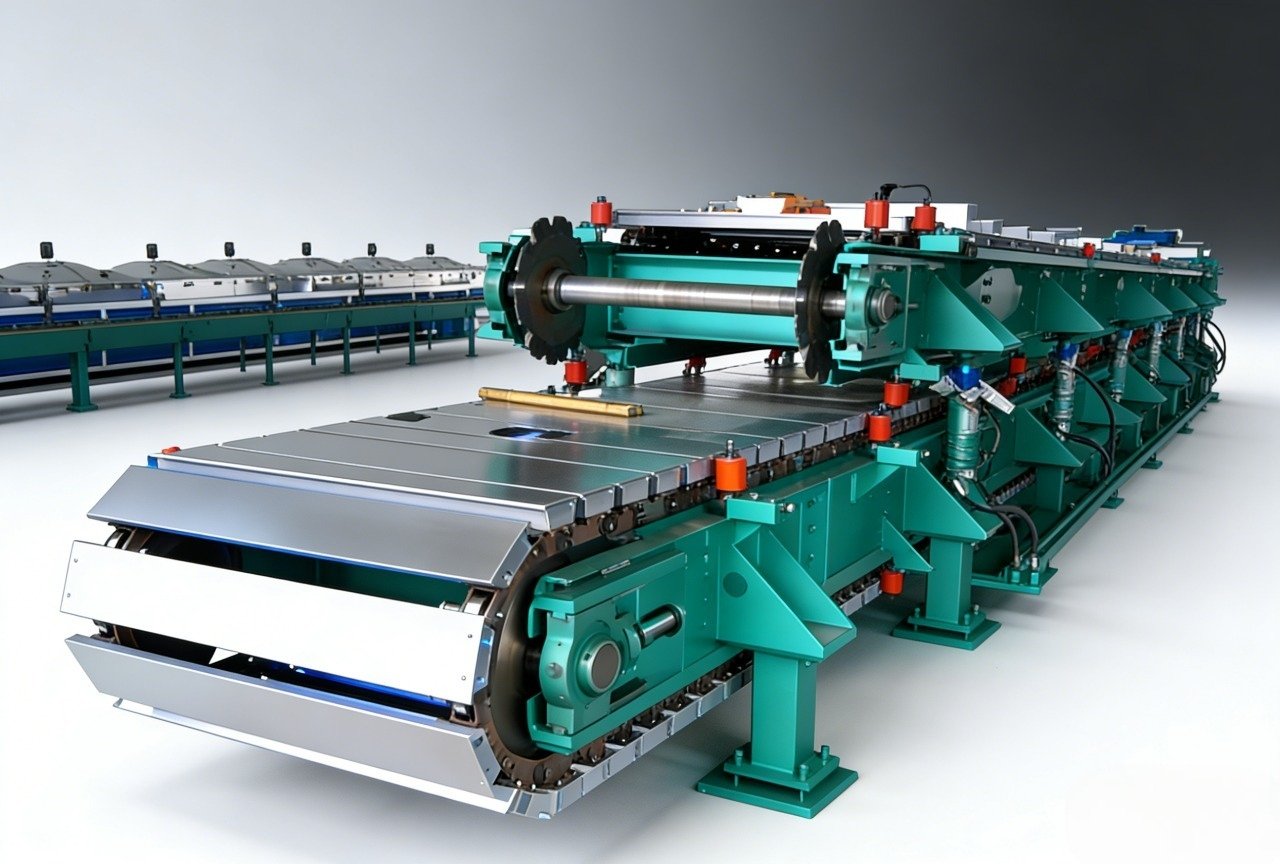
Continuous production flows facings, foam laydown, lamination, curing, and cutting in one direction without stopping the foam path. Discontinuous production fills a fixed mold, closes the press, cures the panel as a discrete shot, and demolds before the next cycle.
| Factor | Continuous double-belt line | Discontinuous press line |
|---|---|---|
| Dominant flow model | Steady-state line speed and residence time | Intermittent cycle time and mold inventory |
| Foam deposition | Moving laydown onto lower facing | Static or limited traverse pour into open or closed mold |
| Pressure control | Belt constraints, partial side sealing | Press pressure and mold closure |
| Width changes | Tooling-intensive, usually wider fixed width | Mold set change, modular width |
| Economic fit | Long campaigns, high annual output | Short runs, custom sizes, frequent formula changes |
The table is not a ranking. It shows what changes in daily operation. A continuous line is chosen when the plant’s job is to make many panels of the same construction. A discontinuous line is chosen when the plant’s real product mix changes every day or every shift.
Process Control: Where the Differences Show Up
Continuous panel lines expose metering and mixing errors for much longer periods. Because foam is laid continuously, any drift in polyol/isocyanate ratio becomes a moving band of defective panel that may not be seen until after curing and cutting. Ratio deviation in sandwich panel foam does not simply change hardness or density; it can shift thermal conductivity, adhesion to metal facings, and cell structure in ways that are expensive to rework because the panel is already laminated.
High-pressure impingement mixing is common on continuous lines because it cleans quickly, handles short reaction profiles, and supports a compact laydown traverse. The tradeoff is that pressure balance, nozzle alignment, and recirculation temperature become critical operating parameters. If pressure is not balanced, mixing quality falls before any alarm appears.
Metering and mixing stability govern continuous foam quality far more than nominal line speed. <High Pressure PU Foam Machine: Technical Specifications & Industry Applications> covers the pressure-balance and metering parameters that separate a tolerance-holding line from one that drifts across a shift.
Discontinuous presses still require accurate metering, but the defect is contained to a shot or a mold. That containment makes diagnosis easier and scrap smaller, at least by volume. However, discontinuous processing repeats the same start-stop material conditioning problem many times a day. Feeding lines, mixing head startup, and purge sequences become a larger share of total cycle time than many buyers expect.
Temperature control matters in both formats, but differently. In continuous lamination, facing temperature and belt temperature influence foam rise, adhesion, and skin formation. In discontinuous molding, mold temperature and demold time dominate. A continuous line may tolerate a narrow raw-material temperature window and fail when day tanks fluctuate. A press may tolerate a wider material temperature range but produce panels with end-to-end density drift if molds cool unevenly.
Capacity, Changeover, and Economic Fit
Throughput is not a single value. For continuous lines, capacity is a product of line speed, usable width, and calendar time. For discontinuous lines, capacity is a product of panels per cycle, cycle time, and number of molds in rotation. Both can be sized to impressive annual numbers, but they fail in different ways.
A continuous line loses money far faster when order backlog is short. Line speed is fixed within a practical window; slowing a double-belt line below a stable processing range can disturb foam rise and belt temperature. The plant may continue producing panels it does not need, or pay for extensive purging and restart between thin orders. A discontinuous line absorbs this problem by simply running fewer cycles, but its labor cost per square meter rises when volume drops.
The reverse is also true. A discontinuous press sized for annual high output accumulates more molds, more mold handling, more cure storage, and more operator touches. At some volume, the continuous line’s fixed process becomes less risky than coordinating hundreds of daily press cycles.
Capacity calculations for continuous and discontinuous panel production should not use the same spreadsheet. <Continuous PU Foam Line Capacity Guide: How Much Foam Can One Line Produce?> covers how output, line speed, and foam demand interact on a continuous line, including parameters that are easy to overstate before commissioning.
For many panel manufacturers, the deciding factor is changeover capability. If the plant serves cold-room panels, roof panels, wall panels, and fire-rated panels in varying widths and densities, a discontinuous line may avoid the tooling cost and downtime of changing a continuous laminator’s width or core thickness. If the plant runs one or two stable constructions for weeks, the continuous line’s material and labor efficiency usually wins.
Defect Patterns and Quality Discipline
The defect map tells buyers what they will actually manage on the floor.
Continuous lines characteristically produce long-axis defects: density bands, foam streaks, facing adhesion variation, side-seal leakage, and thickness variation along the line direction. Because the panel is cut later, a single root cause can repeat for hundreds of linear meters before the line stops. End-to-end thermal conductivity testing on cut panels is therefore less about product design and more about detecting process drift.
Fire performance complicates continuous operation. PIR cores have a shorter reaction window and a more brittle cured structure; a line that was tuned for soft PU may suffer adhesion problems or shear defects when switched to PIR. Under EN 13501-1 [2], the completed panel system, not merely the foam, must be classified. Some markets also require FM 4880 [4] or ASTM E84 [5] performance, which can restrict formulation changes and increase the documentation burden for every process deviation.
Discontinuous presses show different defects: short fill at mold corners, voids from trapped air, density differences between panel edges and center, and surface marks from mold release or premature demolding. These defects repeat in mold patterns, which makes them easier to trace but more labor-intensive to correct when the mold inventory is large.
Selection Framework for Sandwich Panel Producers
The following sequence separates line type from vendor preference.
- Define the product envelope. Panel width, thickness range, face material, core material, density, and fire class. If the product portfolio contains many envelope variations, count them explicitly.
- Decide the annual volume in stable campaigns. The key phrase is “stable campaigns.” If order mix changes weekly, annual volume alone overestimates continuous-line suitability.
- Map changeover requirements. Width changes, core formulation changes, and facing changes have very different costs on each format.
- Define quality evidence. Decide whether you will sample thermal resistance per EN 14509 [1] and ISO 8302 [3], and how often you will run fire-class compliance checks.
- Compare three scenarios, not one. Evaluate the best-fit line, a larger line, and a smaller line against the same product mix. The larger line may fail on changeover; the smaller line may fail on delivery.
- Check utility and building fit. Continuous lines need long, flat floor space and stable utilities. Discontinuous lines need curing storage, mold handling, and more distributed ventilation.
This framework is deliberately unglamorous. Equipment buyers rarely fail because they chose the wrong nominal throughput. They fail because they bought a line for an idealized production plan instead of the order pattern that actually reaches the plant.
The format decision is only part of a larger machine-specification problem. <Polyurethane Foam Machine Selection: A 2026 Buyer’s Guide> covers how to link production requirements to metering, mixing, and line-engineering choices before a quotation is fixed.
Build the Line Around the Process, Not the Label
Continuous and discontinuous are labels. The useful specification includes foam system, fire class, facing behavior, dimensional tolerance, changeover frequency, and documented thermal performance. If those parameters are defined first, the choice between line formats often narrows quickly. If the parameters remain unclear, the faster machine will simply produce off-spec panels faster.
For a technical review against your panel dimensions, core density, and annual output targets, contact Haifeng Polyurethane Machinery at info@haifeng-automation.cn or WhatsApp 86 13566296633. Include panel width, thickness range, facing material, rising/curing time behavior, and required fire classification so the discussion begins from process reality rather than a generic line quote.
FAQ
Which is better for large-volume sandwich panel production?
A continuous double-belt line is usually better when the plant runs long, stable campaigns of similar panels. It reduces per-panel handling cost and keeps foam density more uniform across long production runs.
Can a discontinuous press make fire-rated PIR panels?
Yes. Discontinuous presses are often used for fire-rated panels because they allow more control over short reaction formulations and are easier to adjust when changing between PU and PIR cores. The fire classification depends on the complete panel system, not only the production route [2][4].
What factors make continuous panel lines expensive?
High capital cost, long floor space, utility stability, and tooling-heavy width or core changes are the main cost drivers. The economic benefit appears only when campaign length and annual volume are high enough to amortize these fixed costs.
What defects are more common in continuous panel production?
Density bands, long-axis thickness drift, facing adhesion variation, side-seal leakage, and repeated streaks are common. Because cutting happens after lamination, an undetected defect can affect many linear meters before the process is stopped.
How do I decide without overbuying capacity?
Start from the product envelope and the real order pattern, not from a single annual output number. Compare at least three scenarios: best-fit, larger, and smaller. If weekly changeovers dominate, a discontinuous press may be the lower-risk choice even when the annual volume looks high.
References
[1] EN 14509:2013, Self-supporting double skin metal faced insulating panels — Factory made products — Specifications, European Committee for Standardization.
[2] EN 13501-1, Fire classification of construction products and building elements — Part 1: Classification using data from reaction to fire tests, European Committee for Standardization.
[3] ISO 8302:1991, Thermal insulation — Determination of steady-state thermal resistance and related properties — Guarded hot plate apparatus, International Organization for Standardization.
[4] FM Approval Standard 4880, Approval Standard for Class 1 Insulated Wall or Wall and Roof/Ceiling Panels, Interior Finish Materials or Coatings, FM Approvals.
[5] ASTM E84, Standard Test Method for Surface Burning Characteristics of Building Materials, ASTM International.
If you’re interested, check out these related articles:
Glass Wool Sandwich Panel Production Line: Applications, Advantages and Production Challenges
Best PU Machinery for Safety Shoe Manufacturing