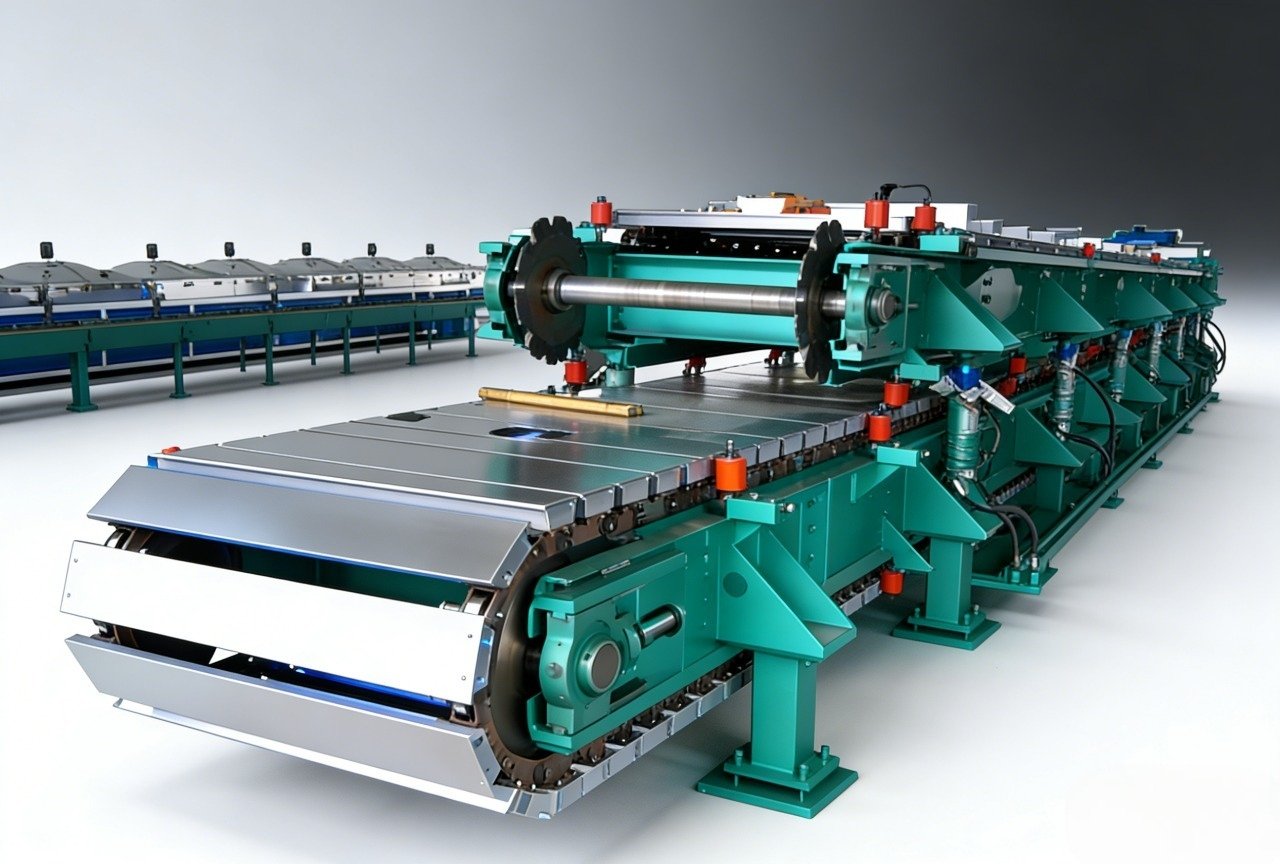
The choice among gear, piston, and screw pumps for low-pressure polyurethane metering is not a catalog decision; it is a process decision. A low-pressure PU line that drifts a few parts per hundred in the A:B ratio changes foam density, surface quality, and scrap rate before an operator sees a trend on the screen. The pump is where that drift begins, so the selection must start from the material’s viscosity curve, filler type, minimum shot size, and required turn-down—not from a generic spec sheet.
What the Pump Must Do in Low-Pressure PU Metering
Low-pressure polyurethane metering feeds two or more reactive components into a dynamic mixing head at controlled flow rates and ratio. Unlike high-pressure impingement systems, low-pressure lines rely on the metering pumps themselves to hold the ratio while the mixing head disperses the components. That places four demands on the pump:
- Repeat short shots and continuous pours without drift.
- Hold flow against changing back pressure when the mix head opens and closes.
- Handle the material viscosity at the lowest expected operating temperature, not just at the nominal process temperature.
- Tolerate fillers, pigments, or additives without accelerating internal wear.
The three pump families—gear, piston, and screw—meet these demands in different ways, and the choice changes with formulation and output envelope [1], [3].
Gear Pumps: Smooth Continuous Flow for Unfilled, Low-Viscosity Systems
A gear pump meters by filling the spaces between tooth flanks and carrying material around the casing. External gear pumps are common on low-pressure PU machines because they are compact, relatively simple, and produce a continuous flow with only slight ripple. With a servo drive, the gear pump can follow a ramp or step change quickly, which helps during open-pour and mold-filling sequences.
Gear pumps are most at home with unfilled polyols, isocyanates, and low-viscosity additives. Their main limitation is internal slip: when viscosity is low, back pressure rises, or clearances wear, a portion of the displaced volume recirculates from the high-pressure side to the low-pressure side. That slip is not a fixed percentage; it changes with pressure, viscosity, temperature, and wear. The result is a flow that looks stable at the drive but is lower than the displacement says it should be [3], [4].
Hard abrasive fillers create a second problem. Because gear teeth are close-clearance components, hard particles accelerate flank and bush wear. Once clearance opens, slip increases and ratio drift becomes harder to correct.

In a low-pressure machine, the pump never works alone. <PU Casting Machine Mechanics: Mastering Metering Pumps & Hydraulic Pressure [Part 4: Mechanics & Fluid Dynamics] covers inlet-pressure limits, discharge pressure, and how pump selection fits the wider hydraulic circuit.
Piston Pumps: High Accuracy for Low Flow and High Viscosity
Piston and plunger pumps meter by displacing a defined volume from a sealed chamber. Stroke volume is deterministic, so low-flow shots can be more accurate than a gear pump operating near its minimum speed. The cycle count multiplied by chamber volume gives a predictable shot mass, and the pumped volume is less sensitive to viscosity changes because there is less internal slip.
That accuracy comes with pulsation. A single-piston pump discharges on one stroke and refills on the other, which produces a flow peak at each stroke. At low shot sizes, this pulsation can create uneven mixing or mold filling. Multi-piston or duplex arrangements reduce ripple, but they add valves, seals, and maintenance points. Seal and check-valve wear also increases with abrasive fillers, and material that cures in the cylinder becomes a start-up problem.
Piston metering is often the right default for low-flow, high-viscosity, or small-shot low-pressure PU applications where the material is too thick for a gear pump and a screw pump would be oversized [2], [3].
Screw Pumps: Low Shear for Filled and High-Viscosity Materials
Screw pumps—progressive-cavity or multi-screw designs—move material in a continuous axial chamber without the tooth contact of a gear pump. This gives low pulsation, relatively low shear, and better tolerance for filled or shear-sensitive polyols. The continuous cavity also reduces the risk of hard particles being trapped in a gear mesh.
The main trade-offs are cost, footprint, and maintenance. A progressive-cavity stator is a wearing part, and dry running can destroy it quickly. Screw pumps can also be more sensitive to wide temperature swings because material viscosity changes the volumetric efficiency and torque. Cleaning is more involved than a simple gear pump, especially when a formula change touches the stator and rotor.
For continuous low-pressure PU lines processing filled polyol, high-viscosity additives, or shear-sensitive formulations, a screw pump often produces a more stable pour than a gear pump, even before any ratio-control software is considered [3], [4].
Comparison Table
| Selection criterion | Gear pump | Piston pump | Screw pump |
|---|---|---|---|
| Flow character | Continuous, slight ripple | Pulsed, shot-based | Continuous, low pulsation |
| Low-flow accuracy | Limited by internal slip | Strong | Good, but may be oversized |
| High-viscosity handling | Weak to moderate | Strong | Strong |
| Filled or abrasive materials | Poor unless hardened and often still limited | Moderate with hardened parts | Good for many filled streams |
| Shear exposure | Higher | Varies with valve and speed | Lower |
| Maintenance burden | Low to moderate | Moderate, seals/check valves | Moderate, stator/rotor or pumping elements |
| Relative cost | Lower | Moderate | Higher |
The table narrows the shortlist, but it does not replace the machine-level review. <Polyurethane Foam Machine Selection: A 2026 Buyer’s Guide covers the broader checks you should run before finalizing a low-pressure metering build or retrofit.
If you are working with a material that falls between two rows—for example, a filled polyol at 2,000 mPa·s with a 5 g/s minimum shot—send the TDS, viscosity curve, and shot-size range to info@haifeng-automation.cn. Comparing pump types without those inputs often leads to a machine that works on paper and drifts on the floor. You can also reach Haifeng Polyurethane Machinery on WhatsApp at 86 13566296633 for a technical review of the metering circuit.

How to Choose Without Guessing
Start from the material, not the pump.
- Viscosity at the lowest operating temperature. A pump selected for viscosity at 25 °C may cavitate or slip at 15 °C during winter start-up [4].
- Filler type and loading. Abrasive fillers rule out many gear pumps and force hardened internals even on piston and screw designs.
- Minimum shot size and maximum continuous output. The ratio between these two sets the turndown required. A pump that meets maximum output may be unstable at the minimum pour.
- Start-up and shut-down sequence. Cold start, recirculation, and solvent flush all affect pump choice.
- Continuous duty vs. frequent recipe changes. A gear pump is easier to clean and switch; a screw pump often requires more flush time.
- Back pressure variation. Piston pumps tolerate higher and more variable discharge pressure; gear pump slip grows with pressure.
As a general starting point: use a gear pump for unfilled, low-viscosity continuous streams; use a piston pump when the dominant issue is low-flow accuracy or high viscosity; use a screw pump when filler, shear sensitivity, or low-pulsation pour quality is the primary requirement. This is a decision framework, not a universal rule—the final call belongs to the formulation and the process window.
If the metering station must sit inside an automated mold-carrier line, the pump decision also has to respect upstream and downstream timing. <PU Shoe Factory Blueprint: Mastering Production Lines & Robotic Automation [Part 5: Factory Layout] covers how the metering unit couples to mold chasing, buffer logic, and robot dwell time.
When the Wrong Pump Becomes a Production Problem
The most common failure is ratio drift at start-up. A gear pump that runs on a cold material may not slip the same way it does after the oil warms; the control system compensates, but the compensation is correct only for the original viscosity. If the pump choice already uses too much of the available control range, a seasonal change in viscosity pushes the line outside tolerance.
Another common problem is filler settlement in a piston pump or check valve. The first few shots after an idle period carry concentrated filler, while later shots are lean. In a screw pump, late-cycle dry running or backflow during shutdown can damage the stator and change the displacement per revolution.
These failures look like mixing defects—bubbles, pinholes, streaks, density variation—but they are pump-related. Before changing the mixer, check whether the pump is operating near its slip boundary, its minimum speed, or its wear limit.
Get Specific Technical Feedback on Your Metering Circuit
If you are comparing pump types for a specific formulation or output range, gather the material TDS, viscosity curve, filler data, minimum shot mass, and expected back pressure. Send those inputs to info@haifeng-automation.cn for a technical review, or contact Haifeng Polyurethane Machinery via WhatsApp: 86 13566296633. A pump recommendation without these inputs is only a starting point; the right answer changes with the process window.
Frequently Asked Questions
Which pump is generally best for low-pressure PU metering?
There is no single best pump. Unfilled, low-viscosity continuous streams tend to favor gear pumps. Low-flow or high-viscosity shot metering tends to favor piston pumps. Filled or shear-sensitive continuous streams often favor screw pumps.
Can a gear pump meter filled polyol?
A standard gear pump is usually a poor choice for abrasive fillers. Hardened gears and controlled clearances can extend life, but internal slip and flank wear still grow. Many filled systems are better served by a screw pump.
Why does ratio drift happen at start-up?
Start-up drift often comes from viscosity changing with temperature. As viscosity changes, gear pump slip and screw pump volumetric efficiency change, while piston pumps may be affected by incomplete fill or seal friction. The control system can correct only when the pump is operating inside a stable region.
Is a screw pump worth the extra cost?
It depends on the material. For filled, abrasive, or low-shear requirements, the extra cost usually returns value through fewer wear failures and more consistent pour quality. For a simple unfilled system, a screw pump may add cost and cleaning time without a process benefit.
How do I test metering accuracy before accepting a machine?
Run repeatability tests at the smallest, largest, and most frequent shot sizes. Capture mass or volume over multiple cycles, then compare against target and variation. The test should include cold-start conditions, recirculation, and back pressure changes to expose the failure modes described above.
References
[1] G. Oertel, Ed., Polyurethane Handbook: Chemistry, Raw Materials, Processing, Application, Properties, 2nd ed. Munich, Germany: Hanser Publishers, 1994.
[2] C. W. Macosko, RIM: Fundamentals of Reaction Injection Molding. New York, NY, USA: Hanser Publishers, 1989.
[3] ANSI/HI 3.1-3.5, Rotary Pumps for Nomenclature, Definitions, Application, and Operation, Hydraulic Institute, 2018.
[4] ISO 3219-1:2021, Rheology — Part 1: Vocabulary and symbols for rotational and oscillatory rheometry, International Organization for Standardization, 2021.
If you’re interested, check out these related articles:
What Is an OTR Tire Foam Filling Machine
How to Reduce Waste in PU Shoe Production
Polyurethane Foam Machine: Types, Working Principle and Applications
How Does a Double Density PU Shoe Machine Work
Inside a Continuous PU Foam Line: Foam Production