When scrap rates climb past 5% on a polyurethane RIM line, the first suspect is usually the mold. Based on my years troubleshooting foaming equipment across automotive and footwear lines, the root cause sits further upstream — in the metering system feeding the mixing head. A minor component ratio drift can shift finished part density by more than 3 kg/m³, turning precision automotive parts into waste. This article examines what matters in a PU foaming machine’s metering and mixing design, because the difference between a profitable line and a scrap generator often comes down to chemical delivery precision.
What Does a PU Foaming Machine’s Metering System Do for RIM?
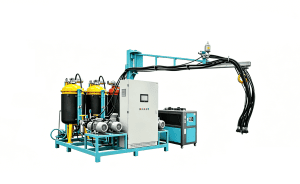
Reaction injection molding depends on two reactive streams — polyol and isocyanate — being delivered to the mixing head at an exact ratio, under controlled temperature, and within a narrow shot time window. A PU foaming machine’s metering system handles this with a combination of precision pumps (typically gear or piston), flow sensors, and a closed-loop control that adjusts stroke speed or valve position in real time. When the ratio deviates even 0.5%, the stoichiometry shifts. Excess isocyanate leaves unreacted groups that cause brittleness; excess polyol produces soft spots and uneven cell structure. In a high-pressure RIM process, where impingement mixing relies on the kinetic energy of the two streams colliding, inconsistent flow rates also degrade mixing quality, creating streaks and density gradients across the part.
Most production managers don’t see the connection between metering drift and scrap until they map density data over a shift. <Polyurethane Foam Machine Types: The Scrap Cost of Inaccurate Metering> covers how a one-percent ratio drift in a continuous line can generate waste worth more than the raw material cost itself when you account for trim, rework, and line stoppage.
How Metering Accuracy Translates to Real Part Quality
The numbers are small, but the impact is large. A metering accuracy of ±0.5% — achievable with servo-driven closed-loop systems — keeps the polyol/isocyanate ratio within the window where physical properties stay stable. At ±1.5%, common on older open-loop machines relying on pressure regulators rather than flow feedback, property dispersion widens dramatically.
| Metering Accuracy | Density Variation (kg/m³) | Typical Scrap Rate Impact |
|---|---|---|
| ±0.3% (closed-loop servo) | ≤ 2 | < 1% |
| ±0.5% (closed-loop gear pump) | 2–3 | 1–2% |
| ±1.0% (open-loop with calibration) | 4–6 | 3–5% |
| ±1.5%+ (open-loop, no active feedback) | 8–12 | 8–15% |
For an automotive instrument panel with a specification of 120 ±5 kg/m³, a machine running with ±1.0% metering variability is already pushing half the tolerance window just from chemistry, before factoring in mold temperature variation or venting. That is why in our experience, the first decision point in machine selection is whether the application demands closed-loop control. Components that carry structural or safety loads — like steering wheel cores or seat frames — rarely tolerate anything less.
What Mixing Head Design Means for RIM Consistency
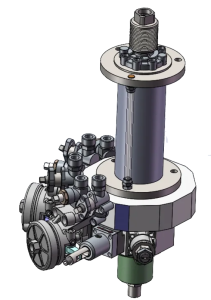
Metering accuracy gets chemicals to the head at the right ratio; the mixing head decides whether they actually combine uniformly. For RIM, the choice is between low-pressure mixing (mechanical stirrer or static mixer) and high-pressure impingement mixing, where the two streams are injected into a small chamber at high velocity and turbulent energy mixes them. High-pressure heads dominate automotive RIM because they allow fast cycle times and self-cleaning — no solvent flush needed between shots. But impingement mixing is sensitive to viscosity differences between the two components. If the polyol side is heavily filled with glass fiber or mineral reinforcement, the Reynolds number mismatch can leave unmixed pockets.
In such cases, a low-pressure head with a dynamic mixer may deliver better homogeneity, albeit at slower cycle speed. I’ve seen lines switch from high-pressure to low-pressure simply because the filler loading made impingement unreliable, only to find that a high-pressure head with a larger nozzle diameter and higher injection pressure (above 150 bar) could restore mixing quality without sacrificing cycle time. The key is to test with actual material, not just water or calibration fluid.
When you’re fine-tuning part quality, the mixing head’s geometry matters as much as the pumps. <Low Pressure PU Foam Injection Machine for Custom Molding: Process & Parameters> explains how variables like chamber volume, L/D ratio, and injection velocity interact with material viscosity — and why the same head that works for an unfilled system may fail when filler content exceeds 15%.
Process Parameters That Make or Break RIM Part Quality
Beyond the hardware, several operating parameters directly affect the quality of a molded part. The most frequently overlooked are:
- Material temperature control: Polyol and isocyanate viscosities are strongly temperature-dependent. A 5°C difference between the two streams can shift the mixing Reynolds number enough to impact homogeneity. Dedicated preheating ovens and temperature-controlled tank jackets (like those in Haifeng’s raw material preheating systems) help keep both sides within a ±2°C band.
- Shot size repeatability: Even with precise ratio control, if the total shot mass varies due to inconsistent valve opening time or slow transducer response, you get flash (excess) or short shots (insufficient fill). Servo-driven metering with closed-loop flow totalizers ensures shot-to-shot mass variation under 0.5%.
- Nucleation control: In structural RIM parts, controlled gas loading (usually nitrogen) is used to nucleate the foam and improve dimensional stability. If the gas metering module doesn’t maintain consistent bubble size, the final part density profile changes, leading to sink marks or voids.
It is common to focus on the big numbers — machine throughput, clamping force, mold carrier speed — and leave these fine parameters to the operator. But in RIM, the fine parameters are what determine whether the part meets spec on Monday morning after a cold start, just as reliably as Thursday afternoon after 100 cycles.
If your RIM line runs filled formulations above 20% reinforcement by weight, it is worth confirming the mixing head’s performance with your actual material before finalizing the machine specification. The interaction between viscosity, filler morphology, and head geometry is hard to predict from datasheets alone. Our team often runs trial pours with customer-supplied materials to verify that the chosen configuration will hold the required density tolerance across the full shot. Reach out at info@haifengmachine.com to discuss.
How to Specify a PU Foaming Machine for Your RIM Application
Start by defining your most demanding part: the one with the tightest density tolerance, the most complex geometry, or the highest filler loading. Then work backward to the metering and mixing requirements. Questions I routinely ask manufacturers include:
- What is the full range of component viscosities across all formulations you plan to run, including the highest filler content?
- Can the machine’s flow sensors and controllers maintain the specified ratio during acceleration and deceleration of the pour, not just at steady state?
- Does the mixing head allow rapid disassembly for cleaning when switching between filled and unfilled systems?
- Is the machine control system capable of logging ratio, pressure, temperature, and shot weight for every cycle? Traceability matters when an automotive customer audits for PPAP compliance.
If the supplier can’t answer these with data from comparable applications, the machine may be fine for open-pour slabstock but probably not for RIM. High-pressure RIM machines designed for automotive — like the models Haifeng builds for car seats and steering wheels — typically include these capabilities as standard because the applications demand it. The extra cost of closed-loop metering and data logging pays back quickly when scrap rates stay below 1%.
For a deeper look at how machine capability maps to real production outcomes, <High Pressure PU Foaming Machine for Car Seats & Steering Wheels: A Production Setup Guide> walks through the configuration choices that determine whether a line hits target cycle time and part consistency from day one.
Common RIM Part Defects Tied to Metering or Mixing
When troubleshooting line issues, I look for these defect patterns because they almost always trace back to the machine rather than the chemistry:
- Density gradients within a part: Higher density near the gate, lower at the far end, indicates poor mixing or premature phase separation during injection.
- Surface voids or pinholes: Often caused by air entrapment from inadequate vacuum degassing of the polyol tank, or from cavitation in the metering pump inlet.
- Brittle, chalky areas: Excess isocyanate due to a ratio drift toward the iso side; often accompanied by excessive exotherm in that region.
- Soft, under-cured spots: Excess polyol, typically from a metering pump seal leak or a check valve sticking open, allowing backflow after the shot.
In many plants, the first response is to adjust the formulation or the mold temperature. But those are band-aids. The machine that produced good parts yesterday should do the same today unless something in the metering or mixing path has changed. Systematic logging of process parameters makes drift visible before it becomes scrap.
When to Involve Your Equipment Supplier
Most facilities that run polyurethane RIM parts initially try to solve quality problems in-house. That’s fine for clear issues like a worn pump seal. But if density variation persists after recalibration, or if you’re introducing a new part with a higher filler loading, the machine’s fundamental design may need re-evaluation. At that point, a candid discussion with an equipment engineer who knows the interactions between mixing head hydraulics, metering pump dynamics, and material rheology can save months of trial and error.
We routinely work with production teams who have already burned through multiple formulation adjustments before they realize the machine’s shot-to-shot consistency isn’t where it needs to be. Sending your part drawings, material specifications, and target cycle time to info@haifengmachine.com is often the fastest way to confirm whether your existing line can handle the application — or pinpoint the upgrade that will make it work.
Frequently Asked Questions About PU Foaming Machine Metering for RIM
Can I retrofit closed-loop metering onto an older RIM machine?
Yes, in many cases. The upgrade involves replacing the open-loop metering pumps with servo-driven units and adding flow meters with feedback to a PLC. The mixing head and injection unit can remain if they are mechanically sound. However, the payback only makes sense if the machine is intended for parts with tight density specs; for low-end gaskets or insulation, the scrap savings may not justify the cost.
My scrap rate is low, but part weight varies more than I’d like. Is that metering?
Probably yes. Weight variation at constant density points to shot size inconsistency, which is a metering and valve timing issue. Look at the flow totalizer data for consecutive shots. If the spread exceeds ±1% of target shot weight, either the check valve is leaking, the pump is worn, or the controller’s update rate is too slow to catch transient flow changes during injection.
Is high-pressure RIM always better than low-pressure for automotive parts?
Not always. High-pressure provides faster cycle times and solvent-free operation, which is why it dominates automotive. But when the part is thick-sectioned and requires extended gel time for complete fill, or when filler loading is above 30%, low-pressure mechanical mixing can yield more uniform density. The decision comes down to part geometry and filler content, not brand preference.
How do I know if my mixing head needs replacement rather than just cleaning?
A mixing head’s service life is typically 80,000–100,000 cycles before the impingement nozzles or dynamic mixer clearances wear beyond tolerance. Signs of wear include streaks in the part that persist after cleaning, increasing density variation between shots, and higher pressure drop at the same flow rate. If you’re seeing all three, replacement is more economical than trying to shim or re-machine the internal components. Send your process data and a sample of the defect to info@haifengmachine.com — we can usually pinpoint whether the head is the culprit or if the problem is elsewhere in the delivery system.
If you’re interested, check out these related articles:
Polyurethane Machinery 101: A Comprehensive Guide to Equipment Types and Engineering Selection
PU Foam Machine vs Traditional Foam Equipment: What to Know
Polyurethane Foam Machine Selection: A 2026 Buyer’s Guide
The 2026 Polyurethane Supply Chain Squeeze: Navigating the Global Price Surge
How to Fill Foam in Heavy Duty Tires