Why the Process Choice Determines Foam Economics
Box foaming and continuous slabstock lines are not simply small and large versions of the same machine. They create different solidification conditions, different heat histories, and different record-keeping granularity. A plant that chooses box foaming for a high-volume flexible foam operation will struggle with labor intensity and density consistency. A plant that chooses a continuous line for low-volume specialty grades will pay for capacity it cannot use and may create more transition waste than product.
The first step is therefore to understand how each process builds the foam. In box foaming, a fixed shot rises in a confined box and cures as a batch. In continuous slabstock, the reacting mixture is laid onto a moving conveyor and forms an endless block under repeatable dynamic conditions. That difference drives density uniformity, scrap behavior, changeover costs, and the equipment controls you actually need.
The batch-vs-continuous decision changes sponge production at almost every stage, from raw-material handling to block trimming. <Continuous Foaming vs Batch Foaming for Sponge Production> covers the same tradeoffs in practical detail.
How Box Foaming Works and Where It Fits
Box foaming is a batch process. A metering unit delivers a defined shot of polyol, isocyanate, water, catalyst, and additives into an open-top box or mold. The foam rises, gels, and cures before the block is removed, trimmed, and moved to storage or further processing.
This route is attractive for low-output plants, R&D centers, and factories that switch frequently among hardness grades, colors, or filled systems. Because each box is isolated, a bad formulation or a contaminated run is contained. You can change grade from one box to the next without creating a long intermediate block of off-spec foam.
The weakness is boundary condition control. The block cools from the outside inward while the top surface remains exposed to air. Side walls and floor restrain foam rise differently than the free top surface. That can produce a density gradient, surface skin, and core-temperature differences. Cutting away top and side trims adds waste, and manual demolding and handling add labor. Box foaming also depends heavily on operator discipline. If shot weight, temperature, mixing-ratio verification, and cure time are not recorded, the batch history becomes a guess.
How Continuous Slabstock Lines Work
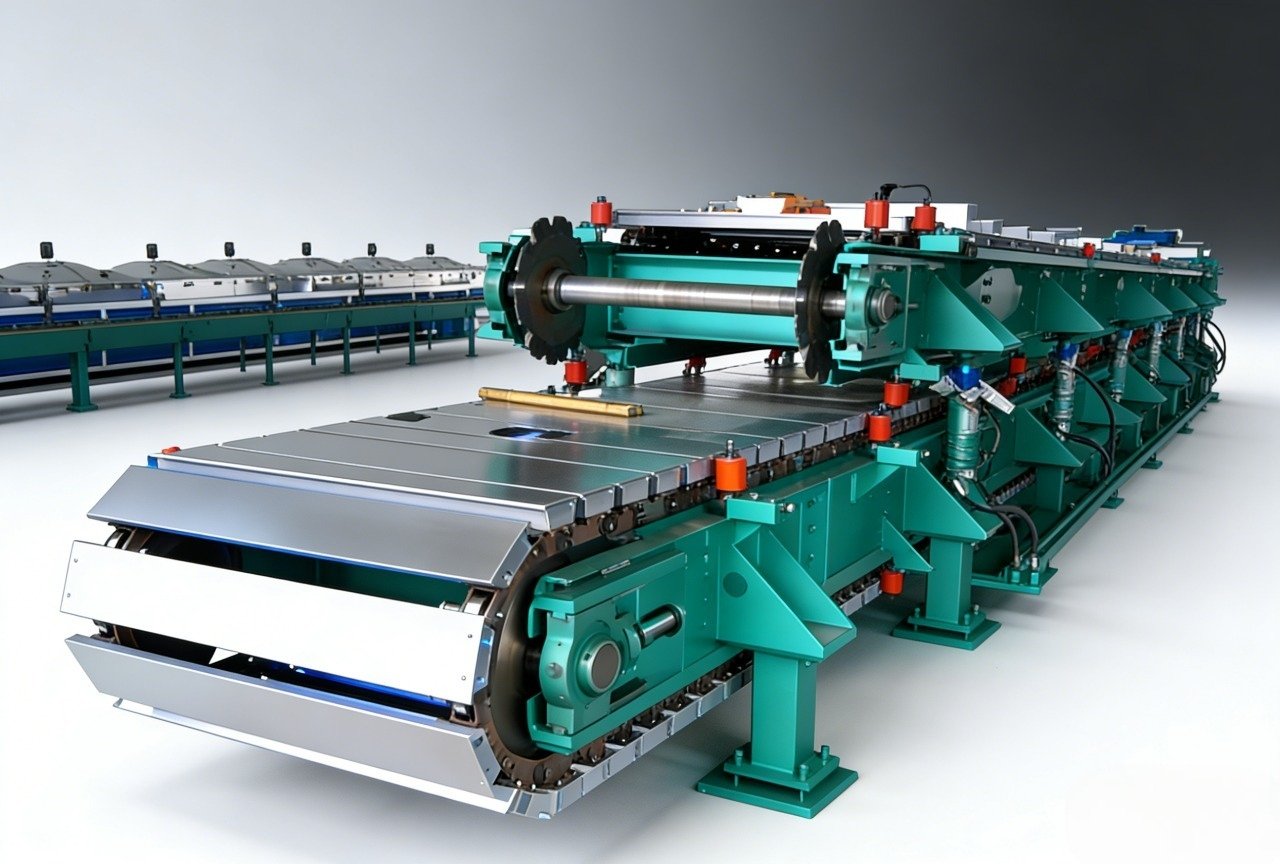
A continuous slabstock line uses metering pumps and a mixing head mounted on a traversing beam above a moving conveyor. The reacting liquid is poured onto bottom paper or film, side papers form the block edges, and the rising foam moves through a curing area before a cut-off saw sections it into blocks.
The advantage is repeatability. Once the line reaches steady state, the foam sees essentially the same pour rate, conveyor speed, temperature, and ventilation conditions from minute to minute. A well-instrumented line can record output, component temperatures, mixing-head pressure, line speed, and block position, giving each block a continuous process history.
The tradeoff is that start-up and grade-change events are more expensive. The line pushes transition material in front of it, so a density or color change creates a length of mixed or off-target foam before the new grade stabilizes. For long campaign runs, that is acceptable. For fast-changing specialty production, it may not be.
Equipment selection starts with the metering loop and mixing control, not just the nominal output figure. <Polyurethane Machinery 101: A Comprehensive Guide to Equipment Types and Engineering Selection> covers the main equipment categories and selection logic in more detail.
Density and Hardness Control: The Real Differentiator
Density is the variable that most often separates a stable operation from a scrap-heavy one. In a continuous line, density is set by the mass output of the metering system against the volume of block formed per minute. In box foaming, it is set by shot weight against the final trimmed block volume. Both methods can make good foam, but continuous lines usually hold density tighter during steady-state operation because the boundary conditions do not reset after every block.
Hardness is not directly set by the machine. It is primarily a formulation result driven by polyol type, isocyanate index, water level, and cell structure. However, the machine influences cell size, cell openness, air flow, and cell orientation, all of which change the indentation feel. When hardness varies between boxes, the first place to look is often density variation, not the hardness formula alone. Block density should be checked by cutting representative samples and measuring apparent density according to ISO 845 [1]. Hardness is commonly reported as indentation force deflection or compressive stress using ISO 2439 [2]. Mechanical properties such as tensile strength and elongation are evaluated with ASTM D3574 [3]. If resilience is part of the product specification, ball rebound is measured with ISO 8307 [4].
Metering repeatability is often the difference between a stable block and hidden scrap. <Polyurethane Foam Machine Types: The Scrap Cost of Inaccurate Metering> covers what happens when component ratio drifts and why the cost shows up later than expected.
Capacity, Changeover, and the Decision Framework
Box foaming scales with box volume and cycle time. Continuous slabstock scales with line speed and block cross-section. That makes the two processes difficult to compare by a single output number. A box plant can add boxes or adjust shift patterns, but its output per hour remains limited by rise time, cure time, and handling. A continuous line can run much higher throughput, but only when it is kept in stable production.
Changeover frequency matters more than nominal capacity in most comparisons. If a plant runs two or three similar grades per week, continuous operation can absorb the changeovers without serious waste. If the plant runs small, one-off grades every day, box foaming is usually cleaner because each batch is isolated and transition foam is limited to the mixing head and lines.
| Factor | Box Foaming | Continuous Slabstock |
|---|---|---|
| Output range | Low to medium | Medium to high |
| Grade changes | Isolated batches; easy to switch | Transition waste; best in campaign runs |
| Density consistency | More dependent on operator and cooling | Better at steady state |
| Capital cost | Lower | Higher |
| Floor space | Smaller | Larger |
| Traceability | Batch-level if recorded manually | Block position plus line data |
A practical decision sequence looks like this: first define the block dimensions and density range for the main product family. Then calculate annual output in kilograms, not just board feet, because density changes the mass-per-block comparison. Third, count how many grade changes the plant actually makes in a week. If the answer is high and volumes are moderate, box foaming can be the more economical route even if it looks less automated.
If you are comparing both routes, send four data points: target block dimensions, density range, expected monthly output, and the number of grades you run in a typical week. Email info@haifeng-automation.cn or WhatsApp +86 13566296633. That gives us enough to compare box and continuous options against your real production calendar, not a theoretical one.
Plan Your Slabstock Project with Haifeng
Choosing between box foaming and continuous slabstock becomes much easier once the product mix, output, and site constraints are written down. At Haifeng Polyurethane Machinery, we supply both low-pressure metering systems for box foaming and high-output continuous slabstock line equipment, including mixing heads, metering stations, and conveyor integration.
Send us your target block size, density range, expected monthly volume, and number of regular grades. We will respond with a process comparison and equipment configuration based on your production reality, not a generic quotation.
Email: info@haifeng-automation.cn
WhatsApp: +86 13566296633
Frequently Asked Questions
Which is cheaper: box foaming or continuous slabstock?
Box foaming is usually cheaper in initial investment and floor space. Continuous slabstock usually becomes cheaper per kilogram at higher output because labor per block falls and steady-state production reduces variability. The crossover depends on volume, product mix, and changeover frequency.
Can a continuous slabstock line handle multiple densities and hardness grades?
Yes, but it handles them best in campaign runs. Each change produces transition material that must be separated or recycled. If you change grades several times per shift, the transition waste can outweigh the advantages of continuous operation.
How do I know if my volume is high enough for continuous?
Look at kilograms per month rather than block count. A continuous line needs enough steady-state hours to justify its investment and the front-of-line infrastructure. If most of your production time would be spent starting, stopping, or changing grades, box foaming is often the better fit.
Why does box foam often show more density variation?
Each box is an independent batch with its own pour, rise, cooling, and demolding history. Slight differences in shot weight, component temperature, or cure time between boxes can add up. Continuous lines hold boundary conditions more constant during steady-state operation, so the density profile is more repeatable.
Is box foaming suitable for high-resilience and memory foam grades?
It can be, especially for specialty grades and development work. The process gives you clean isolation between formulations, but it requires tight controls on mixing ratio, temperature, and cure conditions to match the consistency of a well-run continuous line.
References
[1] ISO 845, Cellular plastics and rubbers — Determination of apparent density, International Organization for Standardization, 2009.
[2] ISO 2439, Flexible cellular polymeric materials — Determination of hardness (indentation technique), International Organization for Standardization, 2008.
[3] ASTM D3574, Standard Test Methods for Flexible Cellular Materials — Slab, Bonded, and Molded Urethane Foams, ASTM International, 2017.
[4] ISO 8307, Flexible cellular polymeric materials — Determination of resilience by ball rebound, International Organization for Standardization, 2018.
If you’re interested, check out these related articles:
Fully Automatic Rain Boot Production Line Guide
What Is an OTR Tire Foam Filling Machine
Polyurethane Foam Spraying Machine: Robot-Assisted Precision Spraying Systems
Continuous Foaming vs Batch Foaming for Sponge Production