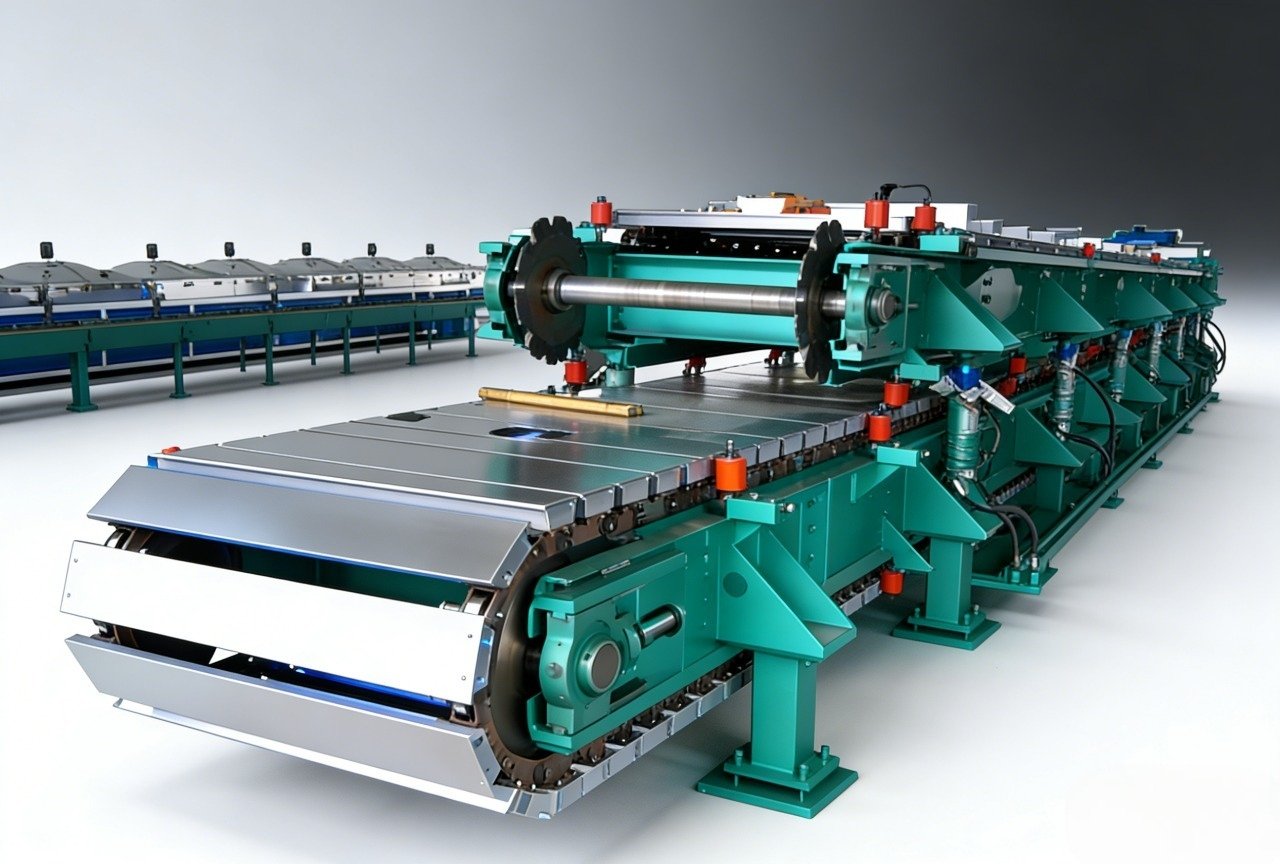
A continuous polyurethane slabstock line takes two or more reactive liquid streams and turns them into a controlled, continuously rising foam block. The process looks simple from the outside: raw materials go in at one end, cured blocks come out at the other. The engineering challenge is that the foam chemistry, the metering accuracy, and the conveyor movement must stay synchronized for hours at a time, because a deviation that starts in the first meter of the line will follow the entire block.
What a Continuous Slabstock Foam Line Actually Does
In box foaming, a fixed amount of polyol, isocyanate, water, catalyst, surfactant, and any additives is mixed and poured into a mold or box. The foam rises inside that closed space, and the operator waits for cure before starting the next box. Each box is a separate batch, with its own mixing time, pour pattern, and cure history.
A continuous line replaces that batch logic with a moving process. Dosing units meter the polyol and isocyanate streams continuously. A mixing head disperses them with a small, controlled amount of air or nucleation gas. The reacting liquid is poured onto an inclined conveyor lined with release paper. As the conveyor moves, the foam rises, expands, and begins to cure while traveling toward the cutoff section.
This is the main operating difference: the line does not wait for each block to finish. It controls conversion chemistry along the length of the line, while the block moves through the rise, gel, and early cure zones.
The choice between continuous and box foaming is often decided by output consistency, product mix, and factory space rather than by chemistry alone. <Continuous Foaming vs Batch Foaming for Sponge Production> covers the decision framework for selecting the right expansion strategy.
Line Stages from Raw Material to Cut Block
A typical continuous slabstock line can be read as four main stations: preparation, metering and mixing, foaming and curing, and cutoff and handling.
Raw material preparation. Polyol and isocyanate are held in day tanks with agitation, temperature control, and recirculation. Polyol blends may contain fillers, flame retardants, or pigments, so they need enough agitation to prevent settling. Isocyanate must be protected from moisture and kept within a narrow temperature window. If the raw materials arrive at the mix head with unstable temperature or pressure, the resulting foam will show density or cell-structure variation before any other problem appears.
Metering and mixing. Continuous dosing pumps supply polyol and isocyanate in a set ratio. Additive streams such as tin catalyst, amine catalyst, water, silicone surfactant, and auxiliary blowing agent are metered in line with the main components. The mixing head can be a low-pressure pin mixer or a high-pressure impingement chamber, depending on the formulation and output. Air is often introduced in a controlled way to create nucleation points for uniform cell growth.
Foaming and curing. The reactive mixture is laid onto bottom paper moving up a shallow inclined conveyor. Side papers and sometimes a top paper contain the expanding foam. The pour pattern matters: an oscillating traverse spreads the liquid across the width so that the rise profile is even. The conveyor speed, fall plate position, and trough design control where the liquid reaches the paper, how much it spreads, and how the rising front develops.
Cutoff and handling. After the foam passes through the rise and early cure zones, large blocks are cut to a preset length and moved to a storage area. Freshly produced blocks may still be warm and need open, ventilated storage before further fabrication. The block dimensions and throughput are set by line width, conveyor speed, and cutting cycle.
Metering and Mixing: Where the Foam Grade Is Decided
Continuous slabstock quality is not mainly a conveyor problem. It is usually a metering problem.
Polyol and isocyanate must be delivered at the correct ratio across the entire operating range. If the required output drops too low, the dosing pumps may fall outside their stable flow range. If the output is too high, the mixing head may not have enough residence time or shear to distribute all components uniformly. Both conditions can create lean or rich zones, which then appear as hard streaks, soft areas, splits, or coarse cells.
The mixing chamber itself must also be sized for the intended flow. A mixing head that operates well at 150 kg/min may not deliver the same cell structure at 40 kg/min. This is why continuous lines should be specified around a defined operating window, not merely a maximum capacity figure.
Nucleation control matters as much as ratio control. If too little air is introduced, the foam can rise late and form dense, irregular cells. If too much air is introduced, the foam may show pinholes, low cell strength, or an unstable rise surface. The correct air loading depends on the formulation, the mixing energy, and the pour pressure.
Metering stability and mixing energy usually determine the scrap rate of a continuous foam plant more than the nominal equipment capacity does. <Polyurethane Foam Machine Types: The Scrap Cost of Inaccurate Metering> covers how component-ratio deviation translates into real material loss.
If you are specifying a new slabstock line, the most useful first step is to define the required output window and ratio-control class before comparing mixing heads. Send the target density range, block width, and throughput to info@haifeng-automation.cn, and the equipment evaluation should focus on the metering, mixing, and foaming parameters that determine the line configuration.
Controlling Density, Hardness and Cell Structure
Density on a continuous line is primarily controlled by the water level and auxiliary blowing agents in the formulation. Water reacts with isocyanate to produce carbon dioxide, which expands the foam. More water normally produces lower density, but it also changes the exotherm and can affect cell openness and hardness.
Hardness is controlled mainly by the isocyanate index and the polyol structure. A higher index or a more crosslinked polyol can produce a firmer block. Density and hardness are related, but they are not the same adjustment. A block can be low density and firm, or high density and soft, depending on the formulation and the way the metering unit maintains the ratio.
Cell openness is controlled by the gel/blow balance. The blow reaction creates gas, while the gel reaction builds polymer strength in the cell walls. If gel strength builds too early relative to gas evolution, the cells may stay closed and the foam may shrink. If the cell walls rupture too easily, the foam may collapse or settle. This balance is managed by catalyst selection, surfactant level, mixing energy, and the pour-to-conveyor transition.
Apparent density is usually measured on a cut block according to ISO 845 [1]. Hardness is often reported as indentation force deflection or compression load deflection using ISO 2439 or ASTM D3574 [2][3]. These measurements are only meaningful if the line produces a consistent block; a single good test block does not prove that the metering and mixing system is capable of repeating the result over a shift.
The line can influence density, hardness, and cell structure even when the formulation stays fixed. Conveyor speed, pour pattern, fall plate setting, ambient temperature, raw-material temperature, and the amount of air introduced all affect how the same formulation expands. That is the reason continuous foam plants run on process recipes, not just chemical formulations.
Factory, Utilities and Layout Requirements
A continuous slabstock line does not stand alone. It needs a material-handling zone, a controlled foaming hall, and a storage area designed for heat removal.
The foaming area must handle solvent vapors, isocyanate handling, and the heat released during reaction. Ventilation should be sized for continuous operation, and the exhaust system should be separate from sensitive electrical enclosures. Isocyanate storage and transfer require dry air or nitrogen blanketing to prevent moisture ingress. Polyol day tanks need enough agitation to keep filled systems homogeneous without pulling air into the feed stream.
Temperature control should cover the tank, the recirculation loop, and the mix head. A temperature difference between polyol and isocyanate can change the reaction profile, especially at higher output rates. Chilled water or a separate heat-transfer loop is usually required, sized for the heat load of the pumps and the mechanical mixing energy.
The conveyor foundation should be level and stiff enough to prevent trough or fall-plate movement during operation. Bottom and side paper unwind stands need consistent tension, because paper tracking problems can distort the foam edge or leak liquid at the sides. The cutoff saw or hot-wire unit must cut within the block travel tolerance so that block length stays consistent without stopping the line.
Common Defects and Equipment Causes
Most continuous slabstock defects can be traced back to one of four areas: ratio drift, nucleation loss, pour-pattern disturbance, or conveyor/paper problems.
Hard streaks or soft streaks often indicate a local ratio change. A worn pump seal, a partially blocked additive line, or a pressure fluctuation at the mix head can change the local isocyanate index even when the main flow setpoint looks correct.
Density variation across the block width usually points to uneven pour distribution. If the traverse is not covering the full width, or if the fall plate is set too high or too low, one edge may see more liquid than the other. The foam may be higher and softer on the overfed side.
Splits and internal voids can result from excessive air loading, high catalyst activity, or a trough design that traps air. They may also appear when the foam is allowed to settle before sufficient gel strength has developed.
Bottom skin defects and edge collapse often come from poor paper tracking, insufficient side-paper support, or a pour that starts too close to the edge. These are mechanical problems, but they become chemical defects because they disturb the rise profile.
The hardest part of troubleshooting a continuous line is that several variables move at once. A density complaint may come from a formulation change, a water-flow error, a temperature shift, or a conveyor-speed adjustment made earlier in the shift. The line operator benefits most from having shot records, trend data, and a clear recipe history to separate causes instead of making pattern-level guesses.
Specifying the Right Continuous Slabstock Line
The specification process should begin with the product mix, not the machine catalog. Three questions usually do most of the work.
First, what is the required production window? Define the minimum and maximum output in kilograms per minute, the range of block widths, and the foam grades that the line must run. A line specified only for maximum output may be difficult to run on small trial blocks or low-density soft grades.
Second, what are the control tolerances? For continuous production, metering-ratio stability, temperature control, and repeatability matter more than a single-point accuracy reading. The acceptance test should demonstrate stable operation over a representative production run, not just a short demonstration pour.
Third, what utility and automation interfaces already exist? The dosing unit, mixing head, conveyor drive, ventilation, and cutoff system should be integrated so that a recipe change moves the entire line as one system. If the control system only adjusts the pumps but not the conveyor or the additive flows, the line will still require manual babysitting.
A practical specification table can be built from the following entries:
| Parameter | Main effect | What to confirm before ordering |
|---|---|---|
| Output range | Pump and mixer stability | Minimum and maximum kg/min |
| Block width | Trough and traverse design | Required final slab width |
| Density range | Water and blowing-agent capacity | Lowest and highest production density |
| Hardness range | Isocyanate index control | Required IFD or CLD |
| Material system | Pump selection and tank design | Polyether or polyester, TDI or MDI |
| Utility availability | Cooling and ventilation sizing | Chilled water, compressed air, exhaust |
Frequently Asked Questions
What is the difference between continuous and box foaming?
Box foaming mixes a fixed batch and allows it to rise inside a closed container. Continuous slabstock foaming meters, mixes, and pours continuously onto a moving conveyor. Continuous production is usually chosen when the plant needs consistent block quality and higher throughput, while box foaming remains useful for low-volume products, frequent formulation changes, or very large individual blocks.
What determines the density of slabstock foam on a continuous line?
Density is set mainly by the amount of water and any auxiliary blowing agent in the formulation. The equipment controls density by metering the water stream accurately and by maintaining the polyol-to-isocyanate ratio. Conveyor speed, pour pattern, and raw-material temperature also influence how the expanding foam fills the available cross-section.
Can one continuous line switch between different foam grades?
Yes, but the changeover must be planned. The dosing unit, additive pumps, mix head, conveyor speed, and temperature settings all need to move to the new recipe together. Fast changeover requires reliable recipe storage, automatic flushing, and an operating window wide enough to cover both the old and new output conditions.
What are the early signs of metering-ratio drift?
The earliest visible signs are usually local hardness differences, density shifts in a particular zone, or a gradual change in the rise height. The better warning signals come from the machine data: pump speed, discharge pressure, flow-meter feedback, and the recorded ratio trend should be watched before a visible defect appears in the block.
References
[1] ISO 845:2006, Cellular plastics and rubbers — Determination of apparent density, International Organization for Standardization.
[2] ISO 2439:2008, Flexible cellular polymeric materials — Determination of hardness (indentation technique), International Organization for Standardization.
[3] ASTM D3574-17, Standard Test Methods for Flexible Cellular Materials—Slab, Bonded, and Molded Urethane Foams, ASTM International.
If you’re interested, check out these related articles:
Continuous Foaming vs Batch Foaming for Sponge Production
Rotary vs Linear PU Shoe Machines
Best Equipment for Foam Filling Mining Tires
Polyurethane Foam Machine: Types, Working Principle and Applications