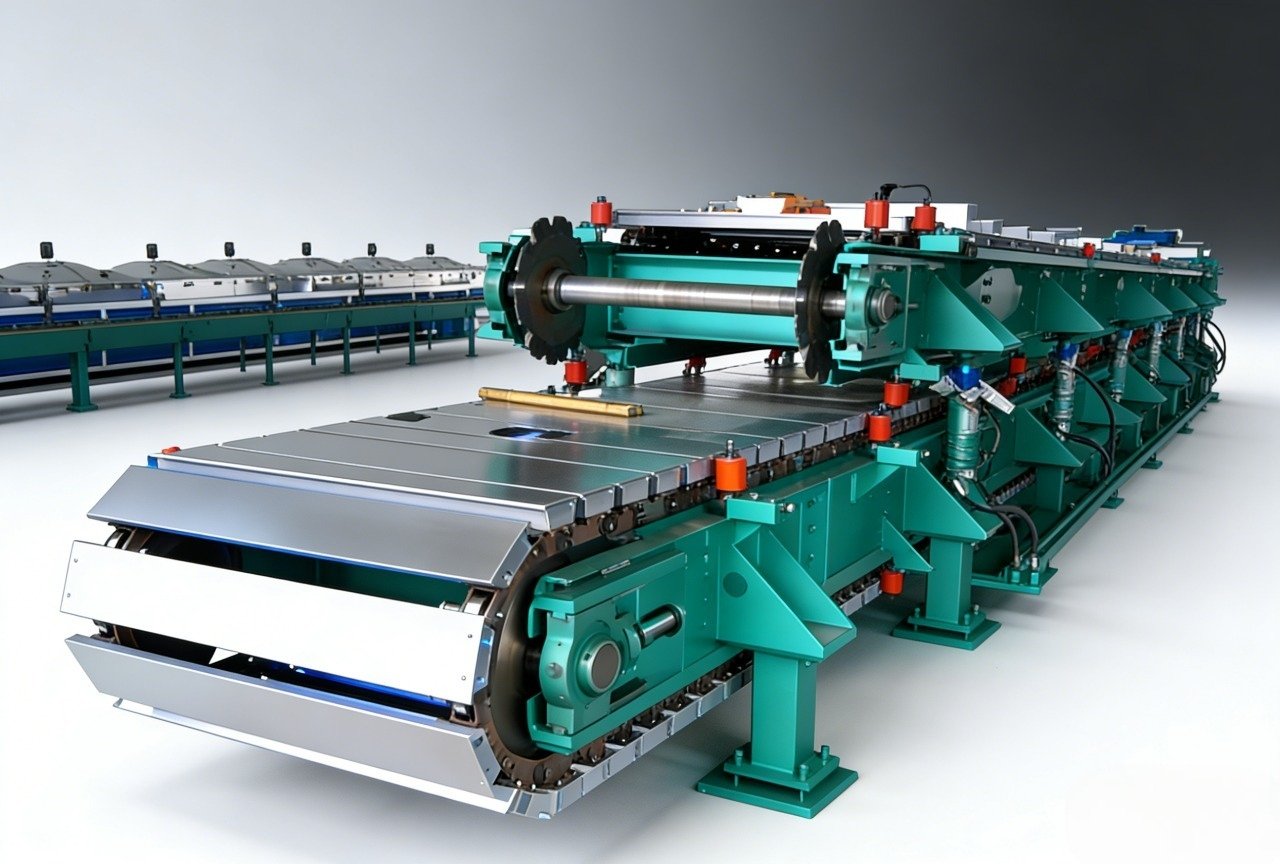
The Control Point Is the Machine, Not Just the Recipe
Most slabstock plants define a target density and hardness for every grade. The harder problem is not writing the recipe; it is keeping the block inside the target window when the same recipe begins producing different results. When density shifts from one block to the next, the cause is rarely a formulation decision. It is usually a machine parameter drifting while the recipe stayed constant.
The distinction matters because density and hardness in continuous slabstock foam are not direct inputs. They are the result of total mass flow, mixing energy, nucleation gas, conveyor speed, and curing conditions acting together. If total output rises while conveyor speed does not change, mass per unit length increases and density moves. If the mixing head shear changes, cell size changes and hardness may shift even when density stays close. The machine is the control point.
The first step is to separate formulation potential from machine repeatability. The recipe sets the target, but the metering and mixing equipment determine whether the block actually reaches it. <How Polyurethane Foam Machines Work: Types and Applications> covers the metering, mixing, and pouring functions that make this separation visible on the production floor.
Metering: Total Output, Ratio, and Temperature
Density control starts with the metering system. For a rectangular block, density is essentially the mass delivered into a unit length of foam divided by the volume that the conveyor and rise height create. That makes total component output one of the strongest density levers available to the machine.
Total output is set by pump speed, stroke, or flow control depending on the metering design. A small calibration error in the polyol or isocyanate stream does not stay small for long on a continuous line. Over an eight-hour block, even a low-level drift in total mass flow becomes a measurable density difference from one end of the block to the other.
Component ratio influences hardness and the completeness of the reaction more than it changes density alone. A persistent offset in ratio can leave unreacted groups, change the polymer network, and shift the indentation force at a given density. For hardness, the relevant test is usually the indentation force deflection at 25% or 40% compression according to ISO 2439 [1]. Density itself is verified by the apparent density method in ISO 845 [2].
Temperature acts through viscosity and reactivity. If the polyol or isocyanate temperature drifts, the metering pump may slip differently, the mixing energy may change, and the cream time may move. On continuous slabstock lines, temperature stability is not an indirect issue. It is a metering condition. Day-tank temperature, heat exchanger outlet temperature, and material temperature at the mixing head all need to be logged together with density and hardness data.
| Machine parameter | Primary effect on foam properties | What to inspect |
|---|---|---|
| Total component output | Mass per unit length and block density | Pump calibration, flow reading, drive stability |
| Mixing ratio | Reaction completion, network formation, hardness | Ratio trend over the run, individual stream calibration |
| Component temperature | Viscosity, reactivity, metering consistency | Day tank, heat exchanger, material temperature at the head |
| Mixing head RPM | Shear, cell size, mixing quality | RPM trend, drive load, bearing condition |
| Mixing chamber pressure or back-pressure | Air entrainment, recirculation, mixing intensity | Pressure signal, nozzle condition, recirculation setting |
| Nucleation air or gas flow | Density reduction, cell nucleation, block structure | Gas flow, gas pressure, injection point condition |
| Conveyor speed | Block thickness, density, rise profile | Belt speed, slip, encoder consistency |
| Conveyor angle and fall plate | Rise geometry, side wall formation, block shape | Angle, position, side paper tension |
The table is not a control strategy by itself. It is a checklist for finding which parameter moved before changing the recipe.
Density drift is usually easier to trace through the machine than through the formula. When mass flow, heaters, and the recirculation loop have not been checked first, the problem is often misdiagnosed as a material issue. <Continuous PU Foam Production Line Maintenance: How to Prevent Costly Downtime and Defects> covers the maintenance items that keep ratio and output errors from becoming block-to-block shifts.
Mixing Head Conditions That Shape Cell Structure and Hardness
Density is only part of the result. Hardness also depends on cell structure, and cell structure is created in the mixing head and the first few seconds after laydown.
Higher shear at the mixing head can produce finer and more uniform cells. Lower shear can leave larger cells or incomplete mixing. The correct setting is not simply “more RPM.” It depends on the formula, viscosity, gas loading, and the head design. If the RPM moves outside the range that the formula was developed for, hardness can shift because the foam structure changes, not because density changed.
Nucleation gas is another core parameter. Adding controlled air or gas into the liquid mixture reduces the amount of polymer per unit volume in the rising foam and creates the nucleation sites that shape the cell network. Too little gas can produce a coarser, denser structure. Too much gas can produce an open, coarse, or unstable structure. The gas flow setting is part of the density control loop because it changes the mass-to-volume relationship before the foam has fully risen.
For compression-related properties, ISO 3386-1 [3] gives the stress-strain method used for flexible cellular materials. In slabstock applications, the same property set is often covered in broader physical testing according to ASTM D3574 [4]. These tests do not explain why a block changed, but they define the numerical target that the machine must reproduce.
Mix head condition also matters. Worn seals, a partially blocked nozzle, or a damaged mixing element can change mixing intensity without showing an alarm. That is why the same density reading can be produced with different hardness results. The density target is met, but the structure is no longer the same.
Conveyor, Rise Profile, and Curing Conditions
Conveyor speed is a direct density control parameter. If total mass flow is fixed and conveyor speed increases, the same mass is spread over a longer length, so the block becomes thinner and lighter per unit length. If the speed slows, the mass is concentrated over a shorter length and density increases. Conveyor speed and total output must be controlled as a pair.
The rise profile is shaped by the conveyor angle, side paper movement, and fall plate position. These settings affect block shape, skin formation, and the way the foam rises against the side walls. A malformed rise profile can create density gradients between the center and the edges even when the average density is correct.
Curing conditions also influence final hardness. After the foam has risen, the exothermic reaction continues inside the block. If the block is moved, cut, or stacked too early, the internal temperature profile can change and create soft or hard zones. Humidity and ambient temperature influence the reaction as well, especially for water-blown systems. A controlled production log should include ambient conditions because they are part of the machine environment even though they are not a setting on the control panel.
Before adjusting a machine parameter for density or hardness, it is worth checking whether the raw material lot or supply conditions have changed. Viscosity and reactivity can move even when the machine settings look stable. <The 2026 Polyurethane Supply Chain Squeeze: Navigating the Global Price Surge> covers the supply-side variables that shift processing behavior on an otherwise unchanged line.
What to Log Before Changing Any Parameter
A density or hardness problem is easier to solve when the machine has stable data behind it. The minimum useful log for a continuous slabstock line includes total mass flow, individual component flow, component temperatures, mixing head RPM, mixing chamber pressure or back-pressure, nucleation gas flow, conveyor speed, conveyor angle, ambient temperature, and relative humidity.
Density should be measured by the method in ISO 845 [2] and recorded with the block position and the time of the sample. Hardness should be measured by the method in ISO 2439 [1] at the same positions where density is recorded. Compression behavior can be checked through ISO 3386-1 [3] when the application requires a fuller stress-strain picture. Slabstock test methods are also standardized in ASTM D3574 [4] for many flexible foam properties.
The sequence that usually works is: verify the measurement first, then verify the metering system, then verify the mixing head, then verify conveyor and curing conditions. That order prevents the common mistake of adjusting a downstream parameter when the real error is upstream in the metering loop.
If you are tuning an existing continuous slabstock line, start by comparing the logged parameter trend with the density and hardness trend block by block. If the density deviation is still wider than the target after the metering system is confirmed, contact Haifeng at info@haifeng-automation.cn or WhatsApp: 86 13566296633 with your current machine settings, target grade data, and the measured deviation. The fastest correction is usually a closed-loop metering or mixing-head check, not a new formulation trial.
Define the Density and Hardness Window for Your Slabstock Line
If you are planning a new continuous slabstock line or chasing property drift on an existing one, send us your target grade list, current recipe, and the density and hardness data you are seeing. We will review the metering, mixing, and conveyor parameters that matter for your production range and propose the smallest set of changes to bring the line back inside tolerance.
Contact Haifeng Polyurethane Machinery at info@haifeng-automation.cn or WhatsApp: 86 13566296633.
Frequently Asked Questions
What is the most common machine cause of density drift in slabstock foam?
The most common cause is a change in total mass flow relative to conveyor speed. Pump calibration, flow control drift, and conveyor slip are the first places to look. After that, nucleation gas flow and component temperature are the next likely contributors.
Does hardness follow density, or can it be adjusted independently?
Hardness is strongly related to density, but it is not determined by density alone. Mixing quality, cell structure, ratio offset, and cure conditions can all change hardness at a similar density. This is why the mixing head condition and the reaction parameters need to be checked separately from the density reading.
Can one continuous line run low-density soft foam and high-density firm foam?
Yes, within the machine’s output and mixing range. The formulation changes the density and hardness target, but the machine parameters must also be reset: total output, conveyor speed, nucleation gas, mixing head speed, and temperature setpoints all need to follow the grade change.
How often should metering calibration and mix head checks be performed?
That depends on production volume and the tolerance of the products. High-volume lines with narrow density specifications benefit from scheduled calibration and mix-head inspection at least as often as preventive maintenance. The main point is to compare calibration records with block test data so drift is found before it becomes a rejected block.
Where should density and hardness samples be taken from the block?
Samples should come from consistent positions, usually away from the block edges and the immediate skin, and at multiple points along the length. Density and hardness should be measured at the same sample positions so the relationship between the two properties can be compared. Record the sample position with every test result.
References
[1] ISO 2439:2008, Flexible cellular polymeric materials — Determination of hardness (indentation technique).
[2] ISO 845:2006, Cellular plastics and rubbers — Determination of apparent density.
[3] ISO 3386-1:1986, Polymeric materials, cellular flexible — Determination of stress-strain characteristics in compression — Part 1: Low-density materials.
[4] ASTM D3574-17, Standard Test Methods for Flexible Cellular Materials—Slab, Bonded, and Molded Urethane Foams.
If you’re interested, check out these related articles:
How to Choose a Tire Foam Filling Machine
Polyurethane Foam Machine Selection: A 2026 Buyer’s Guide
PU Shoe Sole Defects: Troubleshooting Release Agents & Workshop Chemicals [Part 3: Workshop Chemicals]
OTR Tire Flat Proofing Technology Explained