Most foam line problems start before the first pour. A production manager comparing a PU foam machine against traditional foam equipment usually looks at purchase price first, but the real difference shows up later in ratio drift, scrap rate, and downtime. I have watched plants lose more than five percent scrap per batch because the mixing method could not hold component ratio under changing viscosity. This article works through five differences that determine whether a line holds specification or quietly bleeds material cost. The decisive issue is not the nominal output figure, it is the stability of metering and mixing from the first shot to the last.
| Factor | Traditional foam equipment | PU foam machine |
|---|---|---|
| Component ratio control | Timer or stroke-based setting, checked periodically | Closed-loop servo metering with ±0.5% accuracy and real-time correction |
| Mixing method | Open-tank agitation or simple mechanical stirring, more air entrapment | High-shear mixing head with controlled back pressure and uniform nucleation |
| Mold filling | Depends mainly on foam rise and cavity shape | Controlled low-pressure or high-pressure injection into thin sections and inserts |
| Changeover | Manual flushing and recipe reset | PLC recipe storage and programmed cleaning, color change under three minutes |
| Scrap and downtime | Ratio drift appears late as density failure or soft parts | Flow feedback catches drift before parts are poured |
Metering Precision in a PU Foam Machine
The first difference is not horsepower. It is whether the machine knows what it is dispensing. On many traditional foam lines, component ratio is set by stroke length or timer and then checked periodically. That works until material temperature changes or pot life shortens. The operator may not notice the drift until density test results fail.
A closed-loop servo metering system on a modern PU foam machine measures actual flow from each component and corrects pump speed in real time. The target we work to in low-pressure Haifeng machines is ±0.5% metering accuracy. That level matters because a deviation of one percentage point in the component ratio can shift final foam density by more than 3 kg/m³.

Metering precision only matters if the machine type matches the production method. <How Polyurethane Foam Machines Work: Types and Applications> covers how low-pressure, high-pressure, and spraying machines differ in material conditioning and pour control, which changes how closely the component ratio can be held on a given line.
For batch foam, the hidden cost of ratio drift is rarely counted as scrap. It appears as soft cushions, collapsed cells, or parts that pass visual inspection but fail density tolerance later. Traditional foam equipment may meet the same nominal ratio on paper. The difference is whether it can hold that ratio when the day tank level drops, the material warms up, or the operator changes from a BDO formula to a MOCA formula. A machine with flow feedback does that without a manual recalibration.
Mixing Head Design and Cell Structure
Mixing head design decides whether the foam has fine, even cells or a scattered cell structure. Traditional foam equipment often relies on open-tank agitation or a simple mechanical stirrer. That pulls air into the liquid and creates a wider cell size distribution. A PU foam machine designed for controlled pour uses a high-shear mixing chamber with a defined mixing length and back pressure. The result is a more uniform nucleation pattern.
In the Haifeng high-flow box block machines, tank vacuum degassing plus terminal vacuum at the pouring head cuts the bubble rate by more than 70 percent. The mixing head itself uses a multi-stage helical blade design. Cell structure is set here before the material ever enters the mold.
Cell uniformity is not a cosmetic concern. For footwear midsoles, automotive interior parts, and medical sponge, uneven cells create soft spots and variable water absorption. A traditional line can compensate by overshooting density, but that adds material cost. A better mixing head reaches the target density with less polyol and isocyanate. We have seen production teams accept a lower-priced traditional mixer, then add reformulation time and extra demolding time to recover quality. The equipment saving disappears in the first season.
Process Pressure and Mold Filling
Process pressure changes how the foam reaches thin wall sections, inserts, and deep mold details. Traditional foam equipment often depends on the foam’s own rise to fill the cavity. That is acceptable for simple block or open mold work. It is not enough for a steering wheel with a metallic core, a car seat cushion with defined hardness zones, or a medical pad with a tight thickness window.
A PU foam machine that meters and injects under controlled pressure can push the mixture into the geometry before the reaction builds too much viscosity. This shortens flow distance and reduces knit lines.
When mold filling pressure becomes the limiting factor, equipment selection narrows. <High Pressure PU Foam Injection for Automotive Interiors> covers the pressure and cycling parameters that matter for complex interior molds, including the difference between open pour and closed mold control.
Low pressure is not automatically inferior. For small polyurethane accessories, gaskets, and prototype work, low-pressure injection is often the better economic choice because tooling is simpler and material shear is lower. The issue is matching pressure to the mold’s requirements. A traditional setup may be fine for open blocks, but it cannot hold the same fill consistency on a multi-cavity mold with narrow gates.
If your part geometry includes deep ribs, overmolded inserts, or tight wall sections, do not rely on a catalog pressure rating alone. The fill pressure you need depends on material viscosity and gate size. Send a part drawing and your target cycle time to sales@haifengmachine.com and we will confirm whether low-pressure or high-pressure metering fits the mold.
Changeover Flexibility and Batch Control
Traditional foam equipment treats changeover as a cleaning task. The operator flushes lines, clears the mixing chamber, and then manually resets temperatures and pump strokes. That sequence may take an hour or more. It also carries contamination risk if a high-viscosity residue stays in a dead leg.
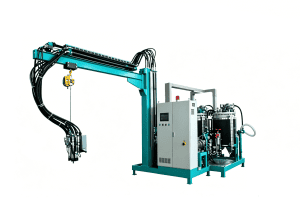
A modern PU foam machine stores recipes in the PLC and drives cleaning as a programmed sequence. On robotic pouring systems, one-key cleaning brings color change time below three minutes and reduces solvent use by up to 90 percent. This matters more as batch sizes shrink.
For short-run and prototype molding, changeover time often matters more than peak throughput. <Low Pressure PU Foam Injection Machine for Custom Molding: Process & Parameters> covers the process parameters that make quick formula shifts practical without contaminating the next batch.
This is not only about speed. Automatic cleaning and recipe storage reduce the chance that an operator forgets a stroke setting or a temperature offset after a product change. For manufacturers running small-batch custom work, that consistency is worth more than a fast fill rate. The traditional machine may pour just as quickly, but it cannot switch as cleanly.
Scrap Rate and Operating Cost in a PU Foam Machine
Scrap rate is where the two equipment paths separate in the accounting records. A traditional foam line may produce acceptable parts when everything is stable. The problem is that stability is the variable. As the day tank empties, ambient temperature shifts, and operators change, ratio drift returns. A five percent scrap rate on a single batch may sound manageable, but multiplied across shifts it becomes wasted isocyanate, additional demolding labor, and delayed shipments.
A PU foam machine with closed-loop meter monitoring catches the drift early, often before parts are made. Operating cost also includes what happens between batches. Manual calibration, solvent flushing, and rework do not show up in the machine price. They show up as labor hours.

Low-pressure operation consumes less energy than older high-pressure equipment, but the larger saving is usually material yield. When component ratio stays stable, density variance drops and the plant can run closer to the minimum specification weight without risking underfill. That shift changes the profit picture more than a marginal difference in list price.
The decision is not between cheap and expensive. It is between buying a machine and paying for material waste across its life. If your line is already losing density control or you are planning a new product with tighter tolerances, the next step is to specify the metering and mixing requirements before comparing quotes. Send your part drawing, target output, and current scrap rate to sales@haifengmachine.com or call +86 577 6276 9999 and an engineer will confirm which machine configuration fits your foam system.
Questions Production Teams Ask Before Switching to a PU Foam Machine
Does every PU foam machine require high-pressure operation?
No. Low-pressure machines cover small accessories, prototype molds, and flexible foam where mold pressure is not the limiting factor. High-pressure operation is justified when the part has complex geometry, long flow paths, or a material system that demands very short mixing and injection. The deciding factors are mold design and material reactivity, not a general preference. Starting from the part geometry usually leads to the right machine category faster than starting from a pressure specification.
Is traditional foam equipment still usable for simple block production?
Many buyers assume a PU foam machine is overkill for simple blocks. That is only partly true. A basic open-pour line can work for low-specification block, but even block production is sensitive to density control because raw material is the main cost. If the acceptable density tolerance is wide and labor costs are low, older equipment may remain viable. For narrow density limits or multi-shift operation, closed-loop metering usually pays back through material savings.
How much metering accuracy do we actually need?
It depends on the density tolerance and part function. For a rigid block with a wide specification, ±1% may be enough. For medical sponge, automotive interiors, or dual-density footwear, ±0.5% is a better target because density shifts change compression set, feel, and absorption. I usually ask for the part drawing and density specification before recommending a meter type. The stated range on a brochure is less important than whether the machine repeats the same ratio at hour one and hour eight.
What causes ratio drift in traditional foam equipment?
In lines I have reviewed, the common causes are open-loop pump settings, material temperature changes, and day-tank level changes. Gear pumps without flow feedback can drift as viscosity changes during the day. The correction is not always a new machine. Some existing lines recover stability by adding servo motor feedback and a flow meter to the metering circuit. If the mixing head and pump sizing cannot handle the required throughput, replacement becomes the better path.
What information should we include with an equipment inquiry?
Send the part drawing or product type, target output per shift, current foam density range, and the material system if known. A sketch of the mold and gate configuration is enough to start. That lets us confirm metering type, mixing head selection, and whether low-pressure or high-pressure makes sense. Without it, a quote is only a ballpark number. Share your part drawing, density tolerance, and current scrap rate with sales@haifengmachine.com and we will confirm the machine configuration and estimated payback range.
If you’re interested, check out these related articles:
OTR Tire Flat Proofing Technology Explained
PU Foam Filling Equipment for Industrial Tires
Low Pressure PU Foam Injection Machine for Custom Molding: Process & Parameters