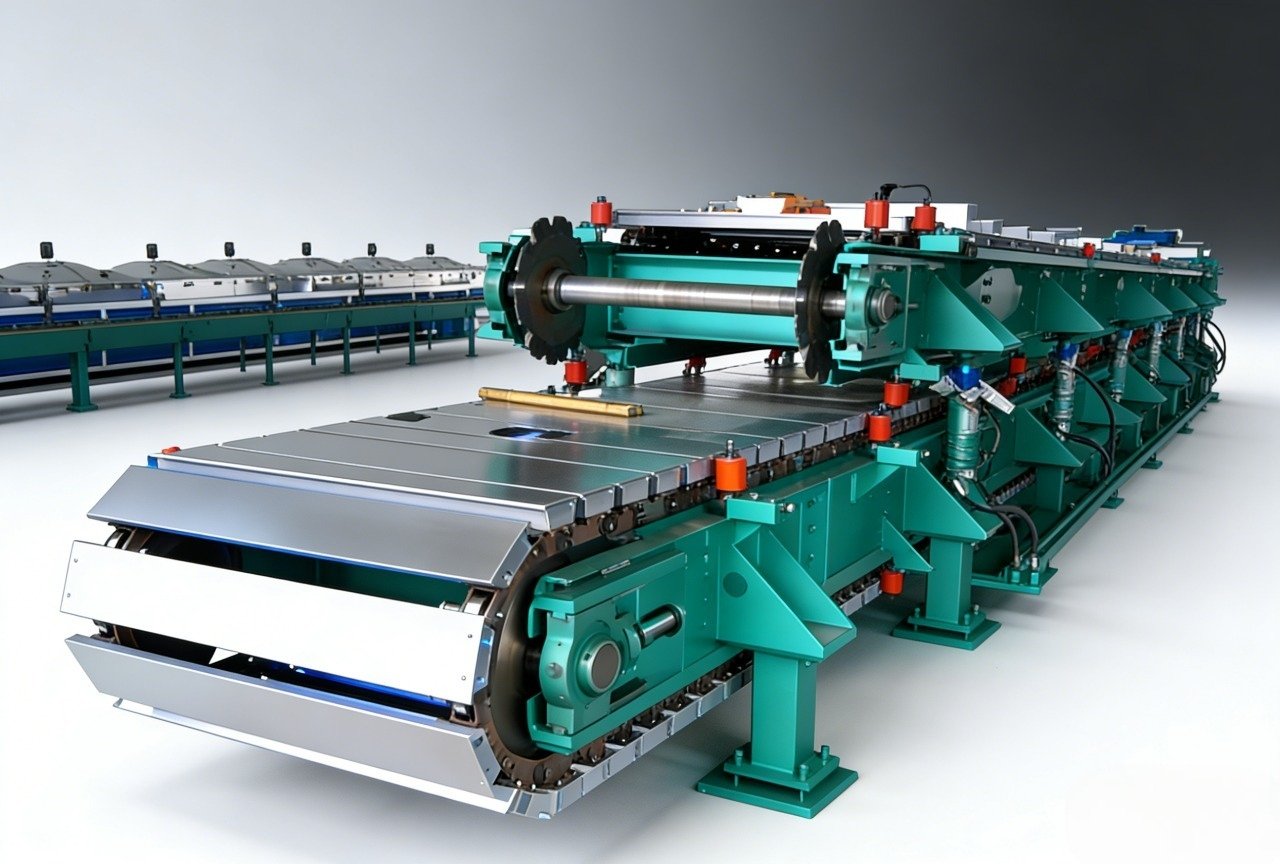
In continuous polyurethane (PU) and polyisocyanurate (PIR) sandwich panel production, the double-belt laminator is the section between the foam dispenser and the cut-to-length saw. It takes the two metal facings and the freshly dispensed liquid foam, then holds the emerging panel at a controlled gap and temperature while the foam expands, cures, and bonds to both facings. Even a small deviation in belt temperature, gap setting, or line-speed synchronization can show up later as thickness variation, poor adhesion, surface ripples, or density change.
Factory-made double-skin metal-faced insulating panels are commonly specified against EN 14509, which covers dimensional tolerances, flatness, bond strength, and thermal resistance [1]. That standard-level expectation is one reason the laminator is treated as a calibration device, not just a conveyor.
What a Double-Belt Laminator Does in a Continuous Line
A PU/PIR sandwich panel line typically runs in this order: decoiling and roll forming of the upper and lower metal sheets, preheating, foam dispensing onto the lower sheet, lamination under the double belt, cooling, profiling if required, and flying-cut length cutting.
The double-belt laminator performs four jobs at once:
- It carries the panel through the foaming and curing window without relative movement between the metal facings and the forming foam.
- It sets the final panel thickness through a controlled upper-belt gap.
- It supplies or removes heat so the foam reaches cure temperature without excessive exotherm build-up.
- It flattens the panel during the pressure-rise phase of the reaction.
For PU and PIR, that last point matters. The rising foam generates internal pressure. If the gap is fixed too early, density rises and the panel can become overweight. If the upper belt floats or loses position, thickness drifts. The laminator’s job is therefore not maximum pressing force; it is consistent restraint over the entire dwell time.
Double-belt laminator selection only makes sense within the full line configuration, from coil handling and preheating to the flying saw. <How to Build a Turnkey Sandwich Panel Factory: Machine Configuration, Layout and Investment Planning> covers machine configuration, layout and investment planning.
Core Components and Their Influence on Panel Quality
The main parts of a double-belt laminator are the upper and lower steel belts, belt support and tracking guides, heating or temperature-control zones, gap-adjustment actuators, side sealing, and the tensioning system.
Steel belts. The belts give the panel its two flat reference surfaces. Surface finish and flatness transfer directly to the metal facings. Belt defects, weld marks, or uneven wear tend to repeat panel-by-panel.
Gap adjustment. The gap between the belts sets the final panel thickness. On a well-designed machine, gap position is controlled by linear guides and position feedback rather than by simple manual spacers. Accurate gap control protects both thickness tolerance and density consistency.
Temperature zones. The first zone usually brings the facings and the foam-reactant mixture to a reaction-friendly temperature. Later zones hold cure temperature and then begin cooling. PIR formulations usually need a higher and more carefully managed temperature profile than conventional PU because the trimerization reaction can generate more heat.
Side sealing. Without adequate side restraint, foam can escape at the panel edges before it gels, causing low edge density and variable panel width. Side seals or adjustable edge dams keep the expanding foam inside the intended envelope.
Belt tracking and tension. If the steel belts wander or lose tension, the result can be edge damage, uneven pressure, and premature belt wear. Tracking and tension are maintenance-critical systems.
The laminator is also where panel thermal test samples later become meaningful. Thermal resistance of the finished panel is commonly measured under ASTM C518 using a heat-flow-meter apparatus [2]. What that standard measures in the laboratory is influenced on the floor by whether the foam cell structure and panel thickness were held stable in the laminator.
How the Laminator Controls Density, Thickness and Adhesion
The easiest way to understand the double-belt laminator is as a mold that moves. The cavity height is set by the gap, the cavity length is the dwell distance, and the cavity pressure is created by the reacting foam.
Density is primarily a relationship between dispensed foam mass and the available cavity volume. For the same dispense rate, opening the gap lowers density; closing it raises density. That is why laminator gap changes must be coordinated with metering-machine output. A plant that changes panel thickness while keeping the metering recipe fixed can unintentionally change density.
Adhesion depends on temperature, surface condition, and reaction timing. If the facings are too cold or the first laminator zone removes too much heat, the foam can skin before it wets the metal, producing weak bond lines. If the belt runs too hot, the exotherm can overheat the core, producing discoloration, voids, or excessive cell coarsening near the facing.
Line speed is the third variable. Speed must match cream time, gel time, and the installed laminator length. If the panel exits the reaction zone before the foam has enough green strength, the cut edge can deform and the facings can delaminate under cooling stress.
Double-Belt Lamination vs Discontinuous Molding
A discontinuous press or jig foam line pours each panel individually and holds it in a fixed mold until cure. It can be a good choice for very low output, frequent thickness changes, or panels with features that do not suit continuous forming.
A double-belt laminator trades some of that flexibility for repeatability and output. The continuous belt path gives a stable production beat, makes thickness control more repeatable from panel to panel, and fits naturally between the decoiler and the flying saw. For building-envelope panels produced in volume, that is usually the preferred configuration.
Once the laminator is specified, line output is still governed by the entire continuous process, not belt speed alone. <Continuous PU Foam Line Capacity Guide: How Much Foam Can One Line Produce?> covers capacity calculation for a continuous line.
Selection Factors and Inspection Points
Before comparing double-belt laminator designs, confirm the production envelope: panel thickness range, usable panel width, facing material, foam formulation, and required line speed. Then work through these points.
- Gap repeatability. Ask how the upper belt position is measured and corrected during production, not just during setup.
- Temperature uniformity. Compare the number of temperature zones and the control tolerance across the belt width.
- Belt condition. Look at belt thickness, surface finish, tracking system, and expected replacement procedure.
- Side sealing. Confirm how edge sealing accommodates the full panel thickness range.
- Synchronization. The laminator, metering machine, and flying saw should share a line-speed reference and alarm logic for drift or stoppage.
- Utilities. Define heating medium, compressed-air demand, and control integration early.
If you are in the specification stage, the fastest way to narrow the options is to send the thickness range, target production rate, and foam system. Haifeng Polyurethane Machinery can be reached at info@haifeng-automation.cn or on WhatsApp at 86 13566296633.
Turn Laminator Specs into Verifiable Acceptance Criteria
A double-belt laminator should not be selected on nominal width and speed alone. Before order, define acceptance conditions for panel thickness, flatness, density distribution, and edge fill at the target line speed. That makes factory acceptance and site commissioning easier to judge.
Haifeng Polyurethane Machinery provides turnkey PU/PIR sandwich panel line engineering, including double-belt laminator integration. Contact info@haifeng-automation.cn or WhatsApp: 86 13566296633 to review your production requirements.
Frequently Asked Questions
What is the difference between PU and PIR in a double-belt laminator?
PU is polyurethane; PIR is polyisocyanurate. PIR formulations use a higher isocyanate index and form isocyanurate ring structures, which improves fire resistance and thermal stability but also increases reaction exotherm. The laminator temperature profile and dwell time must be adjusted accordingly. PIR panel reaction-to-fire performance is typically evaluated under EN 13501-1 [3].
How does the laminator influence finished panel density?
Density is set mainly by the relationship between dispensed foam volume and the laminator cavity height. A wider gap lowers density for the same dispense rate; a narrower gap raises it. Stable gap control and synchronized output are therefore required to keep density consistent.
What thickness range can a double-belt laminator handle?
There is no universal thickness range. The usable range depends on the machine design, belt length, side-sealing adjustment, and foam formulation. The correct question is whether the laminator can hold the required gap tolerance across the panel width at the target line speed for the specified panel thickness range.
How do you prevent voids and poor adhesion in continuous panels?
Control the preheat temperature of the facings, the first-zone belt temperature, and the relationship between line speed and foam cream and gel times. Side sealing must prevent foam loss before gel, and the gap must remain stable during the pressure-rise phase. Poor adhesion is often a wetting problem caused by cold facings or a cold first zone.
Is a double-belt laminator only used for PU/PIR foam panels?
It is primarily used for continuous PU/PIR foam-cored sandwich panels. Mineral wool and other core materials require different adhesive and pressing behavior, although some panel lines combine different core handling methods. The double-belt principle is best suited to a liquid reactive foam that expands inside a moving cavity.
References
[1] EN 14509:2013, Self-supporting double skin metal faced insulating panels — Factory made products — Specifications, European Committee for Standardization.
[2] ASTM C518-21, Standard Test Method for Steady-State Thermal Transmission Properties by Means of the Heat Flow Meter Apparatus, ASTM International.
[3] EN 13501-1:2018, Fire classification of construction products and building elements — Part 1: Classification using data from reaction to fire tests, European Committee for Standardization.
If you’re interested, check out these related articles:
How to Start a Rain Boot Manufacturing Plant
Rain Boot Factory Investment Cost
Advantages of Foam Filled Tires for Mining
High Pressure vs. Low Pressure Polyurethane Foam Machine: How to Choose the Right One for Your Production
Best PU Machines for Safety Footwear Factories