A sandwich panel laminator that runs at design speed while the back end is hand-sorted is not a continuous line; it is a fast process feeding a slow process. Most post-processing mistakes happen at the interface between the cut-to-length saw and the stacker. If panel inertia, clamp timing, and release height are not treated as one control loop, the result is length drift, squareness error, edge damage, or labels that do not match the billet they are attached to.
When buyers scope post-processing, the conversation usually starts with “saw, stacker, packer.” The more useful framing is a small set of control objectives: cut every panel to the contractual length without stopping the line; preserve the panel type, batch, and production time; stack without bending or edge damage; and deliver a readable identifier that links the finished panel back to the process data that made it.
This is not a low-tech accessory. Under EN 14509 [1], panel tolerances and installed performance belong to the finished product, including cut ends and any handling steps before the panel leaves the plant. A panel can be dimensionally correct at the laminator and nonconforming at the truck because of poor cut sequencing or stacking.

Where Post-Processing Begins and Why It Fails Quietly
Post-processing starts the moment the cured panel leaves the continuous laminator or side-trimming station and enters the cross-cut zone. The panel is still moving, often at line speed, and the saw must travel with it while cutting square. That is a synchronization problem, not a saw-blade problem.
Three failure mechanisms dominate:
- Carriage lag: The saw accelerates too late, catches up during the cut, and produces a leading-edge slope.
- Clamp timing: The clamp holds the panel too early or releases too early, allowing the panel to shift during blade exit.
- Return-stroke limitation: The saw carriage returns slower than the pitch time of the next panel, forcing the line to pause or the PLC to skip a cut.
Each of these failures is invisible in a machine specification that lists only blade diameter and motor power. What matters is whether the carriage can complete the full travel, return, and ready-to-start sequence within the time allowed by panel length and line speed.
The simple calculation is:
Available handling time = panel length ÷ line speed
If the saw cannot complete its cutoff cycle within that interval after cutting allowance, the back end becomes the line bottleneck. For short panels at high speed, this constraint usually determines the design far more than nominal cutting power.
Cut-to-length decisions set the pace for downstream stacking and packaging. <Cold Room PU/PIR Panel Production Line Guide> covers how line speed and panel length interact in full production-line design.
Cut-to-Length Automation: The Flying Saw and Dimensional Control
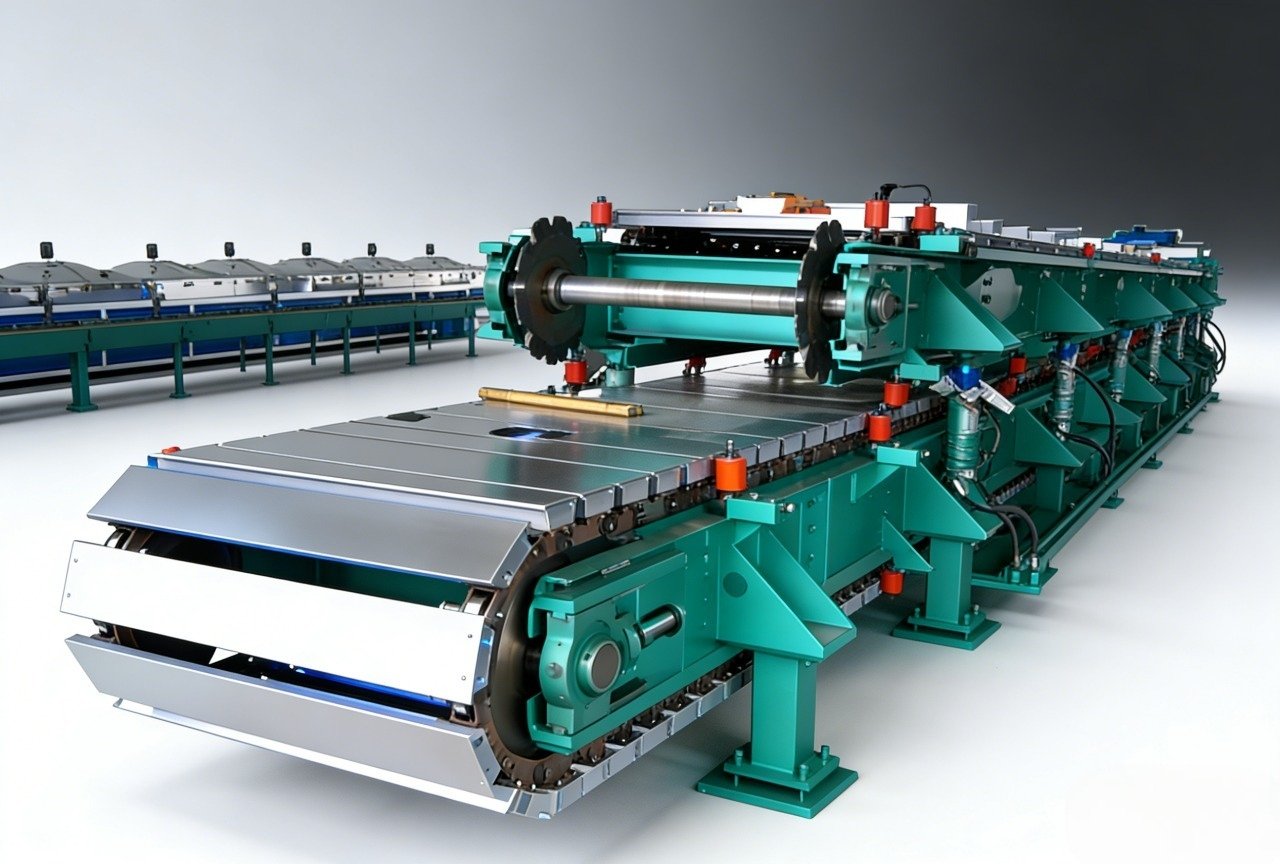
A servo-driven flying saw is the default choice for continuous PU/PIR sandwich panel lines. The carriage follows the panel, executes the cut, retracts, and returns to home. Cutting is usually done with a circular saw blade, while dust extraction runs continuously because PU and PIR swarf is fine, sticky under heat, and tends to collect on guide rails and sensors.
The dimensional control point is not the blade. It is the measuring wheel, encoder, or laser reference that tells the PLC where the panel end actually is. If the measuring wheel slips on a waxed or embossed metal face, the saw cuts at the wrong position even though the servo motion is perfect. For this reason, commissioning should include a cutoff-length verification run with actual panel surfaces, not only with reference plates.
Acceptance should cover:
- Length tolerance at minimum, maximum, and most frequent panel length.
- Squareness across the panel width.
- Cut-edge quality at full line speed.
- Repeatability over a continuous run of at least 50 panels.
- Dust-extraction effectiveness after sustained cutting.
A common mistake is to accept a short trial at low speed. The same saw can behave differently at full speed because carriage acceleration, blade heating, and clamp pressure change together.

Edge Trimming, Profiling, and Stacking
After cutting, the panel moves into orientation and stacking. If the panel has a profiled edge, side trim and crosscut must preserve the profile and avoid tearing the metal skin. Post-processing should not turn a dimensionally compliant panel into a damaged one at the last handling point.
Stacking automation usually combines vacuum lifting with mechanical clamping. The vacuum contact area must be sized for the panel mass and skin stiffness. Too much vacuum on a thin steel face can cause visible local deflection; too little can drop a panel during transfer. In practice, vacuum zones are divided so the PLC can activate only the zones above the panel geometry.
Stacking accuracy is less about absolute position and more about alignment. A stack that is off by only a few millimeters can cause unstable transport and edge pressure. Automated stackers therefore use side alignment guides, final squaring stops, and release-height control. For palletizing or order picking, a robot cell may be justified, but robot safety must follow the relevant requirements for industrial robot integration [3] [4].
Panel material choice changes post-processing behavior: PIR can be more brittle in cut edges than PU, and phenolic panels cut and package differently. <Phenolic Sandwich Panel Production Line vs PU/PIR Panel Line: Key Differences for Factory Investors> covers the practical differences that affect downstream handling.
Marking, Coding, and Packaging
Marking is where traceability either becomes real or becomes decorative. A printed label, inkjet code, or RFID tag must connect the finished panel to the production order, panel type, width, length, density class, production time, shift, and raw-material lot.
The marking sequence should be part of the same PLC controller or communicate with it directly. A common failure is a label printer that receives panel data from a separate PC with a timestamp delay. When the line changes panel type, the printer lags one panel behind, and every subsequent label is wrong until an operator notices.
Automated packaging closes the loop. Stretch wrapping or shrink packaging protects the panel edges and keeps moisture out during storage and transit. Corner protection, strapping tension, and film coverage should be configured for panel width and stack height. Packaging is not merely cosmetic; it is the last physical process that can damage edges, trap moisture, or obscure the panel identifier.
MES Handoff and Batch Traceability
Modern PU panel production cannot end at the wrapper. The cut panel should generate a data record that includes actual cut length, line speed at cut, saw temperature or blade-change counter, stack number, operator confirmation, and marking verification result.
This record should link backward to the laminator batch: component ratio, meter deviation, pouring temperature, core density sample, and line speed. Under ISO 9001 [5], the traceability requirement is not only to create a record but to maintain the chain from finished product back to process conditions. If the post-processing PLC does not export a stable panel ID, plant traceability is broken even when the upstream data exists.
For safety-related automated functions, such as saw-area entry protection, robot cell interlocks, and stacker light curtains, the control system should follow safety-related control principles under ISO 13849-1 [6].
Before you automate the stacker: confirm the material thickness range and packaging format first. These inputs determine gripper type, release height, and pallet pattern far more than panel length. If you are currently quoting a post-processing upgrade, send your line speed, panel range, and packaging format to info@haifeng-automation.cn. A short message on WhatsApp at 86 13566296633 is the fastest way to get a technical response on cycle time, clamping, and MES interface.
Flexible production and capacity planning determine whether you should automate post-processing now or later. <Polyurethane Foam Machine Selection: A 2026 Buyer’s Guide> covers how machine selection and production capacity should be evaluated together.
Retrofit or Integrated Line: How to Evaluate Post-Processing Automation
The biggest decision is whether to automate around the existing saw and stacker or replace the back end as an integrated system. Retrofitting makes sense when the saw carriage and rails are mechanically sound, and the existing PLC can accept encoder and MES signals. It makes less sense when the saw return stroke is already marginal for the required pitch time.
The table below shows the acceptance focus for each post-processing area.
| Post-processing area | Common failure mode | Automated response | Acceptance focus |
|---|---|---|---|
| Cut-to-length | Encoder slip or carriage lag | Servo synchronization with line encoder | Length Cpk over continuous run |
| Squareness | Clamp shift during cut | Clamp-pressure interlock with saw start | Squareness after full-speed cuts |
| Edge handling | Skin tear at profile edge | Side-trim tooling matched to panel profile | Edge quality at line speed |
| Stacking | Panel drop or stack misalignment | Vacuum-zone control with squaring stops | Alignment across full stack |
| Marking | Label lag after panel change | Label data triggered by panel-in-position signal | No-read and mismatch count |
| Packaging | Edge pressure at strapping | Corner protection and strap tension control | Visual check of wrapped stack |
For integrated systems, the acceptance criteria should be written around the same control objectives: cut-to-length stability, squareness, readable marking, stack alignment, and traceability handoff. The line is not complete until the final stack carries the same data discipline as the foam core.
Request a Post-Processing Automation Specification
If you are planning a new PU/PIR panel line or upgrading the back end of an existing line, the most useful step is to share the panel range, line speed, and packaging format. Reference points that help shape the specification include:
- Panel dimensions: minimum and maximum length, width, and thickness.
- Panel structure: PU, PIR, rock wool, or phenolic core; steel face thickness.
- Line speed: design speed and expected continuous speed after upstream limits.
- Packaging format: stack height, pallet type, stretch wrapping or shrink packaging.
- Traceability scope: barcode, QR code, RFID, or label-on-panel requirement.
- Upstream PLC and MES: existing controller brand, communication protocol, and data tags.
Send the information to info@haifeng-automation.cn or message us on WhatsApp at 86 13566296633. The response should focus on cut-to-length feasibility, stacking grip design, and the cleanest way to feed finished-panel data into your MES.
FAQ
What is post-processing automation for PU sandwich panels?
It covers cut-to-length sawing, edge trimming, orientation, automatic stacking, marking or coding, packaging, and the data handoff from the finished panel back to production records. The goal is to maintain dimension, edge quality, and traceability without manual sorting.
At what line speed does automated stacking become necessary?
This depends on panel length and panel weight. When the available handling time between panels becomes shorter than the time an operator needs to position and align a panel safely, the stacker stops being optional. Short panels in lightweight steel faces usually force the decision earlier than long heavy panels.
Can an existing sandwich panel line be retrofitted with automated post-processing?
Yes, if the existing saw carriage and rails are mechanically stable and the PLC can accept encoder and MES signals. The main constraint is return-stroke time. If the current saw is already close to its cycle limit, a retrofit may preserve the bottleneck instead of removing it.
Which data should the MES record for each finished panel?
At minimum: panel ID, product type, width, length, production order, shift, production timestamp, actual cut length, stack number, marking verification result, and upstream batch reference. The panel ID must remain stable from laminator to wrapper.
Does post-processing automation change panel certification under EN 14509?
It does not change the product classification, but it can affect compliance if cutting, edge damage, or handling alters the finished panel dimensions or installed condition. The post-processing line is part of the manufacturing chain and should preserve the panel condition required by the relevant declaration.
References
[1] CEN, EN 14509:2013, Factory-made double skin metal faced insulating panels, European Committee for Standardization, Brussels, 2013.
[2] ISO, ISO 9001:2015, Quality management systems — Requirements, International Organization for Standardization, Geneva, 2015.
[3] ISO, ISO 10218-1:2011, Robots and robotic devices — Safety requirements for industrial robots — Part 1: Robots, International Organization for Standardization, Geneva, 2011.
[4] ISO, ISO 10218-2:2011, Robots and robotic devices — Safety requirements for industrial robots — Part 2: Robot systems and integration, International Organization for Standardization, Geneva, 2011.
[5] ISO, ISO 13849-1:2023, Safety of machinery — Safety-related parts of control systems — Part 1: General principles for design, International Organization for Standardization, Geneva, 2023.
If you’re interested, check out these related articles:
What Is Explosion Proof Tire Filling Equipment
PU Low Pressure Foaming Machine: Maintenance Checklist & Troubleshooting Guide