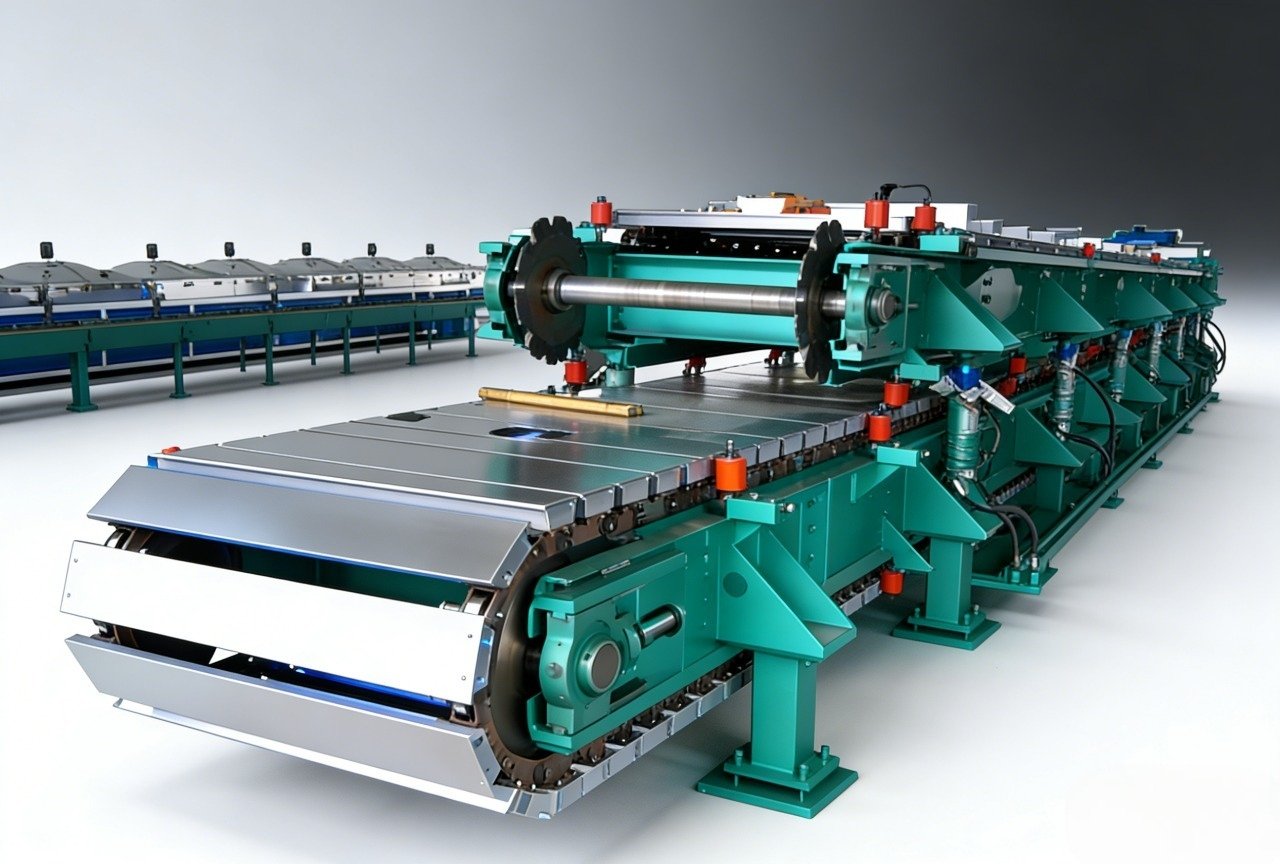
Most capacity errors on a PU/PIR sandwich panel line are not metering errors. They are definition errors. A line planned for 2,000,000 m² per year may fail that target if the number assumed 8,000 operating hours, full working width, zero changeovers, and one fixed foam density. The corrected calculation is usually lower—and that is the number the factory must finance, staff, and schedule around.
This guide shows the calculation sequence, the parameters to lock down first, and where the formula usually comes apart in real production.
The Core Capacity Equation for a PU/PIR Line
Capacity is a mass balance, not a catalog speed. For a continuous double-belt laminator, start with these two lines:
- Net panel area output (m²/h) = average line speed (m/min) × net panel width (m) × 60 × utilization factor
- Foam mass flow (kg/h) = net panel area output (m²/h) × core thickness (m) × average core density (kg/m³)
Each term has a precise meaning:
Average line speed is the speed at the cut-to-length saw during normal continuous running. It is not the maximum speed shown in the machine specification. Start-up, film change, density change, and downstream fault recovery all reduce the shift average.
Net panel width is the sellable panel width after side trimming. If the line forms a 1,200 mm wide foam envelope but the finished panel is 1,150 mm after edge trim, use 1.15 m. Gross working width overstates output and understates scrap.
Core thickness is the foam core thickness, not the total panel thickness including both steel facings. For an 80 mm panel with 0.6 mm facings on both sides, the core is about 78.8 mm. The difference is small for one panel but meaningful across a year.
Average core density is the apparent density of the finished PU/PIR core, measured in accordance with ISO 845 [2]. Use the declared design density from the panel specification, not a rough rule of thumb.
Utilization factor converts ideal operating time into realistic operating time. A continuous line may run at 0.80–0.90 depending on shift patterns, product changeovers, raw material changeover, and planned maintenance. The exact factor should come from your shift audit, not from the equipment offer.
Panel dimensions and tolerances should be based on the finished-panel specification rather than the raw foam envelope. EN 14509 [1] defines the product-level requirements the line must hold in normal production.
Worked Example: From Foam Throughput to Daily Output
Take a common wall-panel case:
| Parameter | Example value | Why it matters |
|---|---|---|
| Net panel width | 1.0 m | Finished panel width after trim |
| Core thickness | 0.06 m | Foam core only |
| Average core density | 42 kg/m³ | Design value, verified to ISO 845 [2] |
| Average line speed | 6 m/min | Demonstrated speed, not peak speed |
| Utilization factor | 0.82 | Based on real shift and changeover time |
Net panel area per hour:
1.0 m × 6 m/min × 60 min/h × 0.82 = 295.2 m²/h
Foam mass flow:
295.2 m²/h × 0.06 m × 42 kg/m³ = 743.9 kg/h
If the line runs 20 hours per day:
295.2 m²/h × 20 h = 5,904 m²/day
That is the number to compare against sales demand. It is not the line’s peak hourly capability. If the plant needs 7,000 m²/day at the same product mix, the calculation must change: higher line speed, wider panel, or more operating hours.
The same mass balance then sizes the raw-material side. For a polyol:isocyanate mass ratio of 100:160, isocyanate is 160 ÷ 260 = 0.615 of the total system mass. At 743.9 kg/h total foam output, isocyanate demand is roughly 458 kg/h. Day tanks, transfer pumps, recirculation loops, and metering pumps must support that continuous rate—not just the average rate.
Where Equipment Limits Change the Calculation
The calculated capacity only becomes real if every module can hold the selected speed. The main bottlenecks are usually these:
Metering output. The metering machine must cover the highest required foam mass flow. If the product mix includes a heavier density, wider panel, or thicker core, the machine sizing must use that peak case. Sizing for average density creates a hard ceiling on the largest orders.
Mixing head and laydown width. The pour pattern must distribute foam evenly across the full board width. A mixing head that cannot cover the required laydown width will force the line to slow, even when the meter itself has spare capacity.
Double-belt length. A higher line speed shortens residence time in the curing and cooling zone. If the core is not stable enough at the saw, the line must either slow down or the belt length must increase. Belt length is therefore a speed constraint, not just a foam-output constraint.
Cut-to-length and stacking. The saw and stacker cycle time must be shorter than the panel cycle time at target speed. If the downstream line is slower than the laminator, downstream equipment becomes the actual line speed.
Raw material supply. Day tanks, premixing stations, and transfer pumps must keep both components available at the peak consumption rate. I have seen a line where the day tanks were sized for the baseline wall-panel formula but could not hold the higher-density roof-panel formula at the same speed.
EN 14509 [1] also makes clear why the saw and stacker matter: dimensional consistency is a product requirement, not an optional quality point. A fast laminator with an unstable cut-to-length section creates length, squareness, and bow defects faster.
The calculated output only becomes real if the metering, mixing head, belt, and saw can hold the chosen speed. <Roof and Wall Sandwich Panel Production Line: Machine Selection for Industrial Buildings> covers the machine-level decisions behind that output.
If you are evaluating a new PU/PIR line, do not finish the capacity calculation with the machinery catalog as the only source. Send the finished panel width range, thickness range, core density targets, shift model, and annual output plan to info@haifengmachine.cn or WhatsApp: 86 13566296633. The calculation must be checked against metering output, mixing-head flow, belt length, and downstream cycle time.
Panel Width, Thickness, and Density Sensitivities
Capacity responds differently to each variable.
Width is linear. If net panel width rises from 1.0 m to 1.1 m and speed stays constant, panel area output rises 10%. Foam mass flow also rises 10% because the machine is filling a wider cavity.
Thickness affects speed, not just foam volume. A thicker core needs more foam per linear meter. If the metering output is fixed, line speed must fall. At a fixed foam mass flow, line speed is:
Line speed (m/min) = foam mass flow (kg/min) ÷ [net panel width (m) × core thickness (m) × core density (kg/m³)]
For example, if the foam output is 12.6 kg/min, width is 1.0 m, density is 42 kg/m³, and thickness is 0.06 m, line speed is 5 m/min. If thickness rises to 0.08 m and all else is unchanged, speed falls to 3.75 m/min.
Density changes mass flow, not panel area. A density change from 40 kg/m³ to 48 kg/m³ raises foam mass demand by 20% at the same panel dimensions and speed. The metering and raw-material system must handle the densest product planned, not the average product.
Trimming changes the net result. If edge trim increases from 40 mm to 60 mm total width loss, effective output per minute changes even though the laminator speed is the same. Always calculate from net panel width.
A capacity number is only as good as the machine package selected around it. <Polyurethane Foam Machine Selection: A 2026 Buyer’s Guide> covers matching metering, mixing, and line integration to the product range.
A Practical Capacity Check for Your Line
Use this sequence before accepting any capacity figure.
- Define the finished panel dimensions and edge-trim allowance for every product in the planned mix.
- Record the core density for each product and verify the density test basis to ISO 845 [2].
- Use demonstrated average line speed from line trials, not maximum speed from the machine offer.
- Find the worst-case foam mass flow: widest panel × thickest panel × highest density × highest required speed.
- Check every module against that peak case: metering output, mixing head, double-belt length, saw cycle, stacker cycle, and raw-material supply.
- Recalculate daily and annual output with a real utilization factor from shift data and changeover records.
- Compare the final number with the annual sales plan and leave a defined operating margin for product changeovers and maintenance.
If the check shows that the peak mass flow is higher than the line can sustain, do not raise the catalog speed without adjusting the downstream process. That is how plants create a line that runs fast for an hour and waits for the stacker for the next hour. For a sizing review, send the capacity check inputs to info@haifengmachine.cn or WhatsApp: 86 13566296633.
What to Do With the Final Number
Use the corrected capacity in three places: the sales plan, the raw-material procurement schedule, and the shift manning model. If the corrected number is below the business target, decide which variable changes—line speed, net width, operating hours, or the product mix. If it is above the target, verify that the excess is real and not the result of an optimistic utilization factor.
Haifeng Polyurethane Machinery builds PU/PIR sandwich panel lines as custom turnkey systems, but the first step is always a capacity calculation tied to your panel dimensions, core density, and shift pattern. Send your panel dimensions, density targets, and annual output plan to info@haifengmachine.cn or WhatsApp: 86 13566296633. The sizing can then be checked against metering output, belt length, curing time, and downstream automation.
Frequently Asked Questions
What is the basic formula for PU/PIR sandwich panel line capacity?
Net panel area output equals average line speed multiplied by net panel width, multiplied by 60 minutes per hour, multiplied by the utilization factor. Foam mass flow equals that net area output multiplied by core thickness and average core density. Use sold panel dimensions after trimming, not the raw foam envelope.
Why is the actual output lower than the machine’s rated speed?
Rated speed usually assumes full width, one fixed thickness, one fixed density, and continuous operation. Actual production loses time to edge trim, product changeovers, film changes, start-up scrap, raw material changes, and downstream equipment stops. The corrected calculation should use average line speed and real utilization.
How does panel thickness affect capacity?
Thickness changes both foam demand and feasible line speed. A thicker core requires more foam per linear meter, so if foam output is fixed, line speed must decrease. If line speed is fixed, metering output must increase. The capacity model should always check both variables.
What density should I use in the capacity formula?
Use the apparent core density of the finished PU/PIR core measured according to ISO 845 [2]. For peak machine sizing, use the densest product in the planned product mix. For annual output, use the real production-weighted average from the product plan.
How do I size the metering machine for the line?
Start with the worst-case foam mass flow: widest panel, thickest core, highest density, and highest required speed. Convert that to total kg/h, then calculate each component’s mass fraction from the mixing ratio. Metering pumps, mixing head flow, day tanks, and raw-material supply must all be rated for that continuous peak, not the average.
References
- EN 14509:2013, Self-supporting double skin metal faced insulating panels — Factory made products — Specifications, European Committee for Standardization (CEN), Brussels.
- ISO 845:2006, Cellular plastics and rubbers — Determination of apparent density, International Organization for Standardization, Geneva.
If you’re interested, check out these related articles:
High Pressure PU Foam Machine: Technical Specifications & Industry Applications
Safety Tips for Tire Foam Filling Operations
PU Foam Filling Equipment for Industrial Tires